John Dolan: A snapshot of Cork in 1926, as Census prepares to reveal all
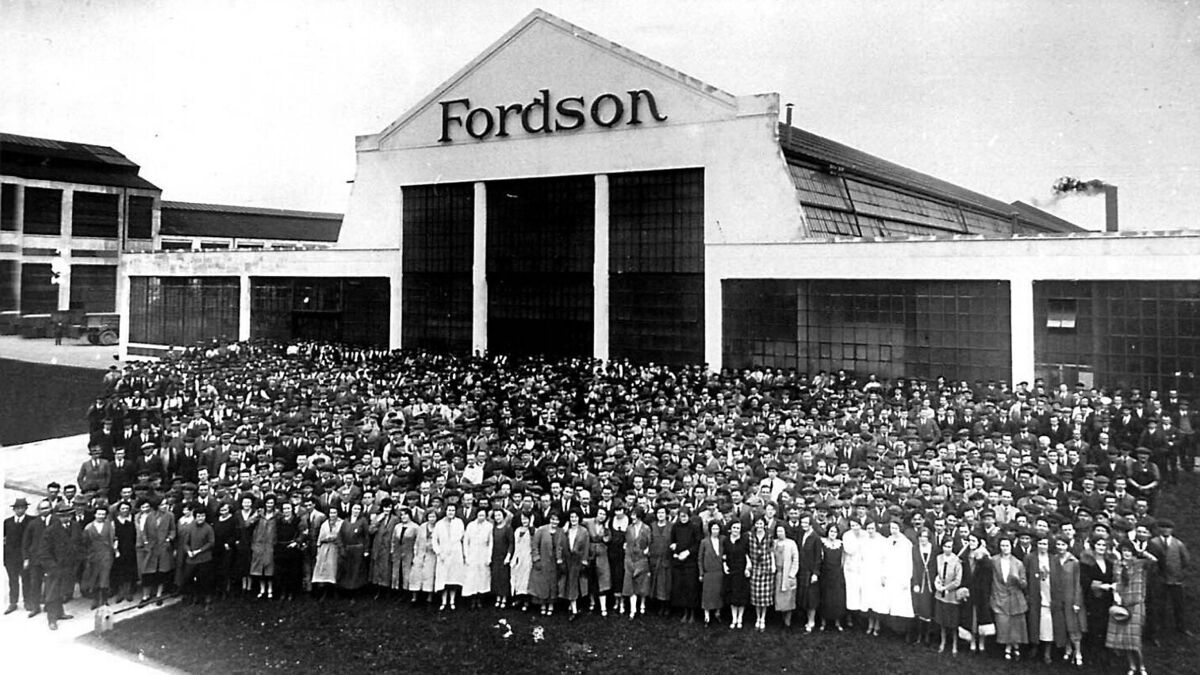
THE STORY OF US: Hundreds of workers outside the Ford factory in Cork in 1926, which was making parts for the Model T car at the time
On April 18, they will wake up to discover that the 1926 Census - compiled exactly 100 years earlier - has been released to the public for the first time.
Until now kept under wraps in government vaults, the Census, which is being made available online, will deliver a snapshot of our ancestors’ lives on April 18, 1926: Where they lived, where they worked, whether they spoke Irish, who lived with and alongside them...
It promises to provide a plethora of information about the people of the fledgling Irish state - fresh from three bruising wars and a pandemic, and not yet a republic.
Owing to the War of Independence, the Census in 1921 had been postponed, so the one in 1926 was the first since 1911 and the first by the Irish Free State. The information it contains is being released due to a rule which states all censuses must be made public a century later.
A 50-strong National Archives team has spent years extracting the records from 700,000 sheets of paper, kept in around 1,300 boxes, and cataloguing it for the digital audience. Next Saturday, it will be available to peruse for free.
You can search for your grandparents or great-grandparents: Do you know how old they were in 1926, and where they lived? Their marital status? The Census will tell us all of that, and more.
But what was life like in Cork for those people when that Census was filled in on Sunday, April 18, 1926?
Well, by then, more than five years after the Burning of Cork, Patrick Street was starting to look more like its old self. In January 1926, the annual meeting of the Cork Incorporated Chamber of Commerce and Shipping heard that “at the rate of progress now being made, all trace of the wicked destruction done in 1920 will have disappeared by this time next year”. To underline this, it was announced that Roches Stores would shortly be opening on the street.
There were plans afoot to tackle the city’s slums. In 1926, the Cork Town Planning Association produced Cork: A Civic Survey, examining appalling housing conditions in parts of the Middle Parish and areas around Barrack Street, Shandon Street, and Blarney Street.
This provided a template for Cork Corporation’s new housing developments in Gurranabraher, Turner’s Cross, Capwell, and Friars Walk.
Unemployment was a relatively low 6%, with most jobs in agriculture. Contrast that with the more industrial and unionised UK where, on May 5, 1926, a General Strike crippled the country and led to fears of a workers’ revolution.
The famous Crowley’s music business was founded in 1926 by pipe maker Tadhg Ó Crualaoi and his brother Denis in their Blackpool home, moving to a shop in Merchants Quay a few years later.
Politics a century ago was in a volatile state, on the back of the Civil War. Fianna Fáil was founded in May, 1926, by Éamon de Valera, after he left Sinn Féin; the party wielded power for 61 of the next 79 years.
However, W.T Cosgrave, in the midst of a decade-long reign as President of the Executive Council of the Irish Free State, was a stabilising influence in those years and, in 1926, he played a key role in The Soldiers’ Song becoming the country’s national anthem. There was a sense of a new country finding its feet.
Another sign that the nation was moving on from its war years came when Piaras Beaslai published his two-volume retrospective on the life of the man he knew well - Michael Collins And The Making Of A New Ireland - still a seminal work about the Big Fella.
The Civil War had ended less than three years before the Census, and bad blood and ill feeling remained.
Shockingly, in November, 1926, a a Garda sergeant became the first member of the new force to be killed on duty in Cork. James Fitzsimons was in the mess room of St Luke’s Barracks when he was shot in a planned series of simultaneous attacks nationwide by the IRA, in defiance of the ceasefire.
On a more upbeat note, 1926 was a hallmark year for sport in Cork.
The All-Ireland hurling championship began on the day of the Census, and culminated with a victory for Cork in the final that October, when there was snow on the ground.
The Rebels walloped Kilkenny, in a match which was the first to be broadcast on radio, with Cork man P.D. Mehigan the commentator.
In a glorious Leeside double, a month before the Census, on St Patrick’s Day, Fordsons became the first Cork team to win the FAI Cup - then the Free State Cup - beating Shamrock Rovers 3-2 in the final.
Other auspicious sporting events in Cork in 1926 included the arrival of Glen Rovers in county senior ranks - where they stayed for 97 years.
Over in Youghal, pioneering film-makers, the forward-thinking Horgan brothers reputedly made a film with sound, and in 1926, their studio was rebuilt to produce the correct acoustics and became known as the House of the Perfect Sound.
Cork ingenuity ahead of its time.
Of course, Ireland was a stoutly Catholic country, and the first Eucharistic Procession in Cork took place a few weeks after the Census when 30,000 faithful participated.
One striking element of the 1926 Census will highlight the exodus of many Protestants from the country after independence - in some areas of Cork, the number was almost halved from 1911. How many of these left of their own accord, and how many fled in fear of their lives, has long been a matter of debate.
In the wider world, the future Queen Elizabeth II of England was born just three days after that Irish Census was filled, and TV legend David Attenborough a month later.
The 1926 Census will be released on the National Archives of Ireland website on April 18, accompanied by a book, The Story Of Us: Independent Ireland And The 1926 Census.
Authorities have also issued an appeal for ‘centenarian ambassadors’ from the ranks of the estimated 1,200 people in Ireland who are aged 100.






 App?
App?


