Recipe collection compiled by woman in Cork 100 years ago is uncovered
A manuscript recipe collection, compiled 100 years ago, recently came through the doors of a library in Cork city. RICHARD FORREST shares details of its unusual contents.
Recipe collection compiled by woman in Cork 100 years ago is uncovered

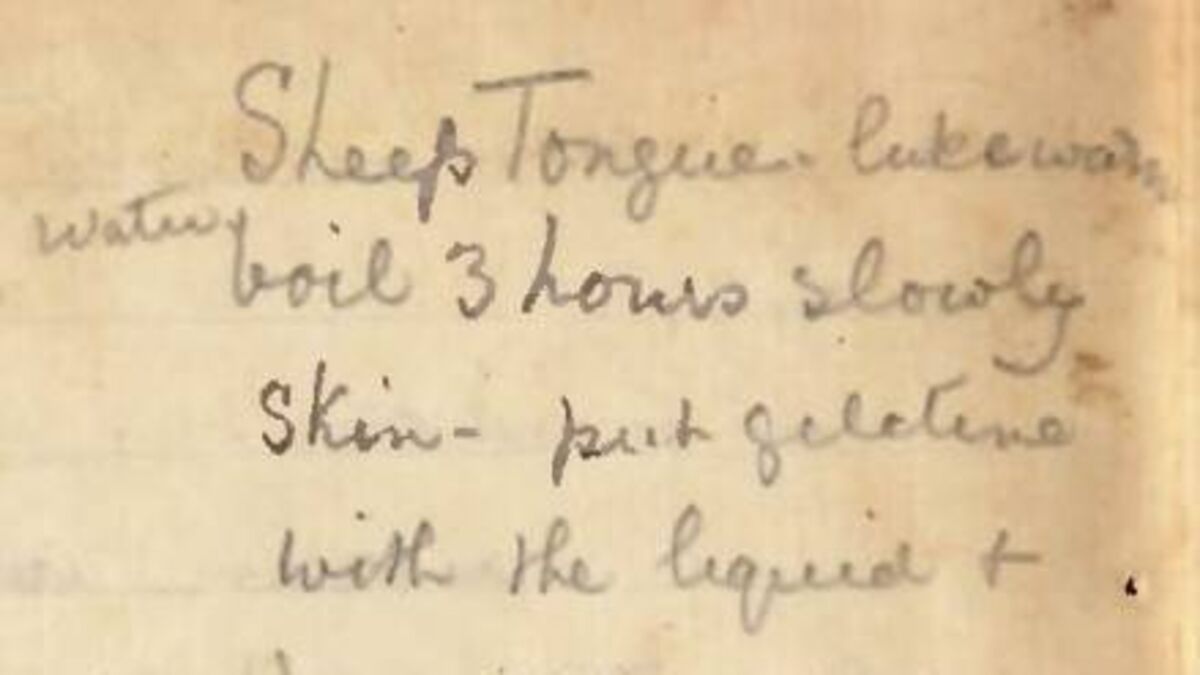
Instructions for cooking sheep tongue feature in the book. 

Unusual books occasionally come through the door at Mayfield Library, and a manuscript recipe collection compiled 100 years ago by Gertrude Anglin was certainly a gem.
Originally from Dublin, Gertrude moved to Cork after marriage and lived at several addresses in the city, her last being at St. Christopher’s Road, Montenotte. 

She was born in 1864, the daughter of Ruben Fisher Alexander, an accountant, of Rathgar, Dublin, and in 1897, aged 33, married Arthur Anglin, Professor of Mathematics at UCC. She was Quaker, while her husband was Methodist and together, they had one child, Leopold.

Gertrude Anglin’s collection of recipes begins in 1917 and features 117 recipes for savouries and desserts.

But before getting on to Gertrude’s collection of recipes and other curious notes, interesting in his own right is husband, Arthur. He was born in 1849, in the same year that the great George Boole was appointed Professor of Mathematics at Queens College, Cork (later renamed UCC). Boole devised Boolean Logic, the foundation for computer programming.

Arthur proved an exceptional Mathematician himself, topping his class, and graduating with first-class honours and a gold medal at the age of just 18 in 1867. It’s likely that Arthur was taught by Boole briefly, in his first term as a student, and he was certainly exposed to his brilliant legacy.

In late November 1864, Boole walked to the college in heavy rain from his house in Ballintemple and lectured in wet clothes. Soon afterwards, he fell seriously ill with pneumonia and died on December 8, something that must have made a deep impression on the young student. 

In 1867, Arthur won a substantial scholarship from the Peel Endowment Fund worth £20 a year for three years. He proceeded to lecture in England and Scotland and became a Fellow of the Royal Society of Edinburgh. In 1887, he returned to Ireland, succeeding Boole as Professor of Mathematics at his old alma mater and continued a brilliant career. After marriage, the Anglin family lived at College View Terrace, Western Road, Fernhurst Villas, all conveniently close to the college, and also at Bishopstown. Professor Anglin predeceased Gertrude, passing away in 1934 aged 84. There were 15 years between them in age and Gertrude spent her remaining years on the city’s northside at Lohengrin on St. Christopher’s Road. She died at home there aged 79 in 1944.

Their son, Leopold, became a bookkeeper and married Charlotte Welsh in Dublin in 1920, and, after widowerhood, Frances O’Connor in 1962. Leo was involved with Hibernian Music Publishing and worked for Dunlops. He died aged 65 at the Bon Secours Hospital in 1964.

The name of the family home on St. Christopher’s Road, ‘Lohengrin’, was inspired by Richard Wagner’s famous opera and reflected the family’s love for classical music. Though Gertrude was also fond of ‘jazzy’ or lighter music. They hosted social musical evenings and Arthur intended his fine music-cabinet record player to go to the blind when he died. Other attractions, especially for the children of the neighbourhood, was Georgie, the shy tortoise that lived in the garden pond (they would feed him buttercups) and the profusion of fruit and flower from the pear tree.

Recipe collection

Gertrude Anglin’s collection of recipes begins in 1917 and is recorded in ink and pencil over 46 pages of what we would identify as a school copy book (20 cm X 16 cm). 

It contains 117 recipes, most for savouries and desserts. Some were supplied to her by family, friends and acquaintances. One of these is from Lottie, her daughter-in-law in 1926, another for Barm Tea Cakes from Maria at “Xmas 1918”, and one for Crumpets from Miss Bailey in Courtmacsherry in 1917. More came from Fanny, Hester, Mrs. Mole, and from Sally who, in 1919, supplied one for Small Cakes and another for Square Biscuits. Figs, lemon, ginger, sago, rice, golden syrup all figure abundantly in the many ingredients that feature.
Among the more curiously, or unusually named items are American Cream, Bachelor Pudding, Caul Cannon for Veg, what appears to be ‘Egg Susie’, Half Pay Pudding, Invalid Egg Flip, Lady Meath’s Pudding, Mrs. Thompson’s Savoury, Paradise Pudding, and Stradbally Cake. Invalid Egg Flip features the hopeful note, “can be retained by invalids”.

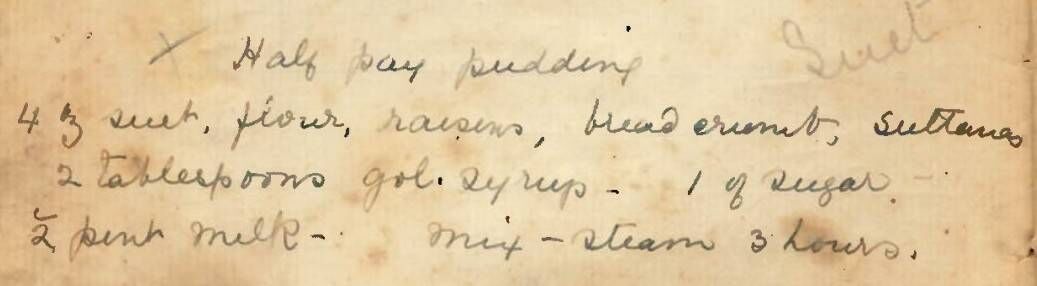
The recipe for Half Pay pudding

Half Pay Pudding was included in Isabella Beeton’s famous Book of Household Management in 1859. Originally a cheap pudding for soldiers and sailors on half-pay, it was also known as ‘Sailor’s Duff’ and required: 4 oz of suet, flour, raisins, bread crumb, sultanas, 2 tablespoons of golden syrup, 1 oz of sugar, ½ pint of milk. Mix, then steam for 3 hours.
The Pudding to take you to Paradise necessitated 1 cup of suet, 2 cups of apples chopped, 3 oz of bread crumb, 1 oz of sugar, 1 teacup of flour, rind lemon, ½ teaspoon of baking soda and nutmeg. Butter the basin and steam for 3 hours. For plain old porridge, the oatmeal could be started in cold water as effectively as in boiling, and the pot would be well cleaned after cooking with sand and lemon.

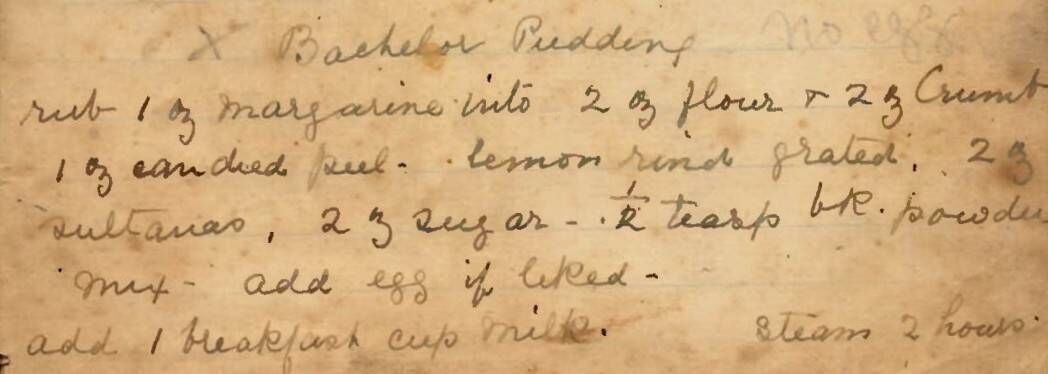
The recipe for Bachelor Pudding

Bachelor Pudding involved rubbing 1 oz of margarine into 2 oz of flour and 2 oz of crumb, 1 oz of candied peel, lemon rind grated, 2 oz of sultanas, 2 oz of sugar, ½ teaspoon of baking powder. Mix, and the bachelor could add an egg if he desired. Finally, add 1 breakfast cup of milk and steam for 2 hours.

Cork food boffins, Darina Allen and Regina Sexton, have both consulted Mrs. Anglin, with the former said to have used a scones formula. That may have been the one supplied by Fanny in Dublin in 1918. 

There is also one for Potato Scones. Take 6 large potatoes, flour, ½ teaspoon of salt, 1 teaspoon of baking powder, 1 dessertspoonful of margarine, ½ pint of milk. Mash and mix. Form into a cake. Set aside till cold. Prick both sides with a fork. Bake on pan or griddle. Split and butter. ‘

‘American Cream’ answers as a perfume nowadays, offering “mouthwatering milkshake vibes” by blending vanilla, lavender and clary sage. But in Mrs. Anglin’s day it required: 3 teacups of milk, ½ teacup of sugar (or less), 3 eggs, ½ oz of gelatine. Put the milk, gelatine and sugar on side of stove till dissolved. Lift off saucepan and stir in the yolks. Put back till about to boil. Take off. Stir in the whites beaten. Beat a little. Add lemon juice and pour into shape.

Cures and treatments

Some of the entries are not really recipes at all, and certainly not edible. These remedies are best not tried at all. One is ‘To Clean a Dog’ and another is for ‘Shiny Clothes’. It’s hard to tell if the first is to clean a dog inside or outside, and the second is not to put a shine on clothes, but rather to take it off. Wear and age in the old days tended to smoothen and shine clothing and, so, was not desirable. To “clean a dog”, well, you simply use paraffin oil and milk. For shiny clothes, take 1 oz of ammonia, ½ of Castile soap, dissolve them in 1 pint of hot water and sponge the clothing. Lukewarm water and salt was effective for some stains. Rubbing paraffin was good for rheumatism. So too, applying cork to the rheumatic spot. Cork was also good for piles. It needed to be burnt and cut up with lard, then put in linen and applied. Newspaper cuttings should not be used, the ink being bad. Mrs. Meadows of Camden Lodge provided a raspberry cure in April 1929. After gathering raspberry leaves, dry them in the oven for “about 20 minutes, or all night in a cool oven”. Then powder them by rubbing them with your hands. To one dessert spoon of the leaves pour on boiling water, this can then be drunk hot or cold, with milk and sugar added “if liked”. Recommended for internal troubles and maternity matters.

Knitting and stitching

There are a few other papers accompanying the recipe book. Possibly with the pitter-patter of tiny feet a prospect, Gertrude had a detailed and intricate pattern for a ‘Baby Jacket’ in 1920. It starts off requiring 2 oz of white two-ply Ladyship wool. Notes from 1924 feature instructions for running up ‘drawing room chair covers’ and a stitch for a crocheted jumper was supplied by Miss Ross at Ballycotton. Lizzie Jacob provided a ‘knitted tie stitch’ in 1925 that required No. 16 steel needles. While the destination was west in 1930 where Mrs. Anglin picked up a pattern for a ‘knitted wrap’ in Glengarriff.


Gertrude Anglin’s recipes, treatments and other notes span the period 1917 to 1930. All told, they are a valuable glimpse into the daily life of a middle-class Cork household of one hundred years ago.

My thanks to Brendan Goggin for allowing the display of the book at Mayfield Library.

This story originally appeared in the 2025 Holly Bough. 

Read More

Throwback Thursday: ‘Connie Dodgers’ took the biscuit in Cork...
'Disaster struck.. and petrol seeped into our instant mash in the boot': Recalling Cork school's epic European tour 
‘More than just a club...it is a lifeline’: Mayfield Ladies Club nearing 60th anniversary

more Holly Bough articles

The journey to building Cork's City Hall...and how it was almost developed at another location  The journey to building Cork's City Hall...and how it was almost developed at another location 
Meet the collectors who have amassed 100,000 match programmes, coins and thimbles Meet the collectors who have amassed 100,000 match programmes, coins and thimbles
And the winner of the 2025 Holly Bough colouring comp is... And the winner of the 2025 Holly Bough colouring comp is...

More in this section

‘More than just a club...it is a lifeline’: Mayfield Ladies Club nearing 60th anniversary ‘More than just a club...it is a lifeline’: Mayfield Ladies Club nearing 60th anniversary
Infant Of Prague Throwback Thursday: 59 days of rain...should we bury the Infant of Prague?
'Disaster struck.. and petrol seeped into our instant mash in the boot': Recalling Cork school's epic European tour  'Disaster struck.. and petrol seeped into our instant mash in the boot': Recalling Cork school's epic European tour 

Sponsored Content

The power of the G licence The power of the G licence
Happy couple receiving new house keys from real estate agent Time to get to grips with changes in rental laws
Boatbuilder turned engineer proves alternative paths can lead to success Boatbuilder turned engineer proves alternative paths can lead to success
Contact Us Cookie Policy Privacy Policy Terms and Conditions

© Examiner Echo Group Limited

Add Echolive.ie to your home screen - easy access to Cork news, views, sport and more