Cork's National Monument...and the friendship that helped to  build it
A 35-year transatlantic friendship helped to bring Cork city’s National Monument to fruition. DONAL O’KEEFFE spoke with the great grandnephew of the man who facilitated the financing of one of Cork’s most significant landmarks.
Cork's National Monument...and the friendship that helped to  build it

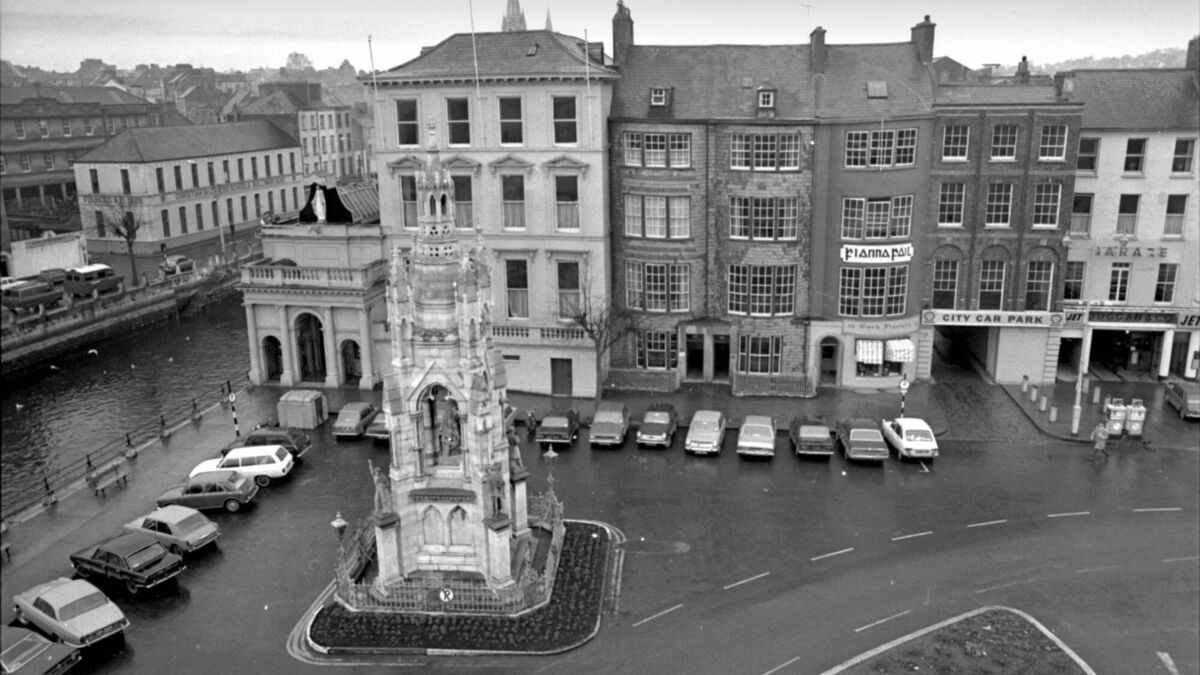
The National Monument on Grand Parade pictured in 1973. 
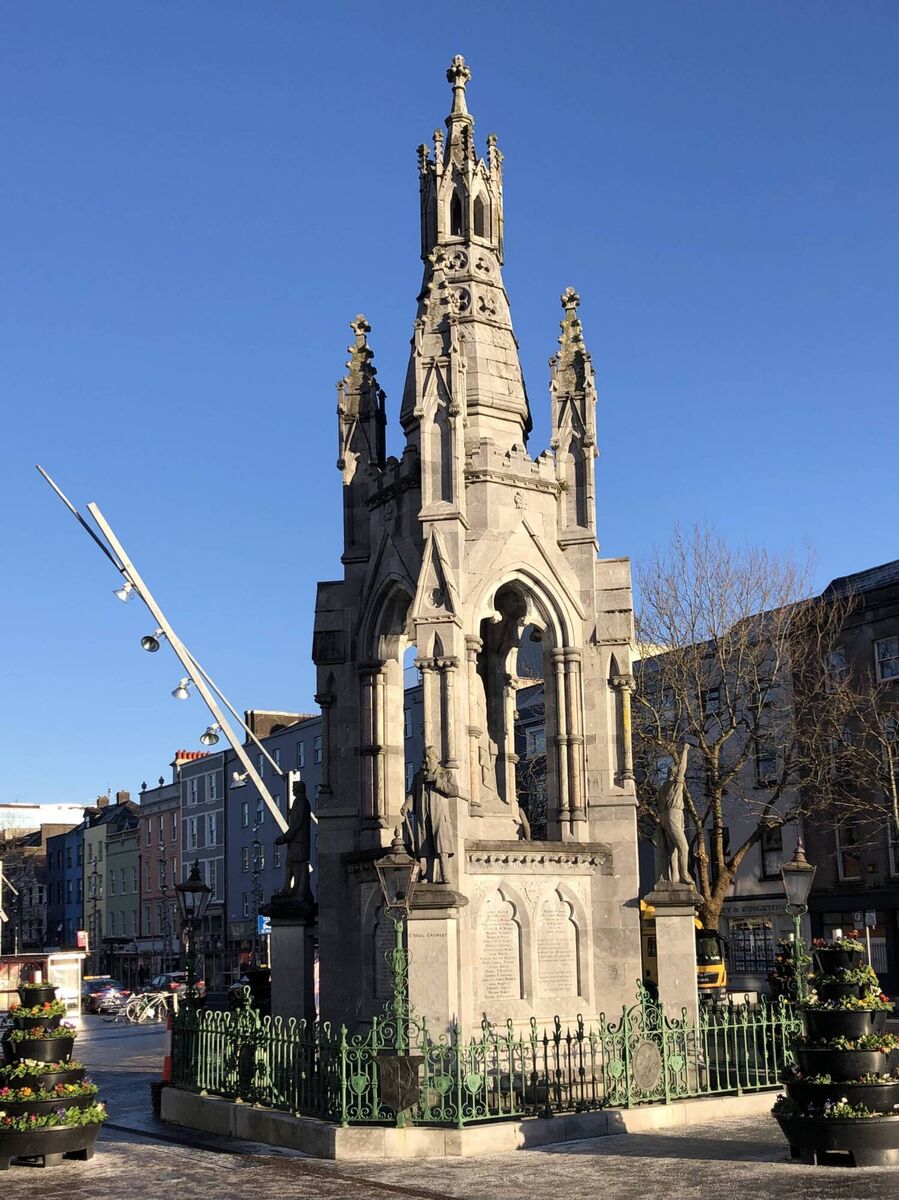
Whenever a very young James Barrett and his parents would pass the National Monument, on the corner of Cork’s Grand Parade and the South Mall, James’s mother, Gretta, would say that her grand-uncle, Patrick R Fitzgibbon, had “built that, from America”.

In later years, James and other family members would note that there was no mention of his mother’s grand-uncle anywhere on the monument, and they would assume that Gretta had been mistaken.

James’s mother passed away in 2022 at the age of 88, and it was only afterward that James’s hobby as a historian drew him to the newspaper archives and something of a revelation. A pair of newspaper articles from 1935, one from the Cork Examiner of Tuesday, August 20, and the other from the Evening Echo of Thursday, September 19, proved that everything Gretta had said was true.

Patrick Richard Fitzgibbon was born in Ballylegan, Glanworth, Co Cork, in 1863, emigrating in the early 1880s to the United States, first to New York for six months and then further afield to the Northwest Territory and what is now South Dakota, before settling later in St Louis, Missouri.

A jack-of-all-trades, he studied law at the Benton College of Law in Missouri, and, according to the Evening Echo, “He quickly rose to the position of one of St Louis’ most prominent citizens, and in turn held various posts of importance under local authority and the Federal Government.
“For a number of years he acted in the capacity of Registrar of the city, and was also Chief Estate Tax Officer for the Federal Government in the division of St Louis, comprising the state of Missouri. In addition, he has been retained by the St Louis Union Trust Company in an advisory capacity relating to income tax matters, this being the largest trust company west of the Mississippi.”

In Cork, plans had been long discussed to erect a national monument beside the southern channel of the River Lee, close to the final site of the former yellow-painted statue of King George II on horseback which had been torn down more than 40 years earlier and which gave the Grand Parade its Irish name, ‘Sráid an Chapaill Bhuí’.

The foundation stone for the new monument was laid in 1898, but that stone was subsequently taken up, the Cork Examiner reports, “and the work begun afresh”. The Young Ireland Society, under its secretary John Ronayne, took over and began to raise funds. 

In 1901, Mr Fitzgibbon contacted Mr Ronayne “and not only offered his personal services but also sent a princely subscription”. At home, Mr Ronayne would organise the work, while in the US, Mr Fitzgibbon would raise the necessary funds. (According to the Echo, Mr Fitzgibbon made a visit home in 1902 for the Cork International Exhibition, but it does not appear the two men met then.)

The monument, designed by Dominick Coakley, with figures sculpted by John Francis Davis of College Road, eventually cost £2,000 and was unveiled on St Patrick’s Day, 1906. The Examiner reports that for “the memorable unveiling ceremony … 50 bands and 60,000 people thronged the Grand Parade”.

It adds: “At that vast meeting, a resolution was carried with acclaim publicly thanking Mr Fitzgibbon for his generous services to the movement which had brought about the erection of the monument”.

The monument states that it was erected to “perpetuate the memory of the gallant men of 1798, 1803, 1848 and 1867 who fought and died in the wars of Ireland to recover her sovereign Independence”.

It includes the wish that “righteous men will make our land A Nation Once Again”.

Statues of Wolfe Tone, Michael Dwyer, Thomas Davis, and Peter O’Neill Crowley stand at the corners. The central figure depicts Mother Erin. Apart from that fictional embodiment of the country, only two women are referenced – Anne Devlin, who played as important a part in the rebellion of 1803 as Robert Emmet, and Caroline Margaret Douglas, the Dowager Marchioness of Queensberry, who is listed among “The Devoted Friends of the Manchester Martyrs”.

The monument predated the 1916 Rising and the War of Independence, and in more recent times, a plaque has been added to the monument to commemorate all “who served the cause of Irish Independence 1916-1923”.

Metal plaques representing the coats of arms of Cork and the four provinces adorn the surrounding metal guard rails. On the northern and southern rails are oval metal plaques depicting the eagle and flag of the United States with the words ‘Hail Columbia’ – the US national anthem until 1931 - and 1776, the date of the US declaration of independence. It seems likely these additions were made in appreciation of the American donations gathered by Mr Fitzgibbon.

More than a decade later, during the War of Independence, the Glanworth man did not forget his native land, raising more than $154,000 for the cause of Irish Independence.

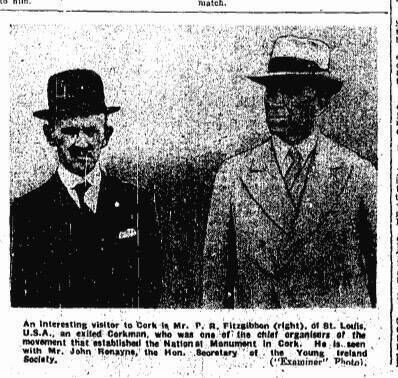
In the summer of 1935 – 33 years after his earlier visit – Richard Fitzgibbon made what would be his final visit home. The Examiner reported that “One of the first to greet Mr Fitzgibbon on his arrival in Ireland was Mr John Ronayne, who, although they had been life-long friends and in frequent communication for 35 years, had never previously had the pleasure of meeting Mr Fitzgibbon in the flesh.

“The two men were naturally immediately pleased at the opportunity of coming together. It is a peculiar fact that Mr Ronayne, who went to Cove to meet the liner, knew Mr Fitzgibbon the moment he saw him.

Mr FItzgibbon (right) and Mr Ronanyne pictured in the Examiner.

“Their greeting was a very happy occasion for both.”

A month or so after Mr Fitzgibbon arrived in Cork, he gave an interview to a reporter from the Evening Echo.

He explained that he kept fully abreast of all the latest developments in Ireland: “I get the Weekly Examiner every week from my friend Mr Ronayne, so I know everything about matters in the country.”

He said that while he had hoped to stay in Ireland for another month, he had been called home to attend to the estate accounts of the late Mr August Anheuser Busch of the Anheuser-Busch Brewery “which is the largest brewery in the world”.

According to the research carried out by his great-grandnephew, Patrick Richard Fitzgibbon married Ellen Nellie Dillon on November 13, 1889, in St Louis.

They had - at least - four sons and five daughters. He died, aged 82, on April 17, 1945, and was buried in Calvary Cemetery, St. Louis.

James Barrett said it was a story he had found fascinating to uncover, and as he went about his research, he felt one publication might offer it a good home.

“My mother has passed now, they’re all passed, but I thought of the Holly Bough, because we get that all the time,” he said.

“Ronayne sending him the paper by post every week is an amazing story, and then the first time they meet is after 35 years. It’s like something out of a movie.”

This story originally appeared in the 2025 Holly Bough. 

more #History articles

RTÉ's David McCullagh for Béal na Bláth oration to mark Michael Collins anniversary in August RTÉ's David McCullagh for Béal na Bláth oration to mark Michael Collins anniversary in August
June walking tours will focus on Cork's suburban development June walking tours will focus on Cork's suburban development
Cork Council to fund restoration of grave of Fermoy man who plotted 1880s dynamite attack on Britain Cork Council to fund restoration of grave of Fermoy man who plotted 1880s dynamite attack on Britain

More in this section

Throwback Thursday: 'I still have the pram I got from Kilgrew’s in Cork city' Throwback Thursday: 'I still have the pram I got from Kilgrew’s in Cork city'
Throwback Thursday: A stroll through the shops of my town in 1950s Throwback Thursday: A stroll through the shops of my town in 1950s
Cork nostalgia: Legends and tales from my time working at the post counter  Cork nostalgia: Legends and tales from my time working at the post counter 

Sponsored Content

Discover the heart and soul of Irish Whiskey at Midleton Distillery Experience Discover the heart and soul of Irish Whiskey at Midleton Distillery Experience
Aimee Connolly’s content room is pretty in pink Aimee Connolly’s content room is pretty in pink
Gas Networks Ireland, committed to conserving and enhancing biodiversity Gas Networks Ireland, committed to conserving and enhancing biodiversity
Contact Us Cookie Policy Privacy Policy Terms and Conditions

© Examiner Echo Group Limited

Add Echolive.ie to your home screen - easy access to Cork news, views, sport and more