The Cork Augustine friar who was a hero of World War II
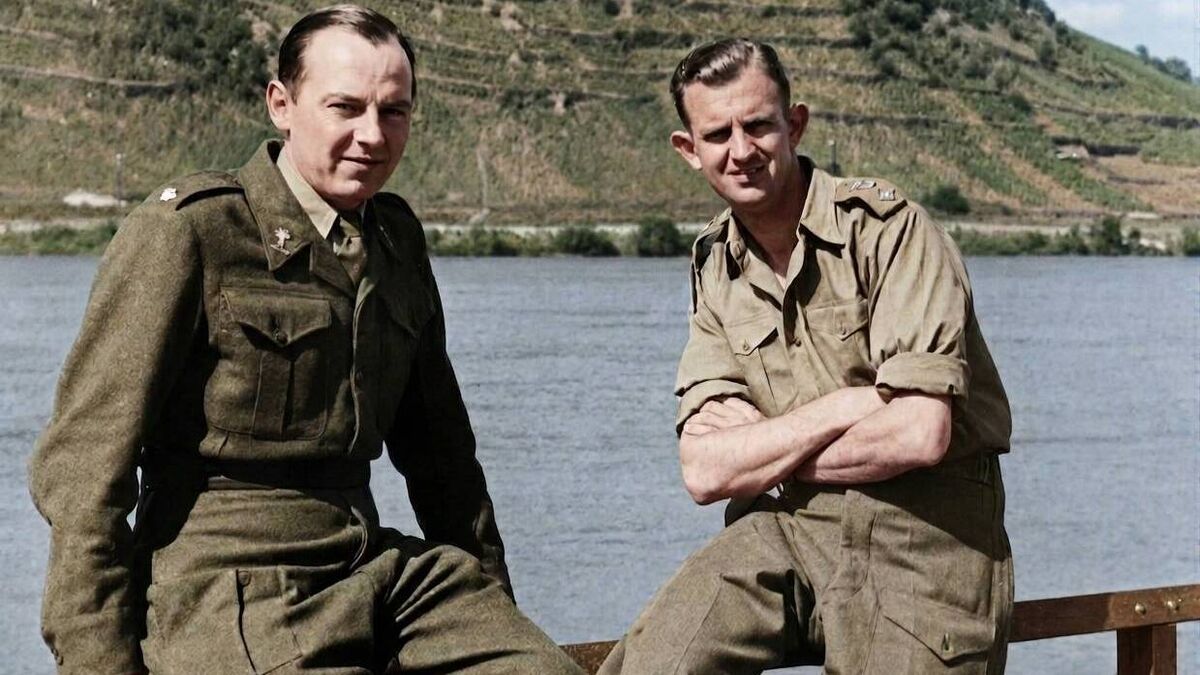
Fr Charles Hussey (right) and a fellow chaplain on the Rhine in 1945
The record books of World War II are filled with stories of reluctant heroes who performed great feats of incredible courage in the face of adversity.
Among that number was Fr Charles Hussey, an Augustinian friar who, for the last seven years of his life, was based at St Augustine’s in Washington Street. Affectionately known to all as Fr Charlie, he died 40 years ago next month.
This is his story.
Charles Raphael Hussey first saw the light of day on August 22, 1916, shirtly after the Rising. As the little boy celebrated his sixth birthday, the Hussey family was saddened to learn of the death, in combat, of the Army’s first Commander in Chief, Michael Collins.
Whether this early exposure to war influenced the impressionable youngster in his subsequent career choice is not known, but he would go on to pack more action into his ten months on active service than many professional soldiers do in a lifetime.
******
The Census in April, 1926, records Charles, 10, residing with his parents Philip and Victoria, both 40, at Killeenreendowney in the Pouladuff area of the south-west suburbs of Cork city. Philip was a ‘Cattle Dealer’.
Four other children are listed: May, 13, Philip, 12, Kevin, 5, and Teresa, a baby.
After his formative schooling in Cork, the teenag Charles gravitated towards the priesthood and, after completing his philosophical and theological studies with the Order of St Augustine, was ordained at the church of St Augustine and St John the Baptist on Thomas Street, Dublin, on June 23, 1941. With its 223-foot tall spire, it is a landmark that dominates the historic ‘Liberties’ area.
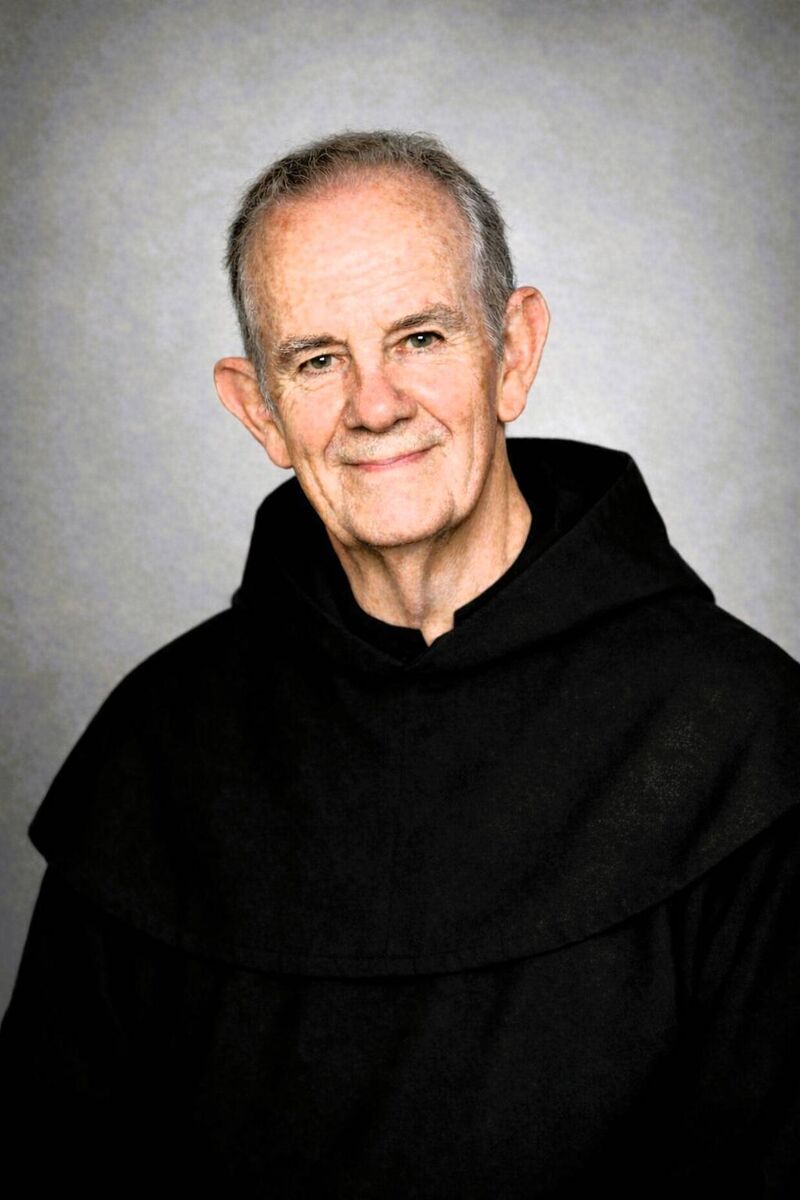
While Charles had been completing his studies, the ominous clouds of war were gathering over Europe. When World War II began on September 3, 1939, Ireland officially declared its neutrality, but that did not stop almost 79,000 men and women from crossing the Irish Sea to volunteer their services in the fight against Nazi Germany. Sadly, before the war ended in 1945, some 5,000 had given their lives.
Meanwhile, tens of thousands rallied to the Irish Government’s ‘Call to Arms’ in the summer of 1940, when invasion seemed imminent, to serve in the Defence and Security forces, the Voluntary Aid cadres, or Civil Defence. Charle’s older brother, Philip, was proud to wear the uniform of Cork Fire Brigade throughout the ‘Emergency’ period.
After his ordination, Charles’ first posting was to the East End of London, at St Monica’s on Hoxton Square in Hackney. The borough suffered greatly in the Luftwaffe Blitz due to its proximity to London’s dockland and the financial district (‘The City’) to its south: both prime targets for the Germans. Great swathes lay in ruins, while thousands were killed in air raids.
For someone like Fr Charles, being suddenly inserted from the bucolic quietude of Ireland into this almost apocalyptic landscape must have felt entirely surreal.
How he found himself as a padre in Britain’s Army is unclear - whether he volunteered or merely followed his Provincial’s orders - but the London Gazette for September 10, 1943, duly recorded his commission in the Royal Army Chaplains’ Department; one of 11 Irish Augustinians commissioned during the war.
During his army service, he would be officially ‘Captain Charles R. Hussey, OSA (291739), Grenadier Guards’, an élite regiment first formed in 1656.
After basic training in Yorkshire, Charles was appointed to the 4th Battalion, one of three tank battalions in the 6th Guards’ Tank Brigade, reorganised in 1943 as an independent unit.
Equipped with the impressive Churchill tank, the formation was specifically designed to work in intimate co-operation with foot-slogging infantry divisions to breach heavily fortified enemy positions. It began intensive training for the inevitable Allied invasion of north-western Europe.
The brigade landed in Normandy on July 20, 1944 - the day a group of German senior officers tried to assassinate Hitler - and, within days, was thrown straight into some of the bitterest fighting of the campaign.
Operation ‘Bluecoat’, an offensive launched by the British Second Army, attacked the enemy through dense, heavily defended ‘bocage’ terrain. Their Churchill tanks proved incredibly adapt at climbing steep slopes and crushing defensive strong-points.
Charles’ date with destiny - arguably his ‘finest hour’ - loomed ever nearer.
******
On D-Day, and the subsequent landings, dozens of chaplains - traditionally referred to as ‘padres’ in the forces - waded ashore alongside the troops.
In a combat zone, such chaplains occupy a unique position. Under the Geneva Convention, they are strictly non-combatants. They do not carry weapons, and their primary mandate is to provide spiritual, emotional and psychological support to soldiers, regardless of their religious beliefs.
They accompany medics onto the battlefield to collect the wounded and dying, and help pull crewmen from their blazing tanks.
It was during one such foray that Fr Charles’ colleague, Fr Pat McMahon, MSC, of Dundalk, was killed, on August 14, 1944, while attempting to rescue a Canadian soldier lying wounded on the battlefield. As the ambulance in which he was travelling approached the site, it was hit by a German shell. The incident occurred in the notorious ‘Falaise Pocket’ when the encircling Allied forces were responsible for more than 10,000 German casualties. (Due to the Allies’ tardiness in closing the escape route, however, significant numbers of Germans lived to fight another day).
Fr Charles’ armoured formation, from its landing in France to the campaign in north-west Europe, to the end of hostilities in May, 1945, operated in support of the 15th Scottish Division. During this time, he cultivated many friendships that were rekindled when, post-war and back in ‘civvy street’, he found himself in Dundee, the pretty Scottish coastal city on the Firth of Tay.
At one stage, Fr Charles’ unit was billeted near Lisieux in the Pays d’Auge region of Normandy and, during a brief lull in the fighting, he was able to visit the famous pilgrimage site - then a place of ruins and utter desolation - the second most important in France after Lourdes. Once the home of St Thérèse, the Carmelite nun known as ‘The Little Flower’, at the time of Charles’ visit two of her sisters , Pauline and Celine, were still alive; Pauline - Mère M. Agnes - being the Prioress. Together, they prayed for a speedy end to the war.
******
As the Allied armies pushed towards the German border, the 6th Guards’ Tank Brigade saw intensive action in the Netherlands in the autumn of 1944, assisting in clearing the regions flanking the Maas River. The brigade played a pivotal role in Operation ‘Veritable’, the Battle of the Reichswald, a gruelling, muddy pincer movement designed to clear heavily forested land between the Rhine and Maas rivers. Once again, the thick armour of the Churchill tanks proved invaluable against the concrete fortifications of the German Siegfried Line.
It was at this stage in his military service that the Cork padre was to gain a remarkable reputation among his peers for personal courage under fire, as the ‘Special Representative’ of the Sunday Independent reported in its edition of November 12, 1945:
“I have just handled a memento of the war that may well become a historic heirloom. It is a combination walking stick and umbrella once the property of General [sic] Montgomery and now at the home of Mr and Mrs Philip Hussey, Pouladuff Road, Cork, parents of a distinguished member of a famous Order who has served for three years as Chaplain in the Grenadier Guards, Rev. Charles R. Hussey, OSA.
“Fr Hussey, who stands 6ft 3in in height, undertook ministerial duties in London and was attached to the famous Guards’ regiment.
He was in the vanguard of the gigantic struggle from Normandy, through France, Belgium and Holland, thence to the Ruhr and on to Berlin. He has been decorated three times for bravery, besides having been mentioned in despatches.
“Perhaps his most conspicuous act of bravery and, incidentally, the one which prompted General Montgomery to send for him in order to express his personal appreciation, occurred during the prolonged struggle in the Ruhr. A platoon of the Guards was holding a section under intense fire while casualties on both sides were very heavy. Out in ‘No Man’s Land’, the moans of wounded men could be heard, but so heavy was the fire that the officer in charge gave orders that no immediate attempt be made to rescue the wounded.
“With complete disregard for his personal safety, Fr Hussey crawled out from his shelter amid the bursting of shells and hail of bullets and succeeded in reaching the wounded men, seven of whom, including two Germans, he carried one by one back to safety.
“He was returning with the eighth wounded man when a German shell screamed overhead and landed in the middle of the platoon, killing the majority of them.
“When Montgomery heard of this wonderful feat of heroism, he sent for Fr Hussey and ‘as a fellow-Irishman’, as he remarked, congratulated him. ‘I am sorry’, said ‘Monty’, ‘that I have no personal token of appreciation to give you in acknowledgement of your bravery beyond this’, pointing to the combination umbrella, ‘but take it with my compliments and thanks’.
“General Montgomery, in a letter to Father Hussey’s parents, also extolled the bravery of their son.”
In the spring of 1945, Fr Hussey’s unit crossed the Rhine in Operation ‘Plunder’, and one of the highlights of his clerical duties at this time was being selected to celebrate Mass for thousands of Allied troops in Cologne Cathedral.
Although it received 14 direct hits in Allied air raids (its towering spires acting as ideal navigational beacons for attacking bombers) miraculously it had come through the war largely intact.
The horrors of war had one more call to make on Charles Hussey’s deep psychological reserves, however. In an Appreciation in the Cork Examiner on September 2, 1986, ‘F O’C’ recounted how the friar had been one of the first Catholic chaplains to enter Bergen-Belsen Concentration Camp, near Hanover, after its liberation by British forces on April 15, 1945.
In scenes straight out of Dante’s Inferno, the liberators were greeted by more than 60,000 starving and mortally-ill human beings while countless rotting cadavers lay all round.
Fr Hussey’s unit ended the war in early May, 1945, on the Baltic coast at Lübeck, capturing more than 26,000 German prisoners of war.
******
Charles Hussey was released from army service on June 27, 1947, and, after a brief spell at home, returned to his Order and ministry.
In the ensuing years, he would serve at Hammersmith, London (1947-48); Dundee (1948-62), Dublin (1962-66); Drogheda (1966-73); Limerick (1973-79), and, finally, back to his native place where he served the last seven years of his life on Washington Street.
Older readers will recall him, striding up and down the aisles as if still on the parade ground, his towering figure straight as a ramrod, directing people to their seats.
At this time, the ‘Annual Mission’ for members of the Defence Forces was a regular feature of army life, and Charles, along with confrere Fr Tom Hand, was a popular preacher with the troops.
In 1973, he was invited by the Church of Ireland Archbishop of Dublin to deliver the sermon at the Remembrance Day service at St Patrick’s Cathedral on November 11 before the Ambassadors of the Allied powers of the two world wars.
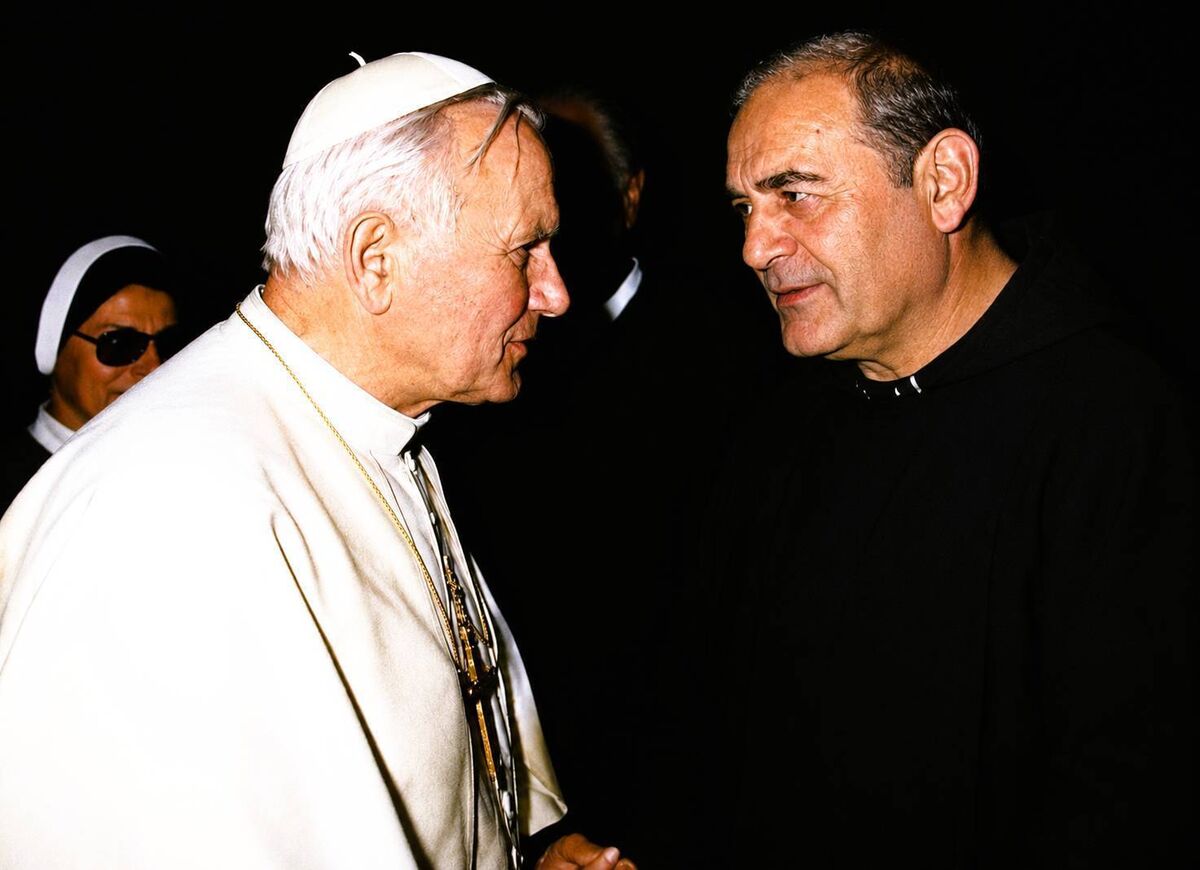
His ministry in Cork was marked by his regular column, On Reflection, in the Cork Examiner, while his pilgrimages to the Holy Land and Italy (usually incorporating a visit to the Shrine of Our Lady of Good Counsel at Genazzano, to whom the Augustinians have special devotion) were invariably over-subscribed. He twice met Pope John Paul II in Rome.
On August 13, 1986, just short of his 70th birthday, he collapsed and died after visiting some friends in Midleton, Co. Cork.
Following Requiem Mass concelebrated by 60 priests, led by Bishop John Buckley, he was buried in St Finbarr’s Cemetery, Glasheen Road.
After a lifetime of service throughout Europe, the UK, and Ireland, Fr ‘Charlie’ had gone home to rest among his own people - practically the ‘loft of a bowl’ from where he was born and reared in Pouladuff.
Dormit in pace.
The author is indebted to Messrs Joe Gill (Fr Hussey’s nephew) and Con McGrath, military historian, for insights into the friar’s military service.
'Postscript: Readers may be interested to know that the attractive cut stone used on the facade of St Augustine's was salvaged from the ruins of the Mallow Viaduct, blown up in August, 1922, during the Civil War, and that the stained-glass windows in the church's sanctuary, installed in 1971 by the renowned French artist Gabriel Loire, are dedicated to Michael Collins.




 App?
App?


