Throwback Thursday: When the horse and cart ruled in Cork
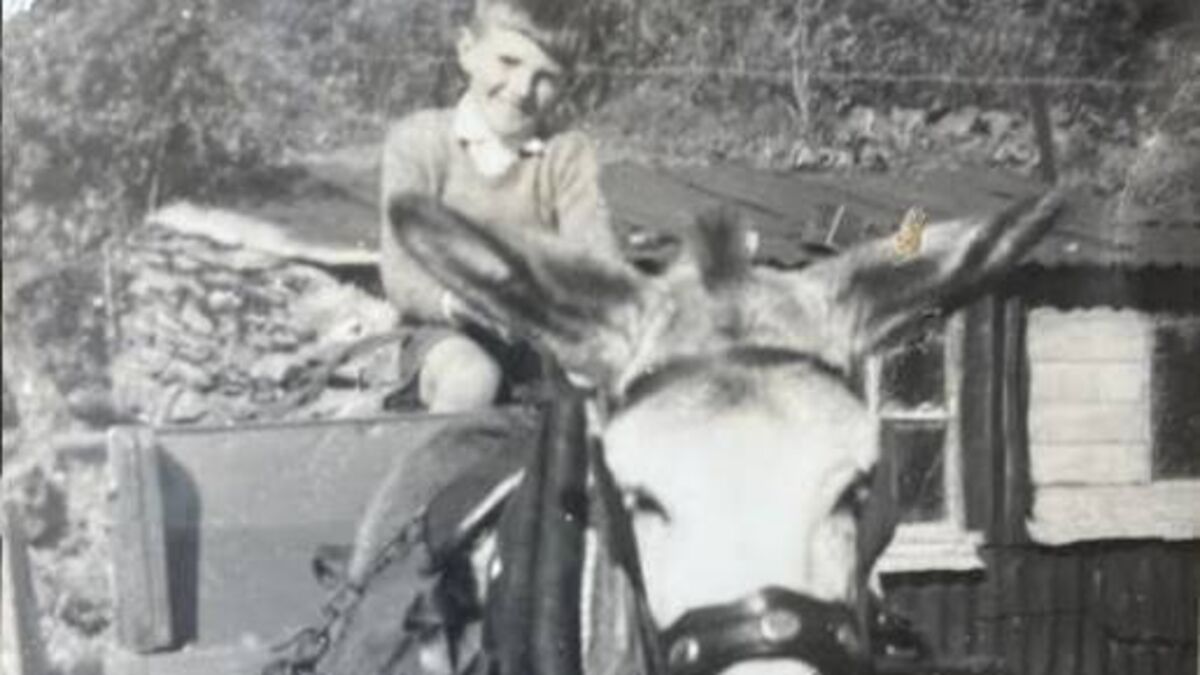
Micheál Kenefick on the family donkey in Whitegate
Regular Throwback Thursday correspondent Tim Cagney wrote in after reading in The Echo that a UCC expert had predicted there would be driverless cars in Cork in five years.
“I’m tempted to suggest that such technology would be a tad better than some of the humanly-operated vehicles currently being driven by certain individuals here,” he said, “Bear in mind, I write from a 53-year-old memory of ‘scary’ Cork driving!”
Well, you have a point, Tim, and perhaps one might agree with you (although we on Leeside will never be as bad, nay as terrifying as Italian drivers tackling the narrow coastal roads there as if they were racetracks.) But you got me thinking about drivers and transport and how we used to get around in the old days before most families had multiple cars.
First of all, we walked. Those of you old enough will recall tramping to school, to Mass, to a football match, or to meet friends for a weekend wander in the woods outside the city.
If you grew up in the country, the world was yours to explore – as long as your legs held out! Walking to school, whether through the fields or along the lanes, by city suburbs or up and down our countless hills, was taken for granted. In later years, when you went to a dance or for a drink with comrades, well, you walked home afterwards. What else would you do?
Unless, of course, you had a bike. Now there was a plus point! Not only could you get to and from the dance, but if you were a good, reliable ‘driver’ you could offer a ‘crosser’ or a ‘backer’ to a friend. (Probably not both at the same time.) They might not get the same offer on the way home though, if you just happened to have met a girl who was going your way?
We all took to our bikes on these long summer holidays, heading mostly for the beach at Crosshaven, Robert’s Cove, or Rocky Bay. Maybe to Kinsale, but that was always more for the financially affluent. Further afield, we took our bike on the country bus to Bantry, Dingle, or Kenmare and took to the pedals from there.
What a sense of freedom you got, spinning along the boreens, with only the occasional slow pedestrian with whom to exchange greetings, or perhaps a herd of cows being guided back to the fields after milking.
Today, unfortunately, cycling on country roads isn’t as safe, and one worries about tourists delightedly hiring bikes and heading off, confident that this is a rural Utopia, with empty roads and no traffic at all. As if!
Back in the day, when even a bike wasn’t guaranteed, our grandparents and great grandparents used far older forms of transport. To be sure, their needs weren’t as great as we think ours are – must get that new 56 inch TV, must see if those new bananas from Costa Rica are in yet, must get a bright outfit for Sophy’s wedding – so many ‘musts’.
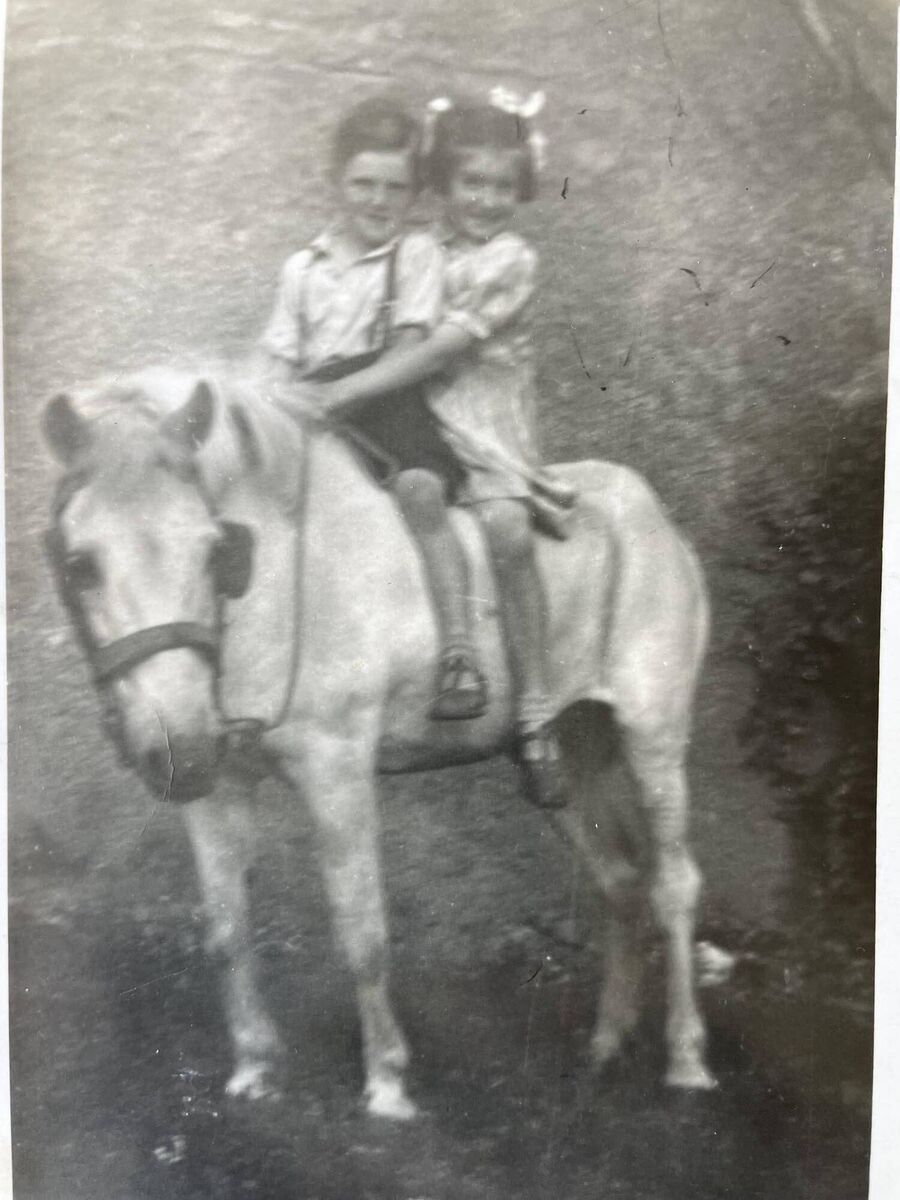
A few generations back, the question was how to get the milk to the customers or the creamery, the turf from the bog, straw for the thatching. The cows would have been milked in the early hours, the turf had already been cut and stacked over days of backbreaking labour, the straw had been harvested and dried. All those tasks had their own time of the year. But now these needed to be transported to their destination. You couldn’t take all that on your back.
Mind you, back in the 19th century, the countrywomen would walk all the way into Cork with creels of butter on their backs, along what is still known as The Butter Road, pausing now and then to rest for a moment, until they gratefully reached Blarney Street and the long slope down to the Butter Exchange. There, it would be taken in, weighed, assessed, priced, packed into those legendary butter boxes, and shipped off to every corner of the world – lightly or heavily salted, depending on the length of the sea voyage.
But the turf! And the milk! And the thatching straw! Micheál Kenefick is fortunate enough to have grown up in a village (Whitegate) that still held to many of the old ways when he was a child: “My very first memory is of a delivery made by a four-legged rather than a four- wheeled vehicle - milk from Furney’s farm.
“It came daily to the Middle Road and many other roads in Whitegate in a pony and trap driven by Pats Horgan. The trap was low slung and had two churns up front. Pats had a measuring cup, like a ladle, with a long handle as the churns were deep. We got our daily amount and ‘a tuille for the cat’ in the same milk tin, so of course no glass, plastic or tetra to be recycled. As well and as important as the fresh milk was the fresh news of the day which was also delivered.
“Around the same time, in the early 1950s, the coalman came, but he had a fine horse and cart as he would have to make multiple deliveries of hundredweight bags, and David Horgan who was the son of Pats delivered blocks for the fire. These would be loose and sold by the dozen and like the tuille, the dozen was always 13.
“We didn’t always need blocks as we had our own donkey (who arrived when White Moses, our pony, died) and used him and the butt (we never called it a cart) to bring timber from the wood in Corkbeg. This was one of the great joys of my childhood.
“I was allowed to help tackle the donkey as I was too small to reach on my own, but I loved it. Jack, my father, always kept the tackle smart with the brasses polished and butt painted and clean. The donkey tackled and butt attached, we removed the tailboard and used it as our seat.
“As we also kept a few pigs, we always had a few Blue Cross ration bags to use as cushions, as the tailboard could be hard on the other butt, especially as roads were not tarred and could be bumpy!
Micheál adds: “We never used the donkey as a mode of transport for ourselves (principally, I suppose, as we had nowhere to go or indeed needed to go as the village catered for all of our needs and Jack had a bicycle to go to work in the Fort and to go to matches on a Sunday after Mass.)
“We did though need the donkey and butt to bring the straw for the thatcher who was John Cashman from Inch.
“This was an easier job than the task of gathering timber for the fire, as there was no risk of cuts from briars going through the wood looking for fallen trees. The straw was also always clean and dry and I could sit on it on the way home.
“On the extensive estate in the Middle Road of about half an acre, as well as the pigs we kept a few hens and planted spuds and vegetables.
“Our donkey was again required to bring the oarweed front the strand. This was messy work as the oarweed was of course wet and difficult to handle and load. Kelp was the best, and in abundance back then, but today on that same strand not a string of kelp is to be seen.
“Amazingly, our transport to first Mass on Sundays was catered for by the CIE bus, driven by Paddy O Connor with Billy Lee as conductor. This was a special run as it didn’t go anywhere else. It brought us home again after Mass.”
So was this an extra labour of love taken on by Paddy and Billy for the village, Micheál? The bus being parked there for the weekend, it might as well be used, is that it? What a very nice community spirit!
“Many of our neighbours in the early ’50s went to Mass in a pony and trap,” recalls Micheál, “and it was a joy to see them travelling in a style to which we were not accustomed. We did, on the occasions there was room, get a spin which was a delight.
“The bicycle took care of everything else. Work, school and entertainment were only a dawdle. The Athletic Grounds was only a bit more: the 20 miles to the ‘Lower Road’ and you rowed across the river and back for a few pence. Your bicycle, in an era before a lock was heard of, waiting exactly where it was left with a thousand others. What a glorious era in which to have lived.”
You are so right, Micheál! Simpler times, hardworking times, when you didn’t take easy transport for granted, when you looked for pleasure in the places and friends around you. And when you could cycle some distance away and get back again with nary a threat or danger. A glorious era indeed.
Of course, less money and far fewer things to long for, but if you didn’t see the need for them, wasn’t that fine?
We had horses, ponies, and donkeys all over our city of Cork back in the 1950s and ’60s, and took them for granted.
One afternoon in the week, the country farmers’ wives would come into town and tether their pony and trap in Princes Street or North Main Street while they did their shopping.
The flat drays of CIE with their patient clopping horses were a familiar sight, as were the great Clydesdales drawing the Thompson’s Bakery freshly-baked breads, or sacks of flour, along MacCurtain Street.
And, of course, there were light, big-wheeled horse-drawn delivery vans from several smaller bakeries making their rounds, and innumerable battered wooden carts with loads of fresh vegetables from the surrounding countryside.
Do you remember James Stephens’ poem about a small boy pressing a great seashell to his ear and hearing in his fancy the eerie sounds of a desolate windswept shore far away?
“And then I loosed my ear – O it was sweet,
To hear a cart go jolting down the street.”
When this writer first read that, at about the age of five, she knew exactly what he meant, because just such a cart came jolting in just that way down the steep incline on Wellington Road.
In such places, the driver would put a metal ‘shoe’ in front of one wheel, to act as a brake, and this caused the distinctive jolting sound.
We don’t hear that any more. Nor the clop of hooves, the jingle of harness.
At McNally’s in narrow Bowling Green Street, where harnesses were made, the many smithies were docile giants.
Now, even the rich manure to be shovelled up from our streets to enrich our gardens – all gone, gone with the wind.
Yes, we have more than enough noises to cope with instead, but they are not of the old times, the old ways.
What do you remember about your life and times in Cork in bygone times? Email jokerrigan1@gmail.com or leave a message on our Facebook page: www.facebook.com/echolivecork