Throwback Thursday: My grandad, Michael Collins, and the Black and Tans
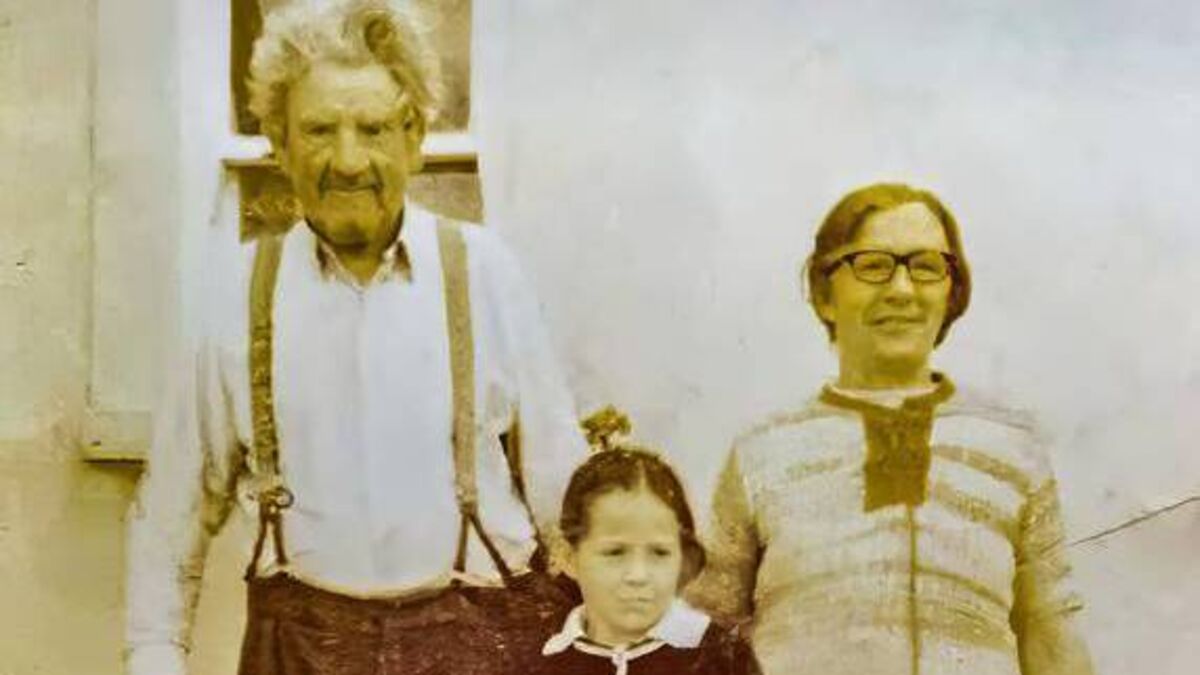
Regina Hegarty with her grandparents in West Cork. “They were the best days of my life, my time in West Cork," she said
After last week’s Throwback Thursday article about the older ways of getting around and delivering goods, we have had a short yet delightful note from Dan Ahern in Ovens.
“ I really enjoyed the Echo Throwback Thursday feature on our old ways of transport, especially the photograph of the man drawing milk to Killumney creamery,” said Dan.
“My late father drew milk there in a horse and cart, as he worked for a local farmer. He also kept a donkey and cart at home for his own use. Happy days.”
Indeed. Who can recall seeing the little donkey and cart, its driver sitting easily sideways, the milk churn standing up tall, as it made the journey from the little shed where the cow had been milked to the local creamery? It used to be a regular sight on our roads, but now no longer. Big tankers have taken over.
We would love to hear more from you, Dan, about those times, and the simpler sounds of yesteryear, like the clip-clop of a horse’s hooves as it drew the cart, or the softer patter of a donkey coming by with a load of turf. Tell us what else you can remember, do!
We were also talking last week about the Muskerry Tram (why didn’t they call it a train? Was it because it was a narrow gauge?) that puffed out the Western Road to Blarney and Coachford, with so many stops along the way, now nearly all forgotten.
As many of you will know, the original line from Cork to Blarney (built with the express purpose of encouraging tourists to visit the legendary castle) opened in 1887, with the Coachford branch following closely behind in 1888.
It went from the station on the Western Road out the Straight Road (a stop at Gaol Cross by request) to Carrigrohane and Leemount where the line swung north along the river Shournagh to Blarney.
The Coachford route branched off before this, and in 1893 another branch was built from St Anne’s on the Blarney line to reach Donoughmore. Or rather not Donoughmore but way below it in the valley at New Tipperary, as topography dictated, giving locals a hefty climb to get home.
Any reader know why on earth that location and railway station received that name? Was the station master from Tipp’?! Or the chief architect? We would love to know!
Hardly anybody today, alas, will be able to remember travelling on any part of this line, as it closed in 1934, but perhaps there might be family stories? Share them if so.
It would be wonderful to be able to hear of those who used the Muskerry line to commute between the city and their homes along the river, or to visit Blarney for a day excursion.
St Anne’s, where the Donoughmore line branched off, was of course the stop for St Ann’s Hydro out beyond Blarney, where Dr Barter ran his famous spa for the rich and over-indulged from the 1870s.
One can imagine these wealthy invalids - as they were called at the time - arriving by train in Cork and taking a hansom cab out to the Muskerry station on the Western Road, en route to the luxurious surroundings of the Hydro.
Now, here are some wonderful reminiscences of West Cork. Regina Hegarty wrote to us from the U.S (nice to know we are read so eagerly there!) to say: “I love your Throwback Thursday articles, and I was wondering if your readers would like to know about my grandad and nana. They were from West Cork.
“My grandad was great friends with the famous war hero Michael Collins, also from West Cork.
“I spoke with my mam recently (she still lives in Cork) and asked her if she had a picture of Michael Collins. Unfortunately, she said no, as having a camera was rare back then.”
You do have a point, Regina. We take it for granted today that everything will be photographed, selfie-d, and spread around the world on social media, but back in simpler times, a camera might only be seen on a great occasion, brought by a professional from the outer world.
And thus many of the simpler things of daily life back then have disappeared from memory – unless, as Regina has done, they are brought back in words.
“My mother’s side was from Raheen, Union hall, Skibbereen,” continues Regina. “I asked her for a house number, but she said there were no numbers back then. It’s across from Castletownsend.
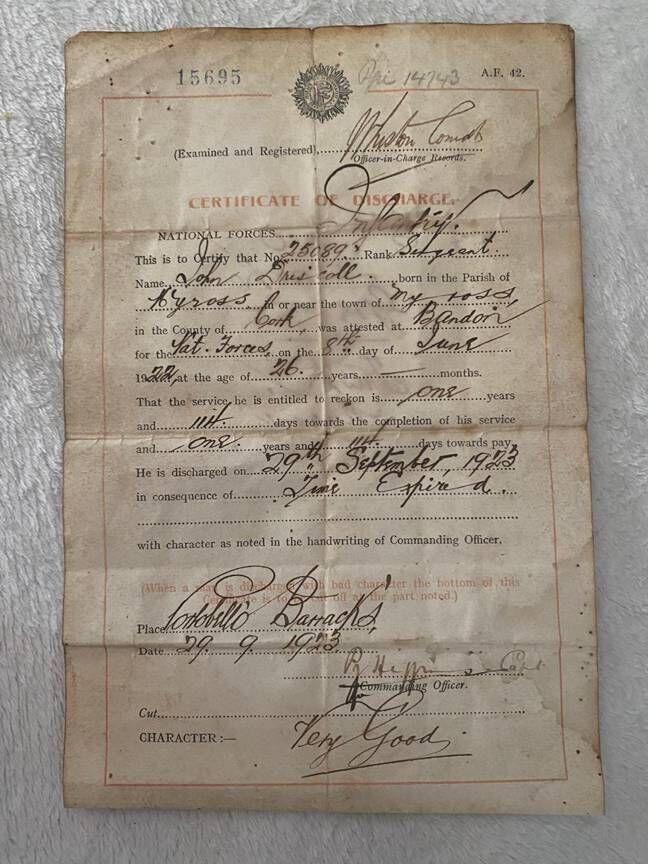
“My grandad, John O’Driscoll, was a sergeant in the army in West Cork in the 1920s, alongside his best friend, war hero Michael Collins, or, as my grandad referred to him, General Michael Collins. They slept in graveyards and ditches, fighting the Black and Tans.
“My mam also told me there was a curfew of 6pm back then, and if you were caught out after 6pm you were shot.
“They had the names on a list behind the door in every house to show who was living there, so they could be checked by the Black and Tans.
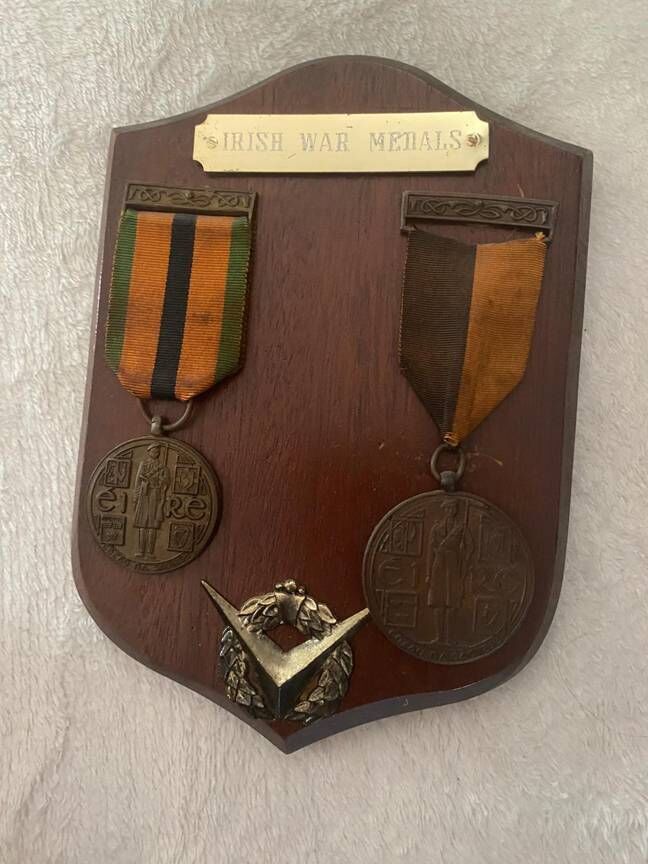
“My mam has her dad’s Irish war medals hanging on the wall in her house, and I got her to send me a picture of them.”
Regina also sent us his discharge paper from the army in West Cork.
“My Mam left at 18 years old to go to Cork to go to college to be a nurse,” continued Regina. “She has a lot of stories from the old days.
“Her cousins, the Deasys from West Cork, still live next door to where my mother grew up. She says she would love to go back to live there.”
Regina also sent on a photo of her and her grandad and nana in West Cork. “Great memories. The old ways were the best,” she said.
“They had a small farm and were very self- sufficient. My grandad used to take me out fishing in his boat. I remember helping to plant the potatoes and vegetables with them.
“The whole family would have picnics on the front lawn at their house. Where they lived it was like something out of a story book. There was a small castle myself and my brother and sisters used to walk to near their property.
“One of my grandparents’ friends would bring by his greyhounds, and we would walk the fields for miles with them.
“Our cousins, the Deasys, lived next door, and they had fishing trawlers, so they were well known all over the area.
“I used to walk down to the pier with my nana when they were unloading their boats, and they would always give us a tub of mackerel, and my Nana would fry it up for breakfast for us.
“She told me about all the pishogues and old Irish sayings handed down thru generations. She had a great memory.”
Regina continued: “The old farmhouse they lived in was handed down through the O’Driscoll clan over generations. My nan was a McCarthy, also from West Cork, her parents owned a farm there.
“Also, my grandad’s side had a huge family, with two nuns, and a priest that ended up in Boston - a very holy family, I remember.
“Also, there used to be a beach we used to go to where you could find white shells with a faint image of Our Lady on them, I remember finding two when I was little. I have never seen anything like it. There’s a story behind that that my mam knows, I will have to ask her again.”
Regina even remembers the happy journeys she made to and from the beloved farmhouse, as well as her grandparents’ frightening memories.
“My nana used to get the bus up to Cork and collect me and take me back down with her to West Cork,” recalled Regina. “I remember like it was yesterday.
“She was a tough old lady. She used to tell me about the Black and Tans and how she used to go out to the farms with notes under her apron for the old IRA.
“On one occasion, she told me, she was watching the clock and the 6pm curfew had passed, and my grandad was running late. She was looking out the window for him and she saw three Black and Tans had him on the ground with guns to his head. She said she ran out of the house and threw herself over grandad, pleading for his life, and they left him go.
“I would hear all the stories about the Black and Tans and what they did to the Irish. How hard times were. But they loved life, loved each other, were always happy, and I never heard them complain.”
Regina added: “I will never forget the feeling I had when I woke up in the morning at my grandparents’ house. The first thing I would do was open the curtain, and the sea used to look so tropical, see-through almost.
“I used to love going to Skibbereen shopping with them, picking out baby chickens.
“My grandad is someone I will never forget. He smoked a pipe, and we would always sit by the bushes in the yard. He would pull up two milk crates for seats. Sometimes, this seagull would be perched on the gate, and he would say bad weather is coming, ‘Sheila’, as he would call the seagull, is in.
“He was a fisherman, a farmer, and to make ends meet he was a gardener to rich people in Castletownsend. He had a green thumb, he could grow anything.
“They used to row their boat over to Castletownsend, and my nana would polish, as she would say, the rich people’s silverware and my grandad would do the gardening. It was all to make ends meet.
“I think I was 10 when my grandad died. I remember him laid out on the settee when he passed. I think that’s what they called it back then.
“I couldn’t believe he had a battery under his chin holding it up. And so many people came by the house to pay their respects.
“My nana wouldn’t stay there by herself after grandad passed. She moved up to Cork with us. She was truly one of a kind. She got me my first job working at Clifton Convalescent home in Cork.
“They were the best days of my life, my time in West Cork.
“Our family continued to go there after my grandad passed to see the cousins and spend holidays there.
“When I was 20 years old, I followed my brother over to Boston. My dream was to be a nun. I will never forget selling cupcakes for the starving children in Africa, that’s where I wanted to end up.”
And that’s where Regina’s story so far ends up!
Don’t stop there! What did you do next? We don’t even know if you did become a nun. Tell us!
And we are going to make contact with your mother in Cork too, and hear even more of those wonderful sunlit days in the West Cork of yesteryear, whether it was getting fresh mackerel for breakfast from the fishing trawlers, or polishing the silver for the wealthy people of Castletownsend (wonder if it was the Somervilles, of The Irish RM fame?)
And the rest of you, let’s have the stories treasured in your own hearts, the memories of childhood summers.
Email jokerrigan1@gmail.com or leave a message on our Facebook page: www.facebook.com/echolivecork.