John Arnold: My relative’s Cork grave and a link to linen and €10,000 cash
I have no real memory of my own father, Dan Arnold. He was buried in Rathcormac cemetery in September, 1961 -the week I started in Bartlemy National School. Down the years, visiting his grave to say a prayer was a very normal and natural thing to do.
In total, there were seven (now eight) ‘Arnold’ headstones in two separate rows. The names on some were familiar enough to me -branches of the family in Bartlemy village and in Moulane, whilst others I knew absolutely nothing about.
In the 1970s and ’80s, Billy Barry -formerly of Hightown, Bartlemy and Mondaniel, Rathcormac, gave me a lot of ‘family tree’ information. His mother was Ellen Arnold - her grandfather and my great grandfather were closely related.
Though domiciled in Dublin for many years, Billy never lost touch with his native parish. Long before computers were invented, all genealogical research had to be painstakingly undertaken. Billy was just great at research and spent hundreds of hours in different archive and record offices in Dublin.
Along with another cousin, the late Timmy Arnold, Billy gathered vast amounts of information on births, death and marriages as well as Land ownership Records. All this studious research further fuelled my interest in family history- not just of the Arnolds, but of nearly every family I knew!
Some say the Arnolds came to Ireland with Cromwell in the 1600s – a Captain John Arnold was one of the commanders in the Cromwellian Army! My cousin Timmy, on the other hand, maintained we were here long, long before that!
His theory was that after Castle Arnault in Gwent in Wales was destroyed by fire around the year 1177, that the Arnaults (Arnolds) high-tailed it across the sea and settled in this country! At this remove, it’s hard to know where we came from. Nevertheless, my curious mind was always anxious -still is, to find out more and more about local and family lore and history.
It must be about 45 years ago or so that someone said I should meet a Cork city grocer, Richard Henchion. Well, the very first time I met him in his shop – I think it was in Barrack Street - I was stunned by his knowledge of nearly every cemetery in Cork city and county. Truly, I gazed and still my wonder grew how one small head could carry all he knew!
For decades, Richard had been visiting burial grounds and meticulously recording the headstone inscriptions. He also drew a map of each cemetery and used his own ‘numbering’ system to provide a detailed index for each location. He spoke of his great friend, the late Liam Ó Buachalla from Carrigtwohill - another passionate and learned historian.
Then, in 2005, I began a project to record and publish the headstone inscriptions in Gortroe Cemetery in our parish. Richard had already completed this work with Liam in 1964. I contacted him and he suggested I go ahead with the task and when I was finished we could ‘compare notes’.
That’s exactly what I did and I got my book published in 2007.
Since Richard and Liam had completed their work there 40 years earlier, seven headstones had ‘disappeared’ - two had probably been replaced by newer stones, but the other five had probably simply sunk into the ground - never to be seen again.
Luckily, Richard gave me so many ‘tips’ on how to ‘read the stones’ -simple things like using fistfuls of lush green grass to ‘bring up’ difficult inscriptions. Another useful piece of information imparted to me by the doyen of Cork Headstone transcribers was using natural light - early morning sunshine - as it ‘slants’ across the stones - or reading by moonlight!
Over the years, Richard Henchion has published several books in relation to specific burial ground with extensive ‘notes’ on the families buried therein. His research has been stunning, combining local knowledge with archive and record sources.
In recent years, much archive material is now available ‘online’ and I must admit - though I’m not very computer literate - that the online resources combined with Irish Newspaper Archives are really invaluable. For example, it was only in recent times that I found out about the online Registry of Deeds.
Established in 1708, the Registry was set up to provide a method of recording and indexing deeds and legal transfers of unregistered property. Property is deemed ‘Unregistered’ where the title has not yet been listed in the Land Registry Office.
Anyhow, let me explain what a friend of mine recently discovered for me!
Last year, on a Parish History Tour, I was surprised to discover how big an influence William Dargan was in this area. Dargan (1799-1867) is widely regarded as the ‘father of Irish railways’. He was a businessman, inventor, agriculturalist and entrepreneur.
In 1849 - just after the Famine - Dargan leased 2,000 acres of land in Kildinan from his friend Edmond Burke Roche - later the 1st Baron Fermoy. On this land, Dargan set up a flax growing industry.
He built canals, ‘retting’ ponds and modern scutching mills that employed hundreds of locals, including women and children. The project initially boomed, and flax, which was predominantly grown in Ulster, became popular.
Problems with marketing abounded – jealous Ulster merchants frowned on Dargan’s endeavour. Industrial ‘health and safety’ was non-existent and accidents were frequent.
Karl Marx wrote about the six fatalities in Dargan’s Kildinan Mills between 1851 and 1861. Eventually, the entire project was abandoned.
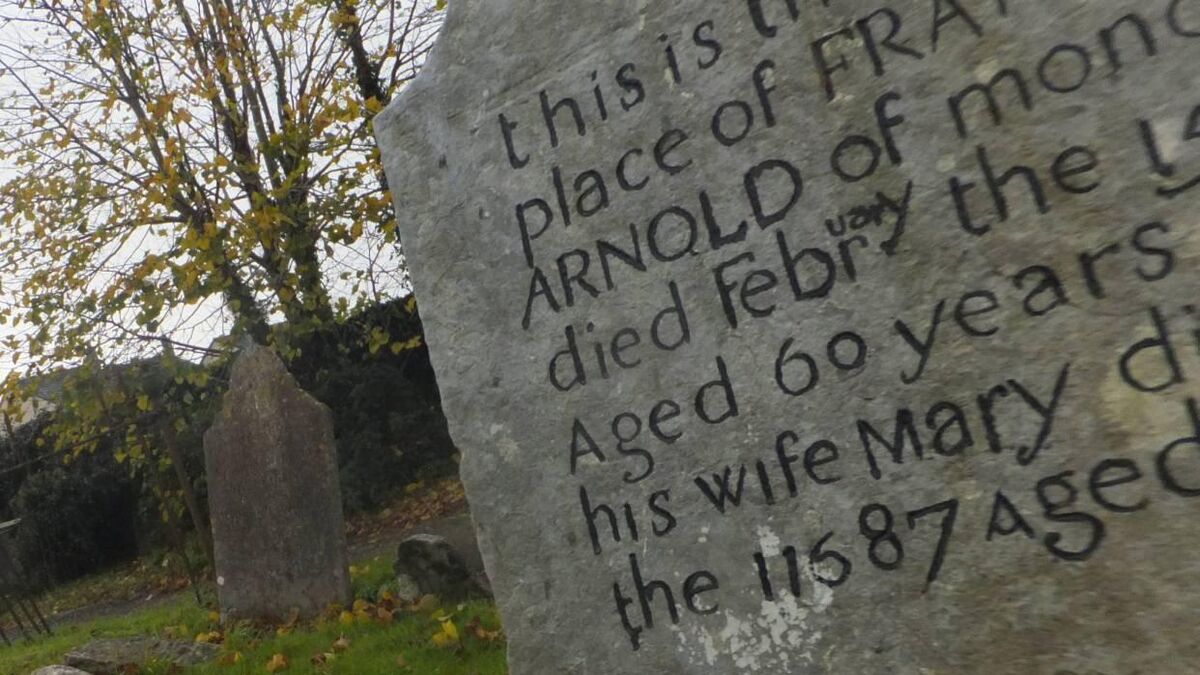
On the oldest Arnold headstones in Rathcormac cemetery, the names George and Francis Arnold appear. Maybe they are my ancestors - certainly relations as they are buried in the same ‘ground’ as my family.
In browsing the Registry of Deeds recently, Eamonn, a historian friend of mine, came across an interesting item relating to Arnolds. In a deed from 1775, a Francis Arnold surrendered a lease he held on a plot of land 70ft by 70ft.
Francis held the lease from local landlord William Tonson - he served as MP for Rathcormac from 1776 until 1783. On finishing his parliamentary duties, Tonson was elevated to the title of Baron Riversdale- a housing estate in Rathcormac is named after him.
In giving up the lease, Francis Arnold got the then princely sum of Fifty Pounds Sterling.
The ‘flax link’ nearly a century before Dargan’s time is that Francis Arnold’s occupation is given as ‘Linen Weaver’, so flax must have been grown in the area in the mid- 1700s. George Arnold’s name is also on the Registry as well as that of John Hannein.
In ‘today’s money’, the £50 would be worth around €10,000. Now, if I can only find a Last Will and Testament for that Francis Arnold!





 App?
App?


