John Arnold: We three sang song in honour of May at her Cork gravestone
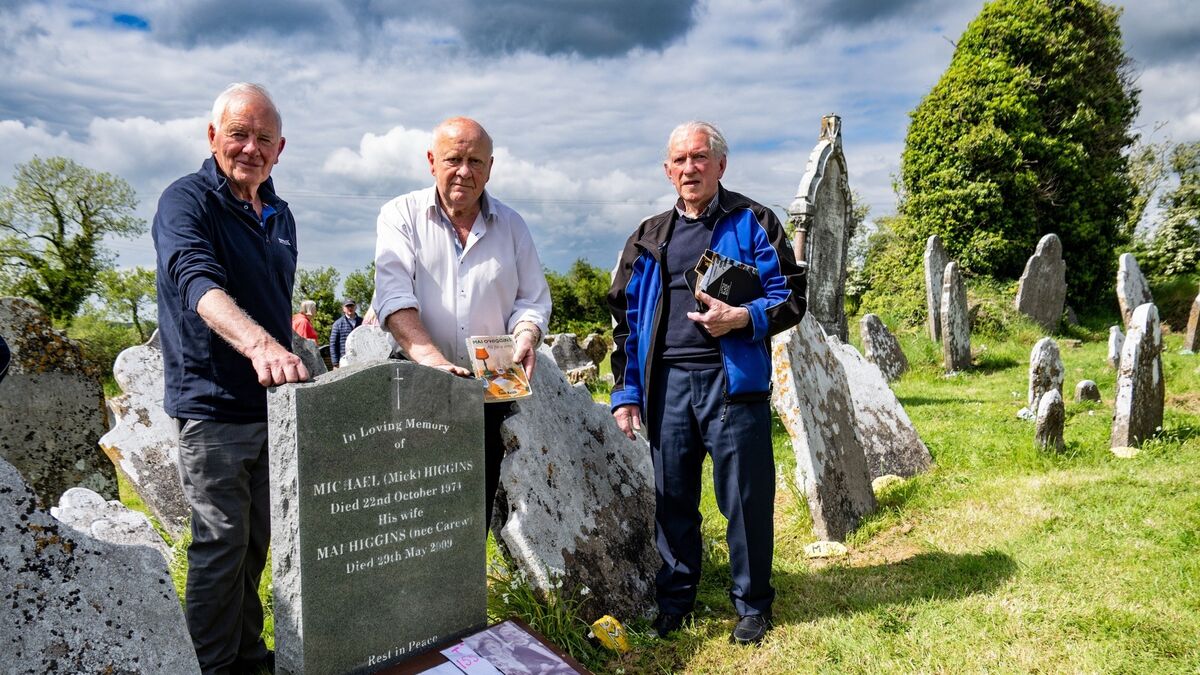
John Arnold with Charlie McAllister (left) and Pat White (right) at the grave of songwriter May Higgins at Templecurraheen graveyard in Carrigtwohill parish, where a ceremony took place this week after its was cleaned up.
Too true, but nevertheless the gift of being able to put words together and then marry them to music and come up with a ‘finished product’ that’s pleasant, enjoyable- maybe even informative, well, that bates Banagher.
I dabbled in poetry myself now and then in my younger days, but my verses can be rhyming or maybe not. The first and third line might have a last word that sounds the same, then the second and fourth lines and so on until the poem is completed.
I never really mastered the trade of being a poet. I could still ‘compose’ a few lines to suit most occasions but wouldn’t have the audacity or temerity to call it poetry!
When I think of some of the great combinations like Rogers and Hammerstein, Lennon and McCartney, Burt Bacharach and Hall David, and the Gibbs Brothers (Bee Gees), I am truly in awe of their undoubted talent.
What about ‘Arnold and St John’, with apologies to the memory of the late great songster Pete St John?
A few years back, I took the liberty of basing a ‘composition’ of my own on Peter Mooney’s (his real name) Fields Of Athenry. I think they call it plagiarism when one person kind of bases one song on a previously written one. My Fields Of Bartlemy was anything but original but it included such magnificent agricultural gems as ‘
Safe to say it never made to No.1, or any other number either!
My pathetic efforts at songwriting aren’t a cause of any major distress to me. No, but they have given me a huge admiration for those who pen never-to-be-forgotten songs and tunes.
In truth, I’ve thought a lot about songs, singers, and songwriters over the last few days, and all because of a simple headstone in a rural East Cork cemetery.
Since medieval times, people had been buried in this sacred spot. A church once stood there - said to have been burned by the forces of Oliver Cromwell in the early 1650s. Though little remains of the building, save portions of two walls, the place was still an intrinsic part of local life and death.
Not far away stand the gaunt remains of a famine workhouse - a huge famine ‘burial pit’ can still be seen at the back of the graveyard.
Local man Michael Finn singularly took on the onerous task of clearing and cleaning this sacred ground.
During his 1968 U.S Presidential election campaign, Senator Robert Kennedy often quoted a line from George Bernard Shaw: “Some men see things as they are, and ask why. I dream of things that never were, and ask why not.” Well ’twas a bit like that with Michael Finn.
Senator Kennedy never realised his plans, dreams and ambitions, but thankfully Michael’s dream came to full fruition on Monday last.
The sun shone gloriously as a few hundred people gathered for an official unveiling of a magnificent Cork. County Council information board.
Truly, we can say of the crowd that came to Templecurraheen that ‘still they looked and still the wonder grew’ - yes, they were amazed to see the burial ground transformed. Now, it’s a well-kept place of serenity and beauty.
My connection with the spot came in an unusual manner. Back in 1834, here in my parish an encounter that went down in history as ‘The Battle of Gortroe’ occurred. In a bloody fight during the Tithe War, 12 men were shot and killed at the Widow Ryan’s farmyard - her son was shot dead that fateful day. Another widow, Mrs Collins, lost two sons, John and Michael - both victims of the hail of lead on that December day so long ago.
The Collins family, like so many others in the early 1800s, were tenant farmers. In 1834, they were farming in Hightown, Bartlemy, but may well have been on a farm in the Carrigtwohill district at an earlier time. It was in Templecurraheen that their father was buried.
So, on December 21, 1834, a sad procession of horse-drawn vehicles brought the bodies of the Collins brothers to be interred with their father.
When a monument was erected to remember Gortroe in 1984 (150 years after the massacre) wreaths were taken to the places where the 12 slain lay buried. The actual location of the Collins grave was not known so Paddy Healy - our postman for many years, and a relative of the Collins family - simply placed ‘their’ wreath inside the graveyard gate.
Michael Finn showed me a simple headstone to Michael Higgins, who died in 1974, and his wife Mai, who passed away in 2009. Sometimes called May Higgins, and even Mai Ó Higgins, her name had a special resonance.
Many’s the Saturday night on his RTÉ radio programme, the great Donncha Ó Dúlaing would play a song written by this brilliant Waterford lady.
Growing up in Dungarvan and Old Parish, young May Carew had a fascination - even admiration - for water, the sea, rivers and lakes. She loved anything to do with the sea and penned so, so many beautiful songs with a maritime theme.
Donncha loved Sweet Youghal Bay and Gweebarra Bay while my favourite was a song my own mam sang, Beautiful Bundoran.
May Carew worked in Dungarvan and there she met Garda Michael Higgins from Knockraha. On a work-related visit to the Garda Station, Garda Higgins asked Miss Carew if she’d accompany him to a Garda Dance - she said yes and their love story began.
May sought and got inspiration everywhere water flowed. While the couple were honeymooning, she wrote Moonlight On The River Shannon.
Though the couple lived in Dublin for many years, her native Decies was never far from her mind. , , and all reflected her love for it.
I suppose one of her very best compositions, which has been widely recorded, is - truly a Waterford anthem.
On Monday last, I was thrilled to meet an old friend, Dungarvan native Charlie McAllister, a great Gael, referee, and a gorgeous singer. He told me he met May once at a concert in their native town where he sang two songs.
On Monday also, I met veteran ceilidhe musician and singer Pat White. A life-long admirer of Mai Higgins, he met her many years ago in Dublin and honours her memory by keeping her songs alive and sung.
I think I have found more than 50 songs written by Mai Higgins.
Her final resting place in an East Cork hillside graveyard surely makes her soul happy as she soars on high, looking out over the Lee and Cork Harbour.
Pat, Charlie, and myself were honoured and privileged on Monday last to join in song at Templecurraheen;






 App?
App?


