Áilín Quinlan: 'It skidded so close I could literally smell the tyres'
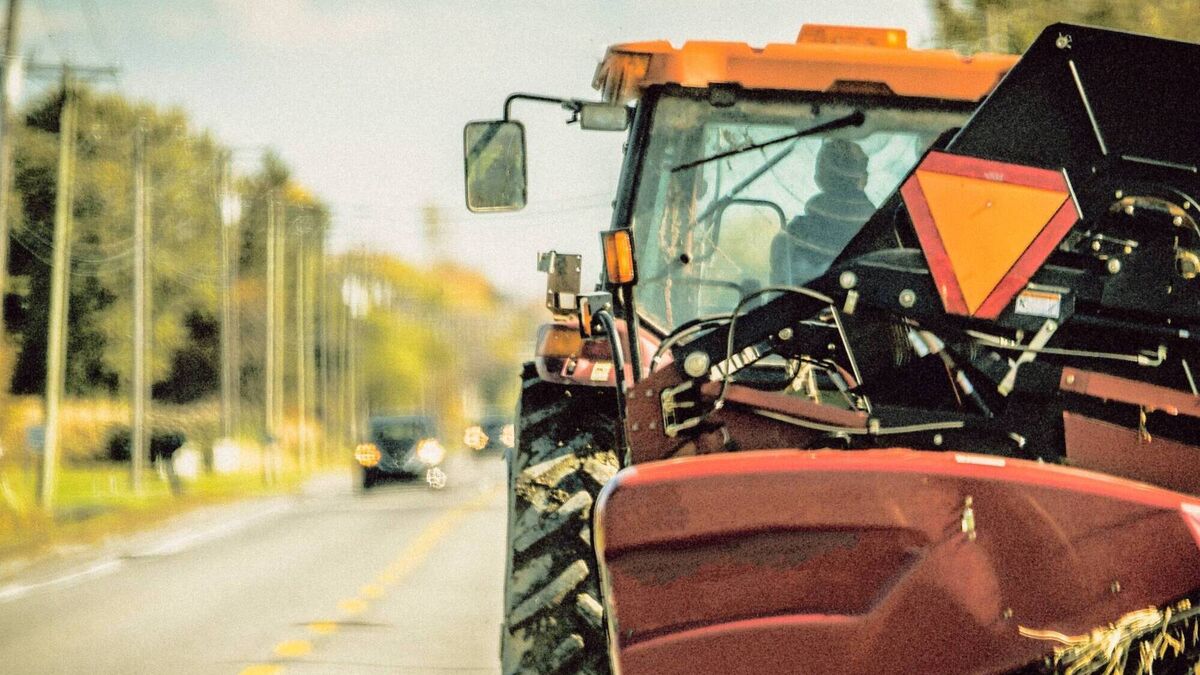
Tractors are a common sight on our roads as silage season arrives. iStock/posed
I looked to my right and my left. There was nowhere to go on this quiet, ribbon-thin country road, no room to move in and off the muddy Tarmac, no hedge to climb up on, no field gate to stand behind.
It had rained hard earlier. The little road was mucky and covered in sodden, rotting leaves.
The tractor rounded the bend ahead of me at speed.
Spotting my bright yellow high-vis jacket, the driver braked. Too late and too suddenly. The huge thing skidded several yards on the slick, slimy surface of the road, skewing towards me and coming close, very close, so close I could literally smell the tyres.
He wrenched it sideways and the machine screeched and juddered before coming to a halt, tilting into the ditch on the opposite side of the road. But still only three or four feet away from me at most. That’s how narrow the road was.
I stood paralysed, my arms clamped around my chest, my neck and shoulders rigid.
The driver seemed awfully young, no more than 16 or 17, I estimated. Although he was close to me, I couldn’t get a proper look at him because he kept his face averted.
If I hadn’t been so stunned and so far from my own car – still an hour’s walk away – I’d have photographed his registration with my phone. I might even have driven behind him to his destination and told his parents.
What happened was that the boy simply started up the tractor and drove off. Not once did he so much as look at me. He did not apologise. He did not in any way acknowledge my presence.
I started the long walk back to my car, suddenly so bone-achingly weary that I just wanted to lie down right there in the muck.
Why was a boy driving such a very heavy piece of machinery so fast in such bad road conditions on such a tight country road?
Here’s the thing. Three o’clock the following morning I woke up in a state of blackest terror. It felt like I was at the bottom of a deep hole. It took ages to shake myself out of it and get back to sleep.
The same thing happened the next night and the next. My neck and shoulders were sore. My legs felt like they were full of sand. A friend who works in healthcare later explained to me that I was suffering from shock.
That there is one of Ireland’s great anomalies.
You can’t buy fags, vapes, alcohol or get your teeth whitened in this country until the age of 18. You can’t book a flight ’til you’re 18. You can’t drive a car until you’re at least 17 years old and have completed a theory test, and then you must always be accompanied by a fully licensed driver until you pass your driving test.
Learners must complete at least 12 hours of driving before taking that test and, if they pass it, they must display N plates on their cars for two years.
Yet, from age 16, a child can drive one of these enormous, extremely heavy machines on a public road.
The minimum age at which a person can apply for a category W provisional licence or learner permit to drive a tractor is 16. They pass a theory test, prove their eyesight is OK, get third party insurance cover, and they’re good to go.
This has been the case for as long as we can remember. But what we’re all forgetting is how Irish roads have changed. And how tractors have changed.
Walk through any rural town or village in the coming weeks and watch the show. Silage season is when these tractors start belting through the main streets of rural towns and villages.
Watch how big and heavy they are and how fast they go, even with a big load hitched onto the back, and even when they’re travelling through densely populated residential areas.
The sight of teenagers charging through a village or town on a big tractor, some of them on their phones at the same time, can be disturbing when you know that same driver wouldn’t be allowed near a Yaris or a Fiesta.
It’s time the government increased the age at which people are allowed to drive these things.





 App?
App?


