Kathriona Devereux: Damn it! To beat future floods, we need to think and act smart
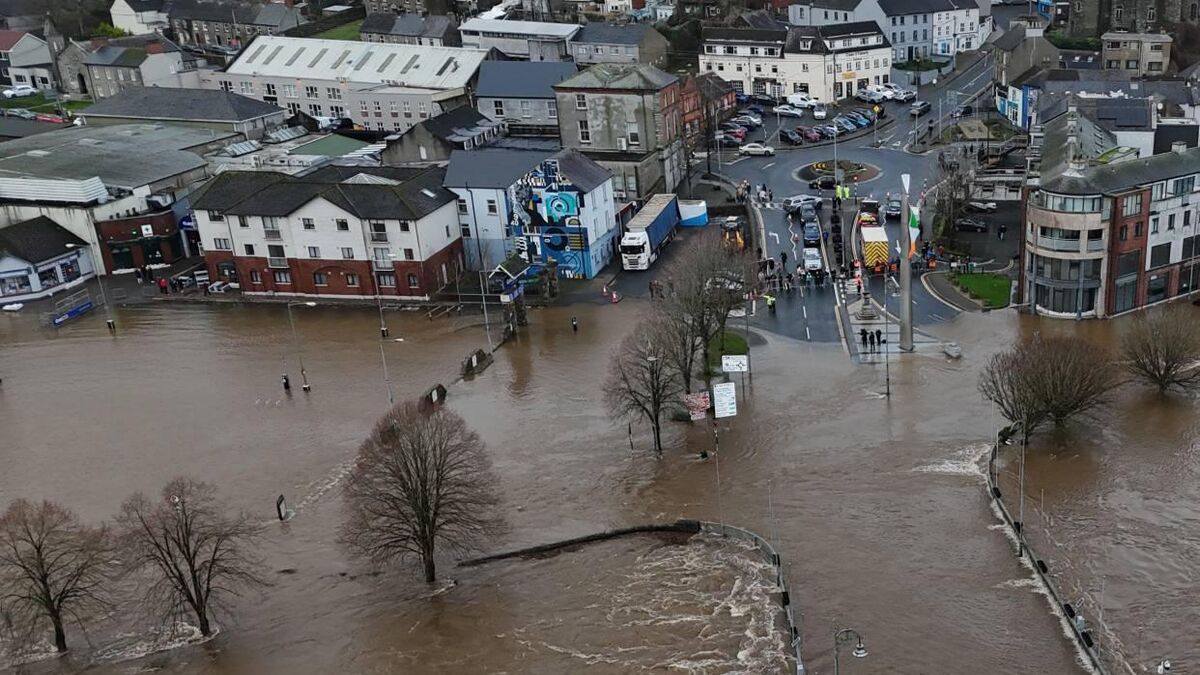
It’s the phrase that kept coming back to me as I watched the latest floods unfold on the news.
It’s also the title of a book by journalist Erica Gies, about how societies can thrive in an age of drought and deluge. As a phrase, it neatly captures the reality we now face.
We have heated the planet, there is more water circulating in the atmosphere than there used to be, and that has consequences - wet ones.
I spoke with Gies several years ago while producing the documentary . She had gathered stories from communities around the world grappling with water challenges - from urban flooding to polluted rivers and depleted aquifers.
What struck me was that the most successful responses all shared one insight - we must repair and change our relationship with water.
Storms like Babet, Chandra, and Éowyn (and their inevitable successors) now arrive with depressing regularity, lodging anxiety deep in the bones of people who have flooded before.
The people of Midleton watch the flooding in Enniscorthy and think, ‘God love them’, followed quickly by, ‘Thank God it wasn’t us’. This rolling cycle of fear and relief has become a grim feature of life in a climate-changed Ireland.
Accepting that ‘water always wins’, and adapting accordingly is essential. That doesn’t mean abandoning every frequently flooded home, although for some extremely vulnerable properties, that conversation has already begun. Nor does it mean giving up on flood defences to protect critical infrastructure.
The Dutch understand this better than most. Much of the Netherlands exists only because of hard-engineered flood protection - dykes, dams, reclaimed land, canals, and tidal barriers.
But faced with more extreme rainfall, rising seas and so-called ‘weather bombs’, the Dutch developed Ruimte voor de Rivier, literally ‘Room for the River’. Instead of endlessly raising defences, the policy gives rivers more space to flood safely while also improving landscapes, biodiversity, and public places.
In Ireland, flood relief is still largely framed as a defensive engineering challenge. We have not yet fully grasped that coping with vastly increased rainfall requires new ways of thinking, not just higher walls.
Across the world, approaches to managing urban flooding, recharging groundwater, restoring biodiversity, and creating attractive public spaces are increasingly treated as parts of the same system.
Along the Mississippi River, a coalition of 105 mayors from cities along its length has reshaped how their communities think about flood risk. They recognised that they cannot fully tame the Mississippi with grey infrastructure alone.
Levees and hard defences are no longer sufficient. Instead, they are investing in green and brown infrastructure - constructed wetlands and restored floodplains where the river can spread during floods and which then act as reservoirs during drought.
Making room for water has become a survival strategy.
This is why it is so frustrating to hear environmental concerns, such as the protection of the freshwater pearl mussels, framed as barriers to flood relief in Ireland.
Mussels are not an inconvenience; they are indicators of river health. They play a vital role in filtering water and maintaining ecosystems. There is a legal obligation to protect them, but protecting rivers and protecting people are not mutually exclusive.
New Zealand offers an example of a different mindset.
In 2017, the Whanganui River was given legal personhood. Now, if you want to do anything on the river you must consult Te Awa Tupua, the legal entity that represents the river itself.
Maori worldviews underpin the system and challenge engineering orthodoxy. The shift in mindset is from ‘what can we do to the river?’ to ‘what does the river need?’
Projects still proceed, including a massive multi-million revitalisation of a major port on the river, but in transformed ways.
It is part of a wider global shift that has seen legal rights granted to rivers and ecosystems in countries such as Colombia, India Ecuador and Spain, all reflecting a growing recognition that protecting people increasingly means giving nature a formal voice.
Here, research projects are exploring the idea of deliberately flooding farmland during peak rainfall events. The concept is simple: when an extreme rain event is forecast, sluice gates would allow water from the farm’s streams onto designated fields. After the peak passes, the water would sit for a day or two, then drain slowly (the key word) back into the river.
Researchers believe that along certain catchments, this approach could hold back up to 30% of floodwater during an extreme event.
Grass growth was unaffected in the farms that took part in the research. Scaled across multiple farms, the impact downstream could be enormous.
However, ideas like this are often dismissed, not because they don’t work, but because questions around responsibility, indemnity, and co-ordination quickly pile up and stall any consideration of them as flood-management tools.
We’ve put a man on the moon, we can coordinate a number of farmers along a river catchment to open sluice gates ahead of a forecast storm. It is not rocket science.
It is more a failure of will, imagination, and ambition.
None of this will bring comfort to people cleaning mud from their homes, counting losses, and wondering how they will face the next storm. They deserve both solidarity and swift support.
The State will write large cheques to help people recover from flooding. It would have made far more sense for previous governments to have spent money on prevention rather than compensation.
Flood-protection projects must be delivered and delivered quickly. But unless they are coupled with a genuine shift towards nature-based solutions - slowing the flow, restoring floodplains and improving river health as core flood protection measures rather than window dressing once the concrete is poured - Ireland will keep spending more, flooding more. and learning less, while the rivers quietly remind us of who really is in charge.
Water always wins.







 App?
App?


