Complacency, and a volatile modern geopolitical landscape, mean the NATO military alliance is facing a threat to its very 76-year existence, says ADRIENNE ACTON
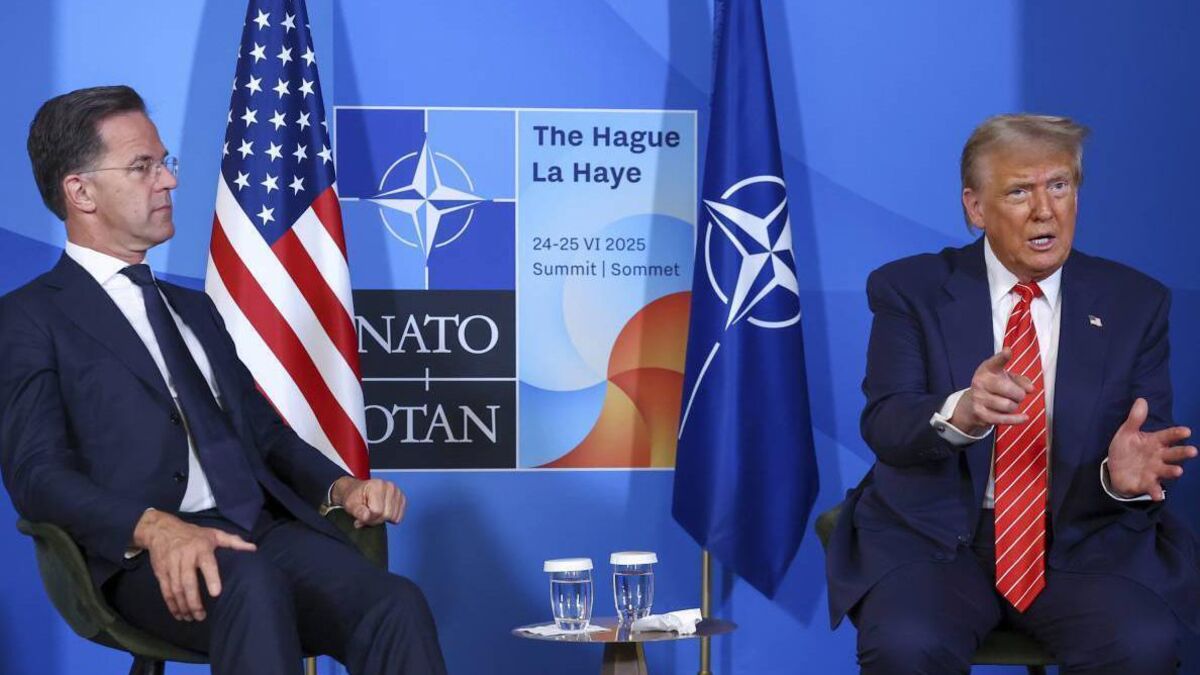
President Donald Trump with NATO Secretary General Mark Rutte at a summit last year
The issue, for me, is simple: the world changed, but NATO, which was an excellent idea originally, never changed with it.
The North Atlantic Treaty Organisation (NATO) is an intergovernmental military alliance between 32 member states - 30 in Europe and two in North America. Founded in the aftermath of World War II by 12 countries, it was established with the signing of the North Atlantic Treaty in 1949.
We are now in NATO’s 76th year, and the alliance boasts a combined army of 3.2 million soldiers from 27 countries. From the northern reaches of the Arctic to Turkey in the south, and from the U.S and Canada to the Russian border, with a military HQ at Mons in Belgium and a political HQ in Brussels, the aim of the alliance has been simple; a united barrier against future wars in Europe.
It is the largest defence alliance the world has ever seen, with more than a billion people living under its protection. In the 1950s, classes and exchange programmes were held so troops could learn about the people and the cultures of the nations where they would be stationed.
Alexus G. Grynkewich, the Supreme Allied Commander since July, 2025, oversees NATO’s three aims: Standardisation, Command and Control, and Exercises. All troops in Europe come under his command for collective defence.
But the issues and problems with these noble aims are mired in problems which became glaringly obvious with Russia’s invasion of Ukraine in February, 2022.
In 2014, after the annexation of Crimea, NATO placed troops in Latvia, Lithuania, Estonia, and Poland. Each battle group amounted to about 2,000 soldiers.
After Russia invaded Ukraine, troops were added to Slovakia, Bulgaria, Romania, and Hungary. Schools and markets were set up for the soldiers as they expected to be there for the long haul.
Ukraine is not a member of NATO but its invasion shone a light on how ill-prepared the alliance is. It begged the question - what if another country decides to invade a NATO country?
Is the group still fit for purpose with international tensions at an all-time high?
And with the U.S President toying with the notion of leaving NATO, can it survive without its biggest contributor? After all, in recent years Europe’s security has been 90% dependant on the U.S.
Many countries have reduced their land armies. France has nuclear weapons, but nothing compared to the scale of Russia’s arsenal. Germany has troops, but again, not enough. China has now the second biggest army and the U.S Office of Naval Intelligence has said its ships are increasingly of comparable quality to those of the U.S navy. All the while, China continues to build huge navy bases in its seas.
Saudi Arabia has tripled its army in the last 15 years. As for NATO, it has been sitting back on its heels: 76 years of peace have allowed the alliance to get too comfortable.
According to F. Ben Hodges, former Commanding General of the U.S army, the ability to move troops across countries is a cornerstone of success in times of conflict.
But he says the bureaucracy of NATO is mind-boggling: 32 sovereign countries with separate laws meant he couldn’t move troops seamlessly during exercises. The helicopter units had issues with maintenance, seeing as parts had to be transported through countries and permissions needed to be granted at each border. There aren’t enough trucks to move tanks across Europe. Many of the bridges, except for in eastern Germany, are not strong enough to withstand military vehicle weight, and movement for exercises had to be conducted outside of commuter times.
Other issues include Article 5 - the idea that an attack on one is an attack on all. All members must agree a response unanimously. Parliament or congress must approve military action.
This is to ensure calm heads and that a collective response is agreed. If one nation opts out, the other nations can respond but it won’t be under the umbrella of NATO.
According to American law, leaving an alliance or treaty needs approval from congress. However, in the event of an attack on Europe, the current administration could say, ‘You’re on your own’, seeing as the President is the Commander in Chief and can simply refuse to send troops.
Nora Muller, from NATOs International Policy Division, reported on a meeting in 2019 at which nations were given a hypothetical scenario. If the U.S left the alliance, how would they react?
Poland responded that they would try and make a bilateral security agreement outside of NATO, and Germany said they would offer a trade deal to the American President. This would undermine the structure and the alliance would falter, Muller says.
In recent years, there have been some improvements: 100,000 troops can now be moved across Europe in 10 days.
However, and in the simplest terms, each of the NATO nations are not going to hand over their military decisions to a central command, and without that, and without a new strategy, NATO will always struggle to remain relevant and effective.








 App?
App?


