How Frederick Douglass fell out with Cork-based Fr Mathew 
American abolitionist Frederick Douglass left Ireland 180 years ago, having met Daniel O’Connell in Dublin and Father Mathew in Cork. Douglass would always speak highly of The Liberator but would fall out badly with the Apostle of Temperance.
How Frederick Douglass fell out with Cork-based Fr Mathew 

Great-great-great grandson of Frederick Douglass, Kenneth B Morris Jnr, at the launch in 2021 of The Cork Abolitionists Trail in partnership with the Journey for Freedom Project, Frederick Douglass Family Initiatives, and Cork City Council. Picture: Brian Lougheed

On January 1, 1846, as he prepared to leave Ireland after four months, Frederick Douglass – the 27-year-old escaped slave and renowned abolitionist – wrote of his experiences here.

“Instead of the bright, blue sky of America, I am covered with the soft, grey fog of the Emerald Isle. I breathe, and lo! the chattel becomes a man.

“I gaze around in vain for one who will question my equal humanity, claim me as his slave, or offer me an insult. 

“I employ a cab – I am seated beside white people – I reach the hotel – I enter the same door – I am shown into the same parlour – I dine at the same table – and no one is offended.

“I find myself regarded and treated at every turn with the kindness and deference paid to white people. When I go to church, I am met by no upturned nose and scornful lip to tell me, ‘We don’t allow n*****s in here!’”

Early life 

Frederick Augustus Washington Bailey was born into slavery, sometime in February 1818, most likely in his grandmother’s cabin, on a plantation on the eastern shore of Chesapeake Bay in Talbot County, Maryland.

He wrote in 1851: “The opinion was … whispered that my master was my father; but of the correctness of this opinion I know nothing.

“My mother and I were separated when I was but an infant … common custom, in the part of Maryland from which I ran away, to part children from their mothers at a very early age.”

Escaping on a northbound train at the age of 20, and later falling in love with a freed woman, he took the surname Douglass and soon became known for his anti-slavery writing and mesmerising oratory.

He was also an advocate of temperance, having seen how slaveholders dulled the spirits of slaves by plying them with alcohol at Christmas and other holidays.

Douglass became a leader of the abolitionist movement in Massachusetts and New York, and he would, in time, be called a friend by Abraham Lincoln, with the president telling him publicly in the packed East Room of the White House: “There is no man in these United States whose opinion I value more than yours.”

When Douglass’ autobiography, The Narrative of the Life of Frederick Douglass, an American Slave, was published in 1845, his friends advised him to leave the country.

The book revealed his real name, and concern grew that his former ‘owner’ might attempt to retrieve his ‘property’. 

Slave-catchers, who abducted freed people and escaped slaves and sold them back into slavery in the south, were a real worry to Douglass.

The 27-year-old embarked on a two-year lecture tour of Britain and Ireland, arriving in Dublin in late August. 

Meeting Daniel O’Connell and Fr Mathew 

There, a month later, he met and befriended Daniel O’Connell, himself a passionate campaigner against slavery.

Douglass would later write: “The first I caught of him, after landing in Ireland, was near Sackville St Bridge”.

Wrapped in a dark cloak and trailed by “a squad of ragged little boys” chanting “There goes Dan, there goes Dan”, O’Connell was then 70 and already in physical decline. He would die two years later.

Douglass recalled: “The great man beamed upon the ragged urchins with a look of overflowing affection and delight, as though they were his own children greeting him coming to his home after a long absence.”

Douglass couldn’t know it, but four decades later, Sackville St Bridge would be renamed O’Connell Bridge.

That day in 1845, displaying what has been called his characteristic “affable arrogance”, O’Connell introduced Douglass to a spellbound audience in the Conciliation Hall on Burgh Quay as “the black O’Connell of the United States”.

Douglass was met with loud cheers when he told the crowd that he had first heard the name of O’Connell in the “curses of his masters”, and he said that O’Connell’s condemnation of slavery had “a great effect” in America.

As Cork author Laurence Fenton put it in his 2014 Frederick Douglass in Ireland: The Black O’Connell, “Douglass would always speak well of O’Connell; the same was not true of the other major Irish figure with whom he would spend time: Father Theobald Mathew”.

Having spent a month in Dublin, Douglass then travelled down through Wexford and Waterford, before arriving in Cork, where he would stay for more than three weeks.

Laurence Fenton describes in vivid detail an event which took place on the evening of Monday, October 28, 1845, in the Temperance Institute on Academy Street. 

With the South Main Street Quadrille Band playing from the balcony, and a crowd of over 250 people assembled, Father Mathew – the Apostle of Temperance – welcomed Douglass to the stage.

Douglass had heard of Father Mathew in America, and he had seen him administer the temperance pledge to a crowd of a thousand in Booterstown, but when he met Mathew in Cork, they quickly became friends.

Douglass later wrote of the welcome he received in Cork: “Amongst them all, I saw no one that seemed to be shocked or disturbed at my dark presence. No one seemed to feel himself contaminated by contact with me. 

“I think it would be difficult to get the same number of persons together in any of our New England cities, without some democratic nose growing deformed at my approach.
“But then you know white people in America are whiter, purer and better than the people here. This accounts for it!”

The next morning, Douglass visited Mathew’s house on Cove Street, with the 55-year-old Mathew rushing out to welcome his guest as he approached. 

“Welcome! Welcome, my dear Sir, to my humble abode.” 

Douglass would recall that Mathew’s home was indeed humble, uncarpeted, and containing very little furniture.

“The breakfast table was set when I went in,” Douglass wrote. “A large urn stood in the middle, surrounded by cups, saucers, plates, knives and forks … all of a very plain order … too plain, I thought, for so great a man.” 

Douglass was hugely impressed with Mathew: “His whole soul appeared to be wrapped up in the temperance cause … His time, strength and money are all freely given to the cause; and his success is truly wonderful.”

Even though Douglass had been teetotal for eight years, he proudly took the pledge from Mathew. 

“He … gave me a beautiful silver badge. I now reckon myself with delight the fifth of the last five of Father Mathew’s 5,487,495 temperance children.”

End of friendship with Fr Mathew 

Douglass’ friendship with Father Mathew would end in 1849, when the Apostle of Temperance, on a tour of America, declined an invitation to attend an anti-slavery rally in Worcester, Massachusetts. 

Not wishing to antagonise American anti-abolitionists, Mathew said: “I have as much as I can do to save men from the slavery of intemperance, without attempting the overthrow of any other kind of slavery”.

He also appeared to suggest that nothing in the Bible prohibited slavery.

Douglass wrote: “Nothing reveals more completely … the all-prevailing presence … of slavery in this land, than the sad fact that scarcely a single foreigner who ventures on our soil, is found able to withstand its pernicious and seductive influence … We had fondly hoped, from an acquaintance with Father Mathew, that his would be a better fate; that he would not change his morality by changing his location … We are however grieved, humbled and mortified to know that HE too, has fallen.”

Douglass “wondered how being a Catholic priest should inhibit him from denouncing the sin of slavery as much as the sin of intemperance.” Douglass said he felt it his duty to “denounce and expose the conduct of Father Mathew”.

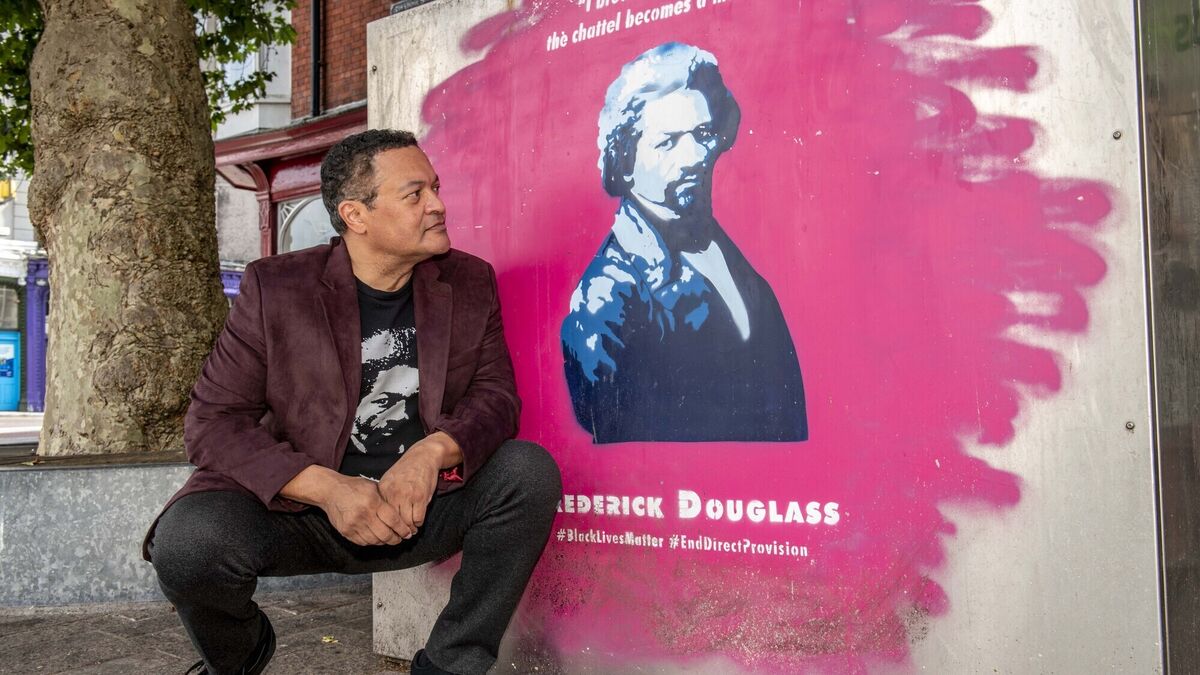
Today, on Cork’s Grand Parade, painted on the electrical box outside Lloyd’s Pharmacy, there is a portrait in blue of Douglass against a bright pink background.

It bears that famous Douglass quote: “I breathe, and lo! the chattel becomes a man”, and beneath it are the hashtags #BlackLivesMatter and #EndDirectProvision.

The painting is by Kevin O’Brien, co-founder of the volunteer art group Mad About Cork. 

In June 2020, Mr O’Brien told Amy Nolan of The Echo that he had been struck by the resonance between that “I breathe” and the last words of George Floyd, an unarmed black man who was killed in Minneapolis a month earlier when a police officer knelt on his neck for almost nine minutes.

“There’s a striking contrast to the last words of George Floyd which have since become a powerful slogan of the Black Lives Matter movement – ‘I can’t breathe’,” Mr O’Brien said.

Douglass described Ireland “as being full of compassion and respect, and a safe refuge”, he added.

“With the Black Lives Matter movement and anti-racism protests taking place across the world, now is probably a good time for all of us to look again at racism and prejudice in our own country.

“How do we treat black people and other minorities, Travellers, asylum seekers, and poor people here? Unfortunately, not all would share Douglass’ sentiments today, but for me there is hope in his words.” 

There is, however, warning too, and rebuke.

Douglass would remain deeply sympathetic of Ireland, and he wrote movingly of the hundreds of thousands of refugees who fled the Famine – a disaster he had witnessed at its beginning – imagining their heartbreak as they left home.

“Not even the comforting thought of going to a better and happier country can dispel the bitter anguish of an Irish emigrant, after he sees one after another of the familiar hills and mountains of his beloved native land sink below the distant horizon. It is a moment when strong hearts fail and nature speaks in tears.”

Later trip to Ireland 

In 1886, Douglass, then 68, saw Ireland again, stopping briefly at Cobh on his way to a tour of Europe and Africa. 

“Poor, barefooted Ireland,” he exclaimed when he saw the then-Queenstown.

He was disgusted by the men who succeeded his great friend O’Connell, denouncing “the Duffys, the Mitchels, Meaghers and others – men who loved liberty for themselves and their country, but were utterly destitute of sympathy with the cause of liberty in countries other than their own”.

Later in life, his sympathy for Irish exiles was sorely tested by some of those who arrived in the United States.

“The Irish, who, at home, readily sympathise with the oppressed everywhere, are instantly taught when they step upon our soil to hate and despise the Negro. They are taught to believe that he eats the bread that belongs to them,” he wrote.

When the young Frederick Douglass was in Cork in 1845, he stayed with the Jennings family on Brown Street. 

The Jennings were a wealthy Unitarian family, and they owned a factory which made such products as mineral oil, vinegar and soda water.

Brown Street doesn’t exist anymore. 

It’s under the Paul Street Shopping Centre now, and on the front of that building, on Rory Gallagher Place, not far from Geraldine Creedon’s ‘Tribute’ sculpture, a plaque commemorates Richard Dowden (1794–1861) “Co-founder of the Temperance Movement, poet and botanist. Mayor of Cork in 1845. Managed Jenning’s (sic) soda-water factory which stood near here”.

It is less than a 10-minute walk across town from Brown Street to Father Mathew’s house at 8 Cove Street. 

The tall young African American would have strolled past the site of the former Carey’s Lane Chapel, where construction had already been underway for six years on the red sandstone and limestone building which would, eleven years later, be consecrated as Saints Peter and Paul’s Church.

Further along, he would have crossed the South Channel of the River Lee at Parliament Bridge, or at the South Gate Bridge – the Nano Nagle footbridge was 140 years away.

Perhaps on his way to Father Mathew’s house, Frederick Douglass rounded the corner of Patrick St, onto the Grand Parade, and passed by the spot where Kevin O’Brien’s portrait of him would sit, 180 years in the unimaginable future.

more #History articles

Don't give our historic Irish annals back to Oxford, urges Sinn Féin TD Don't give our historic Irish annals back to Oxford, urges Sinn Féin TD
'A treasure of Ireland': Irish manuscript on loan from Oxford goes on display in UCC 'A treasure of Ireland': Irish manuscript on loan from Oxford goes on display in UCC
Famous Cork explorer's ski pole 'should be repatriated back to Cork' Famous Cork explorer's ski pole 'should be repatriated back to Cork'

More in this section

Kerryman's long conviction list stems from alcohol issues after six members of family killed in crash, court told Kerryman's long conviction list stems from alcohol issues after six members of family killed in crash, court told
Two Echo journalists win at national awards event for local media Two Echo journalists win at national awards event for local media
RNLI rescues 25ft yacht from rocks off the coast of West Cork RNLI rescues 25ft yacht from rocks off the coast of West Cork

Sponsored Content

Rockwell College – 160 years of excellence Rockwell College – 160 years of excellence
Tesco How Tesco’s Community Fund is helping to keep a vital search and rescue team afloat
Flexible, affordable and functional: Why Irish travellers prefer a travel eSIM to outdated roaming Flexible, affordable and functional: Why Irish travellers prefer a travel eSIM to outdated roaming
Contact Us Cookie Policy Privacy Policy Terms and Conditions

© Examiner Echo Group Limited

Add Echolive.ie to your home screen - easy access to Cork news, views, sport and more