Found as a baby on the banks of the Nile soldier became a 'cultural icon' in North Cork town
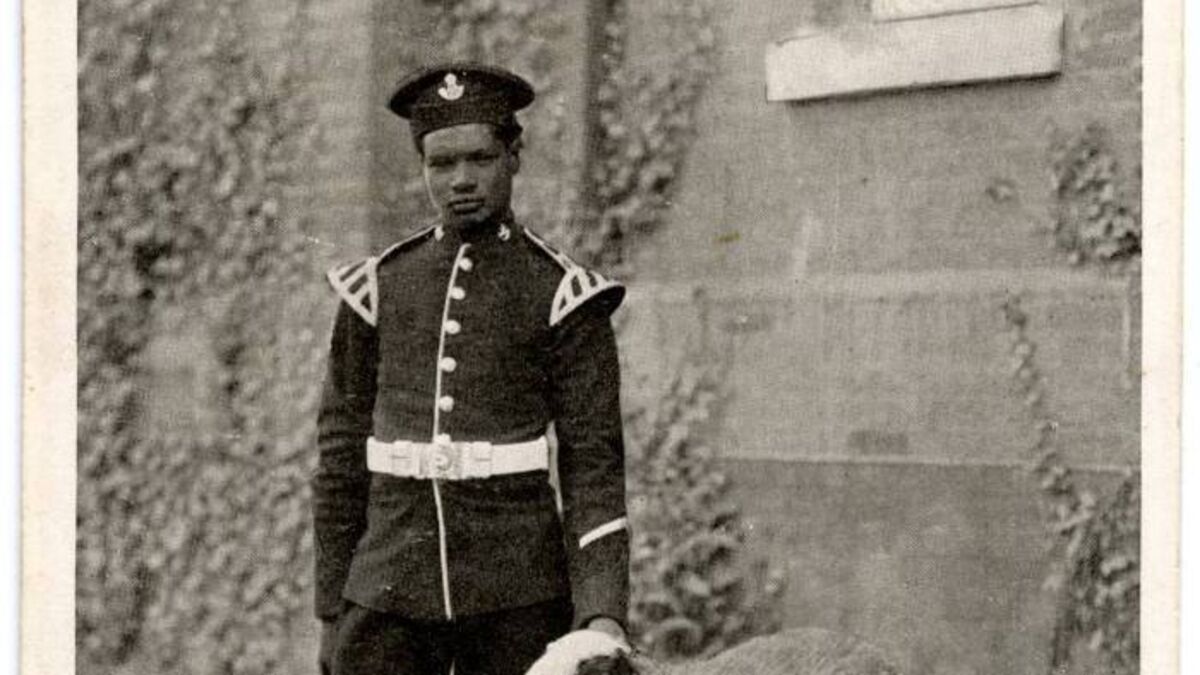
Jimmy Durham and sheep, 2nd Batallion, Durham Light Infantry. Reproduced by permission of Durham County Record Office
In Fermoy’s old military cemetery on the northern side of the town, a simple white marble cross marks the final resting place of a historic figure who died in 1910, aged 25, more than 5,500 miles from his birthplace.
He was, as far as is known, the first black citizen of the north Cork town, and probably the first time anyone on the banks of the Blackwater had ever seen anyone whose complexion wasn’t somewhere between pasty and purple.
Jimmy Durham’s story began 140 years ago, on New Year’s Day, 1886, after the Battle of Ginnis, when British forces led by Lieutenant — later General — Henry de Beauvoir de Lisle found a baby on the banks of the Nile.
The Mahdist War, between the Mahdist Sudanese, led by Muhammed Ahmad bin Abdullah, the self-proclaimed Mahdi (guided one) of Islam, on one side, and initially the Khedivate of Egypt and later British forces, on the other, ran from 1881 until 1899.
Read More
By its end, 30,000 Sudanese Mahdists were dead, injured, or captured. Because of their vastly superior firepower, the combined British, Egyptian, and Sudanese forces had suffered barely 700 casualties.
The Battle of Ginnis was a very minor skirmish of that war, but more then 400 Mahdists were killed, and many more maimed, while 10 British troops died and 41 were wounded.
Soldiers of the Durham Light Infantry, serving as part of the Anglo-Egyptian Army, had defeated Mahdist Sudanese warriors of the Dervish State aboard a barge.
The Sudanese were massacred by British boat-mounted Gardner guns, and the few survivors fled.
De Lisle later recalled: “We ran up to the boat and… and there, standing on the bank of the stream alone, was a small curly-haired child under two years of age, dressed in the full war paint of a Sudanese warrior. As he held up his arms for me to take him up, I did so and threw him to Sergeant Stuart.”
Endeared himself to the men in camp
Stuart, a Scotsman, nicknamed the infant “Jimmy Dervish”.
Deciding the baby would make “a good infantry pet”, de Lisle was told by an injured man that the child’s name was Mustapha and that his father — a Sheikh — had been killed, and his mother had fled.
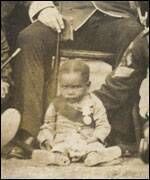
In 1939, the then-General Henry de Beauvoir de Lisle recalled the traumatised child “pointing his finger at me repeating ‘bung-morto’, imitating the sound of the rifle and the result [death].
“He was a very smart lad. He quickly learned to speak English and, when only two-and-a-half, could act as interpreter for the men with the hawkers in camp.”
Private James Birley and Sergeant Joseph Francies decided to raise Mustapha between them.
With their names, and a surname from their regiment, Mustapha became James Francies Durham.
He would soon be Jimmy to the men of the Durham Light Infantry (DLI).
On the long marches, Jimmy sat on the pommel of Sergeant Stuart’s saddle, and he endeared himself to the men in the camp with his singing and dancing.
According to de Lisle’s memoirs, the plan was that when the regiment reached Cairo, Jimmy would be left at a mission home.
However, when they got there, the DLI sergeants asked that Jimmy be allowed stay with them, and they each pledged a rupee — a day’s pay — a month toward his education.
Making history
With the regiment, Jimmy travelled to India in 1897, where he learned to play the bugle.
In 1898, it was on to Mandalay, where, a year later, Jimmy would make history.
When he was about 14 — his exact birthday being a mystery — Jimmy and the sergeants felt he was old enough to enlist.
The British Army had employed black musicians since the 18th century — and colonial regiments were often black — but no African had been allowed to join the regular army on equal terms with white recruits.
Jimmy’s application was said to have gone all the way to Victoria herself. Swayed by strong endorsements from the DLI, the queen approved his enlistment.
On May 23, 1889, James Francies Durham — Boy Soldier Number 6758 — became almost certainly the first black person to be enlisted to the British army.
In 1902, the DLI was brought home, and Jimmy found himself first in Aldershot and then in the English north east.
The cold, wet climate was daunting for a teenager who had known only warm environments, but Jimmy was welcomed by an extended family of former and serving sergeants, and he lived in and around Darlington, Bishop Auckland, and Tyneside.
He was partially brought up with the family of Sergeant Robson, whose daughter, Stella, he came to regard as a sister.
“Dear Stella,” Jimmy wrote in 1908, when he had been stationed to Cork, “I hope you will always reckon me as your brother. I have known you from when you was a dear little child and I always use to look to your father and dear mother as my mother as well.
“They have treated me like one of you all. Our band are in hopes of coming to Newcastle as we have been engaged to play at different places and I believe we are going to finish up at Darlington.
“I shall be very likely to be able to see you all, and I would like you to hear our band.
“Your loving brother Jimmy.”
Not long after, Stella named Jimmy, to his delight, the godfather of her baby.
In Bishop Auckland, Jimmy met Jane Green, daughter of a local blacksmith, and sister to a quartermaster sergeant in the DLI. They were married in a Newcastle registry office on July 25, 1908.
Stationed to Victoria Barracks — which would later be known as Collins Barracks — in Cork, Jimmy played clarinet and violin in the regimental band.
He ran the Army Temperance Association for the 2nd Battalion of the DLI, and he won an award in 1908 for achieving the highest membership percentage in the army. There may have been a less than noble reason for that high membership.
A teetotaller, Jimmy rented rooms for temperance meetings over a public house across from the barracks.
Perhaps the attraction of temperance was that some of the soldiers soon realised that it was a perfect excuse to go to the pub.
As 1910 began, Jane discovered she was pregnant.
Death
Joy turned to tragedy when the Irish climate finally bested Jimmy.
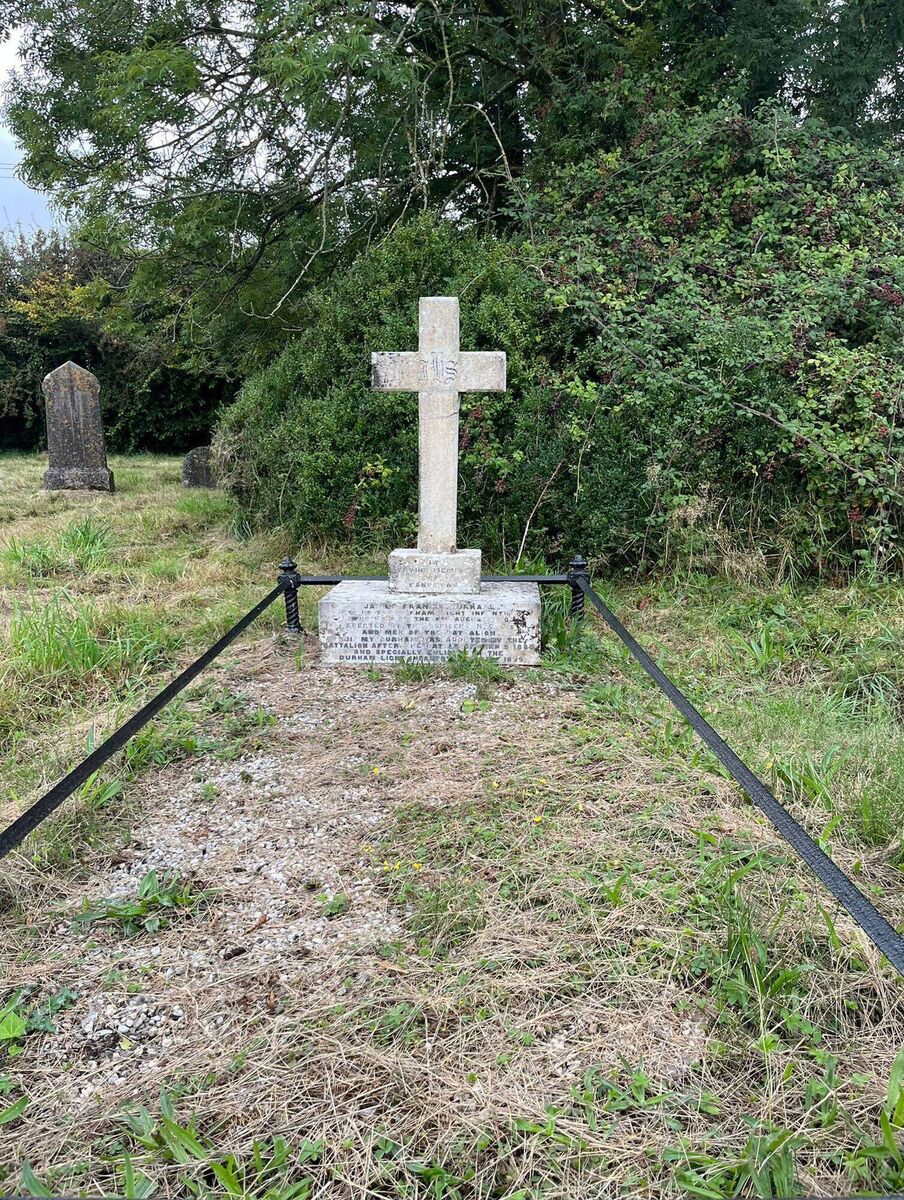
He contracted pneumonia and died in the Fermoy Military Hospital (now the Aldi carpark) on August 8, 1910.
He was perhaps 25.
There was a huge turnout for his funeral, with many floral tributes left at the graveside.
Three weeks after Jimmy’s death, Jane gave birth to their daughter, Frances.
Jane would later re-marry and have four more children with her second husband, Thomas Cleasby of Bishop Auckland, Co Durham.
Frances would live her whole life in Bishop Auckland, marrying a Mr Jubb.
They had no children. Frances died in 1998.
Jimmy's story inspired 'Doctor Who' episode author
In 2017, an episode of the BBC science fiction series Doctor Who, entitled The Empress of Mars, cast a young black actor, Bayo Gbadamosi, as a British soldier battling Martians in 1881.
The author of the episode, actor Mark Gatiss, writer and star of The League of Gentlemen, Sherlock, and Doctor Who, had initially — and mildly — voiced reservation at what he saw as an example of the BBC’s drive to become “more representational, and to make everything less homogeneously white”.
Addressing an audience of around 200 Oxford University students, he said he had mailed a colleague, saying “I don’t think we can do this.”
While stressing that he was in no way objecting to the casting of a “brilliant young black actor” as one of the soldiers, Gatiss said his reservation was that “these are soldiers from the South African war, they’ve just been fighting the Zulus. There weren’t any black soldiers in Victoria’s army”.
He acknowledged that the programme was telling fantastical allegories and already had a reputation for colour-blind casting.
“The argument is ‘It’s Doctor Who’, so everything is already a strange and different world.”
Prompted to research further the matter, Gatiss soon discovered he was wrong about there being no black soldiers in Victoria’s army, and the “amazing story” of James Francies Durham quickly became an obsession for him.
Gatiss championed that story, and his interest sparked media attention in the remembrance of the young man who was, as an infant, taken from his African home amidst great violence and brought thousands of miles to a damp island on the edge of Europe.
'Cultural icon' in Fermoy
Bill Power, a Mitchelstown-based historian, said Ireland’s history of black culture in earlier centuries was sparse, but Jimmy Durham was an important example of that heritage.
“How he came to Fermoy might be a matter worthy of debate, but the fact of the matter is he was the first known citizen to be of African extraction, so in that sense he is important, particularly in the modern sense of how we relate to other cultures,” he said.
“It is important to remember him and how he came to be in Fermoy, because he is a cultural icon in Fermoy, and that is deserving of attention and remembrance, and I think it would be both appropriate and timely to commemorate him.”
The origin of the expression “All to one side, like the town of Fermoy” is disputed, but it is generally thought to relate to the planned nature of the town meaning it is located predominantly on the river’s southern bank.
A minority interpretation suggests, however, that the expression might date back to the modern town’s earliest days in the late 18th century, when its founder, Scottish entrepreneur John Anderson, gave the British Army land for the sprawling barracks on the northern bank.
The barracks was the predominant economic base of the new town, and when the British Army left the town in 1922, the area was financially devastated.
A member of the urban district council complained that the local authority had lost £3,400 in rates and an additional £450 in special water rates, which adjusted for inflation was a total of £195,427 per year, or €228,256.
The entire life of the town revolved around the army, and the barracks.
Everyone knew everyone’s business, and the presence of someone different would have been big news in the garrison town.
“He must have endured all sorts of challenges, and he became one of the best-loved citizens in Fermoy at that time,” said Billy.
A photograph of the funeral, 116 years ago, shows crowds of soldiers and civilians standing around the grave, with mounds of flowers in the foreground.
In Fermoy’s old military cemetery, with its views across the Blackwater and past Fermoy’s spires and steeples to Corrin Hill, Jimmy Durham — Mustapha — taken from his home 140 years ago, has laid at peace for more than a century, half a world from the banks of the Nile.







 App?
App?


