Throwback Thursday: A family connection, and a walk on Oliver Plunkett St
This week on Throwback Thursday, JO KERRIGAN hears of a family link to a mystery photo, plus we take a walk down Oliver Plunkett Street’s old shops
Throwback Thursday: A family connection, and a walk on Oliver Plunkett St

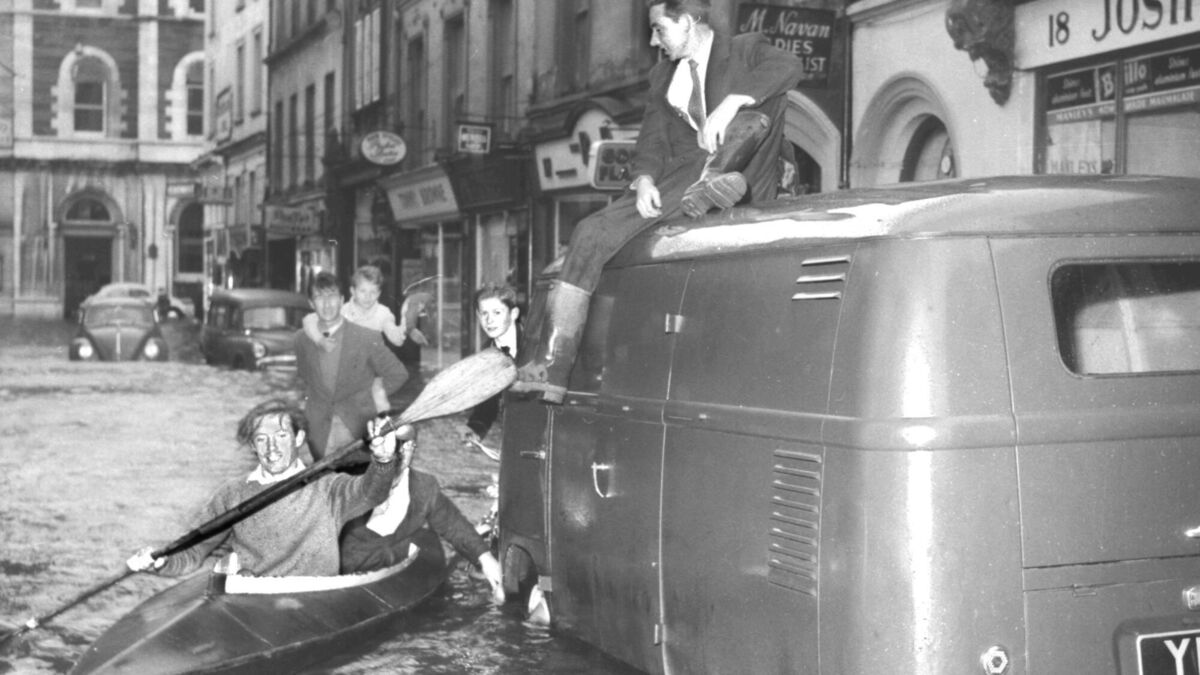
Donal McCarthy and Joey Kerrigan rescue a stranded driver from the floods in Winthrop Street, Cork.

Declan Hourihan has written to us, seeking information on a family link highlighted in a Throwback Thursday column we ran back in 2023.

“I’m reaching out because I’m currently researching the Irish side of my family and recently came across your article on EchoLive.ie. I was delighted to find references to my family’s history within it,” said Daniel.

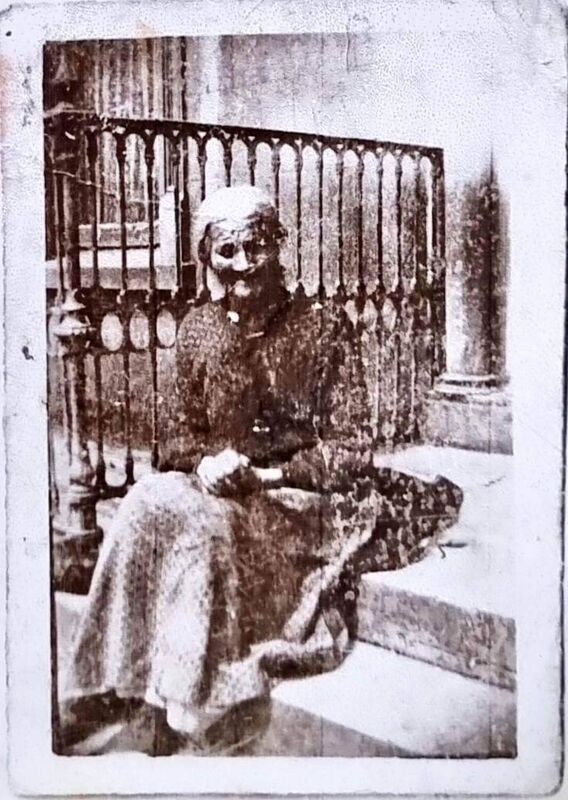
The article in question related to a marvellous old picture we published of an elderly lady sitting on the steps of No.8, North Mall, which had been supplied to us by Fintan Bloss.

He had found it in his family album, with no explanation of who she was, or why it was there, other than that the name Kate Davis was written on the back, and that it came from the Rembrandt Studio.

Well, at the time Frank Roche saw this as a challenge and really got to work on the research, checking out the censuses, street directories, and everything else he could think of to find more information about the photo.

“I located details of the Rembrandt Studio in Guy’s Directory of 1935,” revealed Frank, “The entry for 27, North Main Street, reads ‘Healy Sean, confectionery’ (and) ‘Vanbrook J, photo studio’ - this was John Vanbrook of Glanmire.

“It’s more likely that whoever took the photo got their film developed and printed by John Vanbrook at the Rembrandt Studio.

“One of his ads in the 1934 Echo offers to develop a Kodak Brownie No. 2 film and provide eight prints for one shilling - which would have been approximately the price of two loaves of bread at that time.”

Here is Frank’s exhaustive summary of Kate (Hourihan) Davis, which reflects weeks of hunting, checking, and noting.

The photo of Kate Davis at 8, North Mall in Cork city, which was investigated in Throwback Thursday in 2023 - a reader online recently discovered a family connection to her

“Catherine Hourihan was born in the village of Ballincollig in 1857, daughter of Timothy (Thade) Hourihan and Margaret Murphy who had married in 1852. The couple had (at least) six more children. In various records, Timothy Hourihan is described as a charcoal burner or labourer so he may have worked in the Gunpowder Mills.
“In 1883, Kate married Joseph Davis, a Londoner who was an army pensioner: the couple had no children.

“In the census of 1901, they are living with Kate’s widowed mother who had a boarding house in Ballincollig. By 1911, her mother having died, Kate and Joseph were living at Blarney Street.

“On St Patrick’s Day, 1911, Joseph Davis died so the census two weeks later shows ‘Catherine Davis, widow, 50’ living alone (she would in fact have been 53).

“At marriage, Kate is recorded as a laundress and in Census 1901 as a domestic servant. In 1911 she is described as a ‘shore woman’.”

Frank’s research continued: “The Cork Examiner of July 23, 1937, tells us, ‘A woman named Kate Davis, 357, Blarney Street, Cork, fell on some steps at Winter’s Hill last night. She broke her ankle and having been treated at the North Infirmary, was subsequently removed to the Co. Home where she is detained. She is aged 78 years.”

Was this possibly why Kate was photographed sitting on a rug on the steps of 8, North Mall?

Frank added: “It is likely that it was after her fall that she came to live at Kyle Street. In the street directories from 1930 to 1945, ‘Mrs Hourihan, clothes dealer’ is listed at 9, Kyle Street. This Mrs Hourihan, nee Hayes, was the wife of Daniel Hourihan, a son of Kate’s brother John who lived in Grattan Street - so Kate was living with her nephew and his wife in Kyle Street.”

Kate died in 1942 at the age of 85, stated Frank. Her death record says 67 but the Examiner’s ‘aged 78’ in 1937 was much closer to her true age. She was buried in Ovens, and Frank explained: “Her brother John (died 1922) and his son Daniel (died 1943) were also buried in Ovens, but their wives, who came from North Main Street and Evergreen Street, were buried in St Joseph’s and St Finbarr’s respectively.”

This was the Throwback Thursday article that excited Declan Hourihan very much, as he explains.

“I’m the great-grandson of Daniel and Annie Hourihan of 9, Kyle Street. From the family connections described in the article, Kate (Catherine) Hourihan Davis would have been my great-great-aunt,” explained Declan.

“I was particularly interested in the section mentioning the photograph of Kate. If it would be possible, I would be very grateful if you could share any photographs, links, articles, or other references relating to her or the wider Hourihan family.

“Any information would be greatly appreciated as I continue to piece together our family history.

“Unfortunately,” adds Declan, “I don’t have much to contribute to the research myself. I only knew my grandfather, John Hourihan (Daniel and Annie’s eldest son), when I was very young. Sadly, he passed away from cancer when I was still a boy, so much of the family history was lost before I had the chance to learn more about it.

“Thank-you for the wonderful work you do in preserving and sharing Cork’s history,” adds Declan. “Reading the article was a real highlight in my family research, and I very much appreciate the care and effort that went into it.”

Well, thank-you for that tribute, Mr Hourihan. Fintan Bloss, that picture came from you in the first place, didn’t it? Get in touch with us right away and we will link you and Declan together.

Who knows what hitherto hidden family history may yet be uncovered!

And now back to the streets of our beloved Cork city, those old routes and ways tramped by so many feet over so many years.

Patrick O’Donovan wrote to share his own memories of one particularly well-known thoroughfare and ask if others could add to his recollections.

“Enjoying your columns as usual,” says Patrick. “Reading about people’s recollections of past times in Cork got me thinking of my own memories. This lad me to recall, as a small boy, making my way to ‘town’ from Jewtown which meant traversing Oliver Plunkett Street.

“So I tried to remember the shops, pubs, and other businesses that I passed on the way.

“I remember Hickeys hardware, the PMPA offices, The Vicarstown Bar, Promusica, Buckleys for cakes, Liam Ruiséal’s book shop, Keane’s Jewellers, O’Connor’s Shoes, Cronin’s for jeans, Kelly’s Kitchen, The Bodega, Uneeda bookshop, Moran’s flowers.

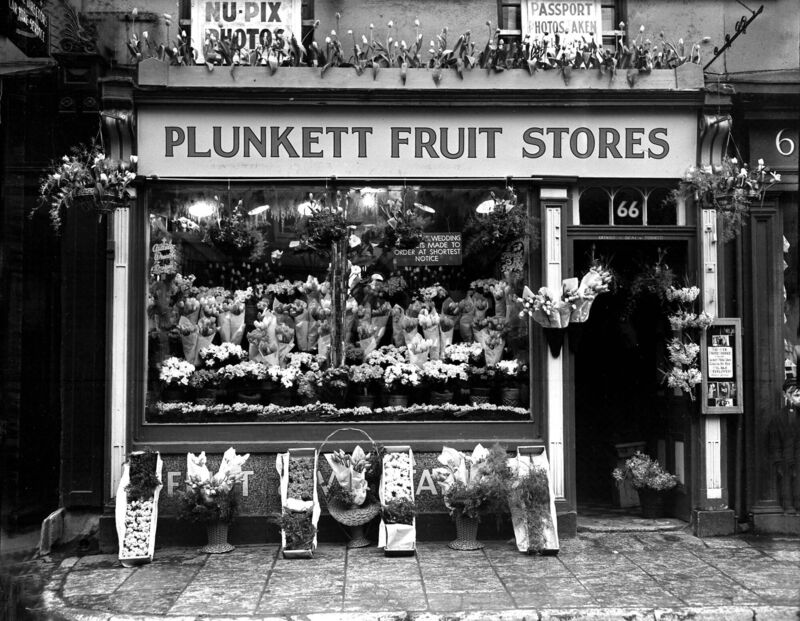
Plunkett Fruit Stores on the road in 1953. 

“Can anyone recall all the other ones that I’ve forgotten? It would save me racking my brain, such as it is.”
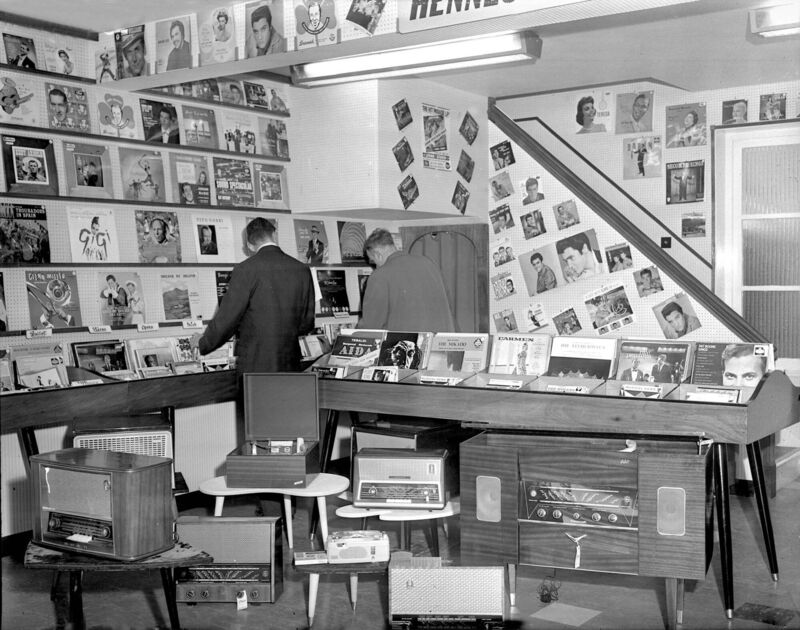
Gosh, Ollie Plunk (as it is sometimes called to save time!). What a wonderfully long, narrow street, with so many side streets opening off it, reaching right from Parnell Place through to the Grand Parade.

Every kind of shop you could imagine, all sorts of services and repairs, specialist outlets, plus of course an entrance to the legendary English Market itself, and not forgetting the Winthrop Arcade, a place of fascination all by itself.

Over the decades, and indeed the centuries, those businesses have come and gone, although there just might be a few remaining from at least the early 20th century?

It was, in fact, the very first street built east of the Grand Parade, in an area then known as the East Marsh or Dunscombe Marsh. Well older than Patrick Street, we will have you know, where the Lee still flowed majestically.

Originally christened George’s Street after the then King of Great Britain, large parts of the thoroughfare were destroyed by British troops during the Burning of Cork.

Once the Irish Free State was established in 1922, it was renamed Oliver Plunkett Street after the 17th century martyr. You can still see references to ‘late George’s Street’ in some business directories as late as 1945.

So, what were the shops and businesses filling the buildings along the length of Oliver Plunkett Street back in earlier centuries? We took a look at Guy’s Directory for 1875/76 to start with (you can find it online at https://archive.org/details/francisguyscount00guycuoft/page/viii/mode/2up?ref=ol, but remember that back then it was still called George’s Street.)

Rutter & Co (no further identification of their role in everyday life); Wm Murphy, vintner; a Total Abstinence Club (possibly next door?); then, in quick succession, a plumber, a land agent, a rate collector, three more vintners, Robert Coghlan, professor of music, a potato dealer, Wm Bell, clothier, Miss Wheeler, tobacconist, Mrs O’Driscoll, dressmaker, J Henley jeweller and watchmaker.

“Further east, The Theatre Royal where the GPO now stands, several more vintners, a hairdresser, an engraver, a veterinary surgeon, yet more vintners, the Angel Hotel, O’Brien’s woollen drapery stores, an umbrella maker, bookseller, gun maker, bootmakers, more dressmakers, tailors, painters, the Munster Co-operative Supply Association. Morton’s Dining Rooms, a saddlers, Rafter’s Boarding House. Timothy Moynahan, professor of languages…

Interior of Hennessey's Record Shop, Oliver Plunkett Street in 1960. 

No, that’s not the lot. Of course not! How could we fit them all in? Go look it up yourself and have a lovely evening poring over the streets of yesteryear.

And imagine your great-great-grandmother doing her shopping, possibly having her carriage stop at each required establishment, or more probably walking from one to the other, ordering this here, picking up that there, checking out the goods on offer over on the other pavement, avoiding a runaway cart or picking up her skirts to navigate a rather dirty crossing (oh, these horses…). All the time knowing that she could get every single thing or service she wanted in this one great street, Cork’s first shopping mall.

Of course, there is one feature of this commercial treasure house which we are never likely to forget. As Cork’s lowest-lying street, barely four metres above sea level, it is, not to put too fine a point on it, rather inclined to flooding when high tides and high winds combine to encourage the Lee to enthusiastically burst its banks.

Over the centuries, it has been a regular seasonal feature, on which the moon, governor of the tides since time began, looks down detachedly, ignoring our ensuing problems.

My own father, Joey Kerrigan, used to seize these natural disasters as an opportunity to have fun and even perhaps do some good.

Out would come the family canoe (The Irish Aspidistra, we called it), and down he would head to paddle the flood waters and rescue anyone who needed ferrying home.

He often told us of taking some elderly lady or other right to and through her front door (she supplying the key at the right moment) and dropping her at the foot of her stairs so she could at least mount to drier conditions and change her shoes. He loved doing this, and the old photo here shows him carrying out such a rescue.

My brother Tom has happy memories of those regular floods too.

“In 1962, I went down with Micky Lee, a friend of mine who lived on Beale’s Hill, off the Lower Road. He was the son of Billy Lee who was in the Munster Motorcycle & Car Club.

“We took the canoe down Summerhill on our heads, slipped it into the water by Patrick Street, and went boating up and down all the streets,” recalled Tom.

“I remember going through the Winthrop Arcade which was fascinating. Boxes of biscuits were floating on the water. We didn’t try eating them – you wouldn’t after the type of floodwater that was there by then – but I remember skimming them over the surface of the inland lake.

“And when we went down the Grand Parade, the big plate glass window of Fitzgerald’s burst inwards just as we passed, with the weight of the water. I remember a garda taking up position there to stop looting!”

Let’s hear your memories of Oliver Plunkett Street shops and pubs. And of those perennial Cork floods too of course!
Email jokerrigan1@gmail.com, or leave a message on our Facebook page: www.facebook.com/echolivecork.

More in this section

Throwback Thursday: I snuck out to see the Dixies...but the car crashed on the way home  Throwback Thursday: I snuck out to see the Dixies...but the car crashed on the way home 
Throwback Thursday: Emigrant’s ordeal as he left Cork for London Throwback Thursday: Emigrant’s ordeal as he left Cork for London
Throwback Thursday: The rise and fall of a North Cork dance hall Throwback Thursday: The rise and fall of a North Cork dance hall

Sponsored Content

Aisling Walsh, customer and strategy manager at ESB Networks More than 50,000 households are being rewarded for flexible electricity use
The office worker presents a document to the client across the desk. Pensions become part of the talent equation
CS ESB Networks Oct 2026 Got a smart meter? Time to unlock its value with an ESB Networks online account
Contact Us Cookie Policy Privacy Policy Terms and Conditions

© Examiner Echo Group Limited

Add Echolive.ie to your home screen - easy access to Cork news, views, sport and more