Christmas in July: Looking back at the origins of the Holly Bough
CONOR MACHALE, Senior Library Assistant at Cork City Libraries, looks back at the earliest editions of the Holly Bough and asks why it is so difficult to find copies of the Christmas number from 1897 through to the early 1930s.
Christmas in July: Looking back at the origins of the Holly Bough

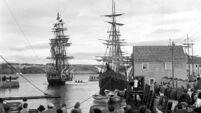
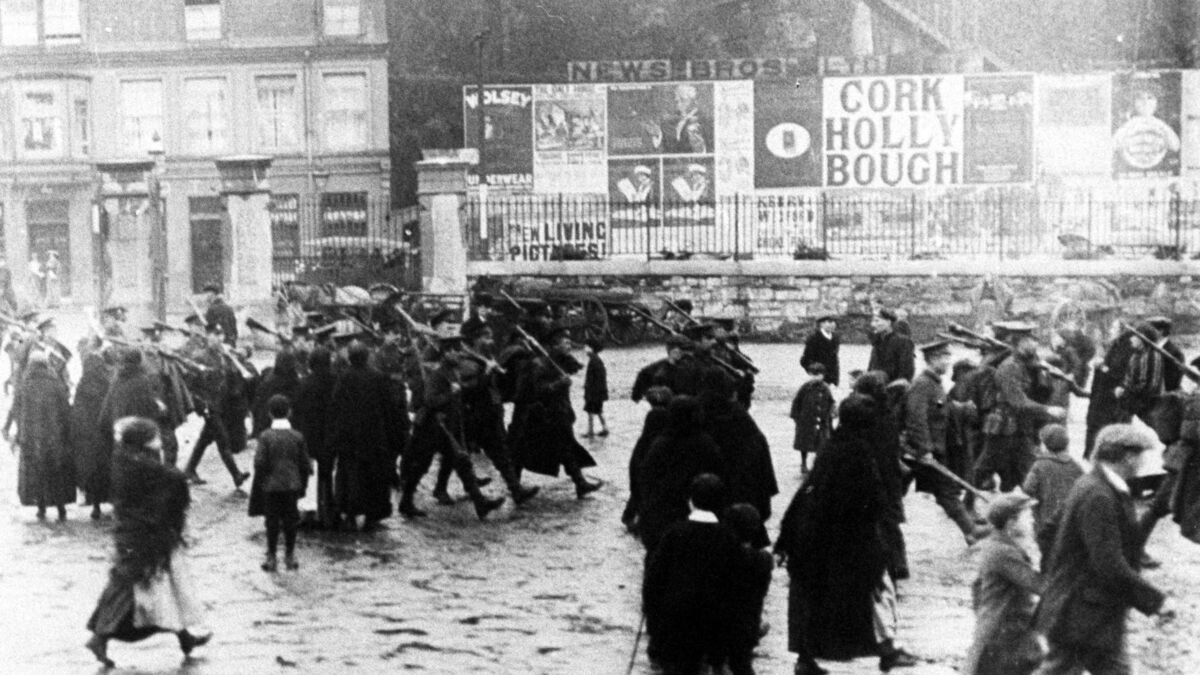
A poster advertising sales of the Holly Bough is seen in the background of this picture taken during World War I. 

In 2022, the former editor of the Holly Bough, John Dolan, wrote a fascinating article about the history of the publication.
Up until then, it was not certain as to what year the first issue was published. A poster advertising the Cork Holly Bough can be seen in the background of a photo depicting the Munster Fusiliers marching toward the train station on the Lower Glanmire Road in 1915, and it was thought to have originated during the 1910s.

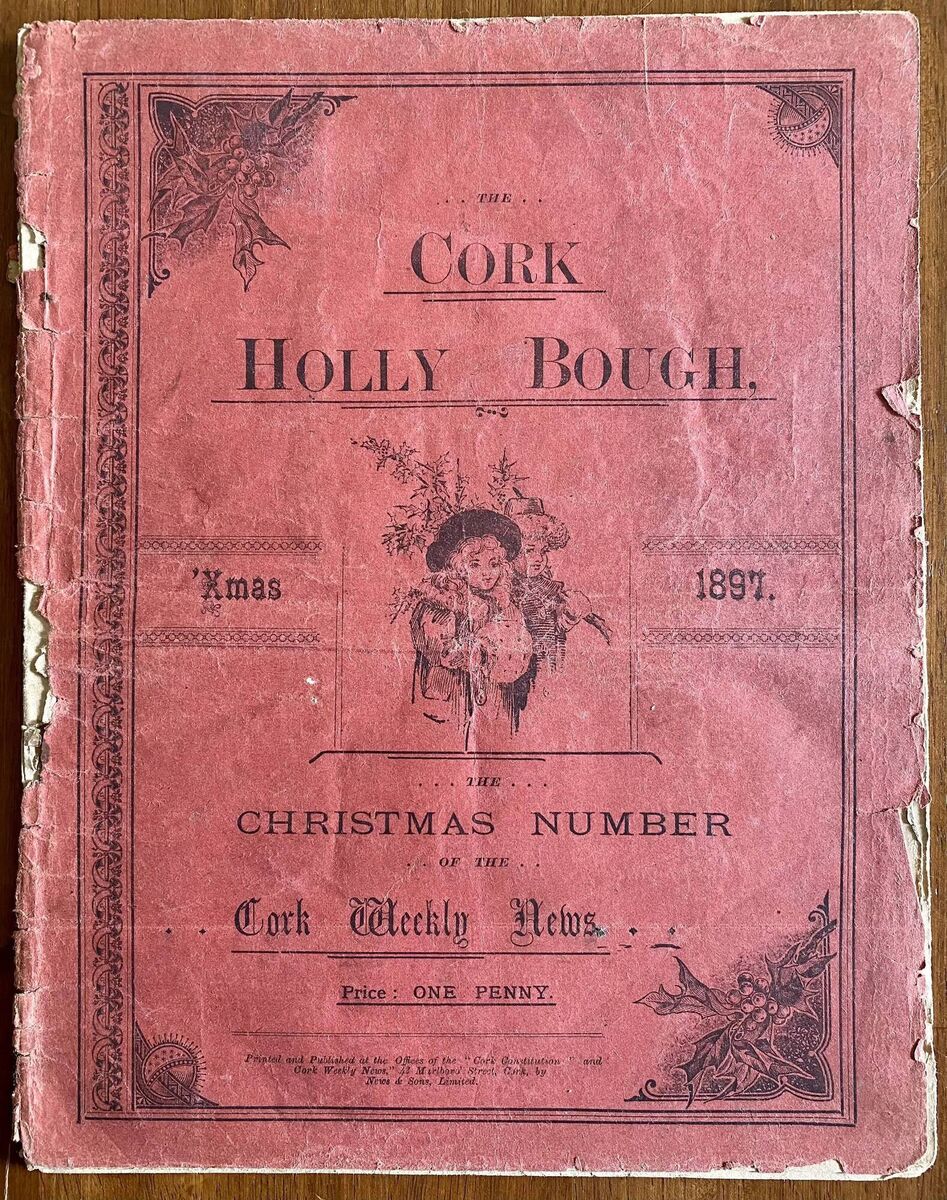
One might have thought this was evidence of when the first issue was published, but this theory was dispelled when a facsimile of the very first issue from 1897 was sent to John all the way from Ottawa by the family of Hugh Connolly, who had moved there from Quaker Road in 1970.

Hugh had a copy of the very first Holly Bough, which had belonged to his grandfather.

John had also put the call out to readers that may be in possession of older copies, so let me take this opportunity here to remind you all to check your attics, garages, sheds and cubbyholes for old Holly Boughs from 1897 to the early 1930s!

The front page from the first ever Holly Bough, in 1897

How did the Cork Holly Bough Christmas number come to be? When did such publications become popular?
An online article on the Library of America website discusses how the origins of the ‘Christmas number’ publication can be roughly dated back to the success of Charles Dicken’s A Christmas Carol in 1843.

Dicken’s himself edited or ‘conducted’ a weekly magazine called Household Words from 1850, and taking inspiration from the popular new Christmas supplement of the Illustrated London Times in 1848, a Christmas edition of Household Words of festive stories and lore was published. This proved so popular that an annual edition was published for the Christmas season.

Many publications on both sides of the Atlantic had Christmas numbers. However, the most to be found in Cork newspapers of this period would have been the occasional festive short story or poem.

The Cork Examiner began producing a Christmas supplement up to four pages of stories and poems from 1867.

In 1877 and 1879, respectively, august institutions such as the Methodist Annual on Commercial, Shipping & General Advertiser for West Cornwall and the Christian Herald both had Christmas numbers called The Holly Bough.

Taking inspiration from the success of these publications and the current Victorian ideals of Christmas as a festive season with gift giving, charity and goodwill to all, the Cork Constitution and her sister paper the Cork Weekly News declared their own version of the Christmas number to be called “ The Cork Holly Bough” and it was to be ‘published on December 14 [1897], in a handsome red cover’.

“In our Christmas Number of this year we hope to produce a distinct advance on anything of the sort which has hitherto appeared in the South of Ireland… and as it is to contain a tremendous amount of literary matter, as well as the results of our novel cake-making Competition, it is expected that there will be a great run on the first issue,” it read.

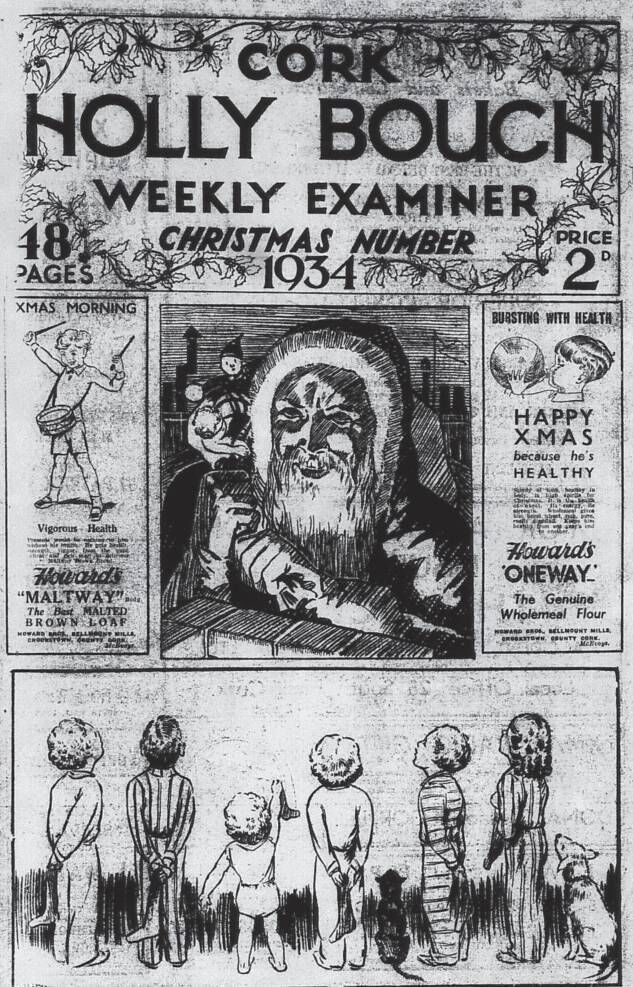
The front cover of the 1934 Holly Bough.

We can get an insight into the content of these initial first years of Cork’s new Christmas magazine in the archives of the Cork Constitution and Cork Weekly News newspapers. 
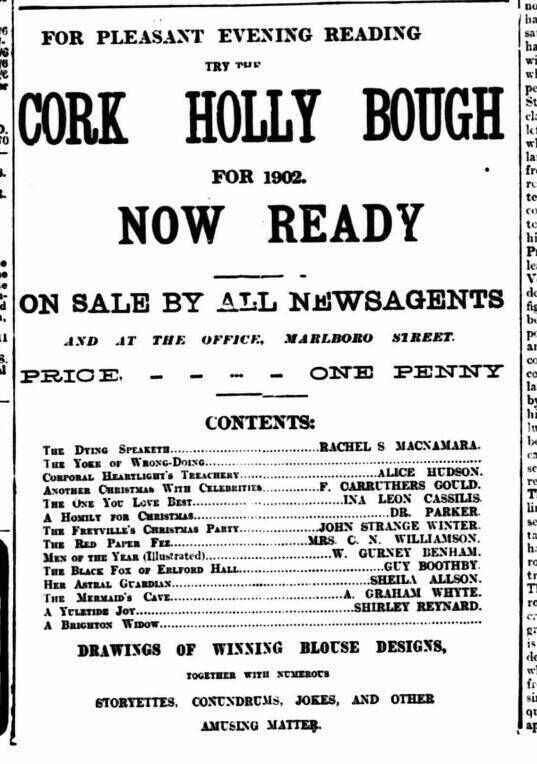
Although there are no digitised versions of the Holly Bough for these early years, there are advertisements and notices that give a good idea of the contents and format.

Interestingly, there are a couple of Dickens connections in the very first issue.

Firstly, his eldest granddaughter Mary Angela Dickens was a contributor to the first issue. Although a popular writer and journalist in the late Victorian and early Edwardian era, she is now not as well remembered, as are many writers of the day who wrote stories and articles published in these early years.

Another perhaps tenuous connection with Charles Dickens is with a story entitled ‘A wedding tragedy of old Cork’ by Fennella, who is described as ‘a Cork lady, well known in literary circles, who has undertaken to record under a thin veil of fiction incidents and events of a startling and tragic character which happened but a few miles out of the city some years ago.’

In Con Foley’s A history of Douglas there are a couple of versions of the tragic wedding story. During his reading visit to Cork in 1858, Charles Dickens may have heard the tragic story of Montfieldstown House in Rochestown, of the bride who killed herself with a pin or even the wedding cake knife over a spurned lover. Startled wedding guests fled the scene, leaving the feast untouched for many years. Pádraig Ó Clára states in a 1976 Holly Bough article that the daughter of the Colbert-Kearney’s who owned Montfieldstown House, was forced into a marriage after her fiancé was lost during the Battle of Trafalgar. She was found dead on the morning of her wedding from a broken heart. Another version places the tragedy at Mansfield House, again in Rochestown, where the bride, forced into a loveless marriage, escaped and met her true love. In the consternation, the wedding feast was left untouched for 80 years. It is claimed that the basis of this story was the inspiration for Miss Havisham in Great Expectations. However far-fetched, it suggests director John Ford’s famous axiom ‘when the legend becomes fact, print the legend’.

With a mixture of stories and competitions, the inaugural publication proved so popular that in 1898 a follow up was promised. The publishers, “encouraged by the phenomenal success of last year, [and] they are sparing no effort or expense to make this year’s issue even a greater success.”

The basic formula of the new magazine was not far off from what is produced today, with a mix of stories, articles, puzzles and competitions.

In these early years were stories leaning heavily toward detective, mystery and romance, being the popular fiction of the time. Titles such as Mystery at Marsden Manor; The Evil Eye; Dead Woman’s Hill can be contrasted with lighter fare such as The Gamekeeper’s Girl; The Ordeal of the Duchess and closer to home One Man’s Dilemma: a Romance of Cork Harbour.

Popular writers of the day contributed stories and articles during the turn of the century. Stories from diverse names like Mark Twain and contemporary short story writer Bret Harte; nationalist politician Justin McCarthy were read during the early years.

There are writers that have now faded from memory like George Manville Fenn, Guy Boothby, Beatrice Heron-Maxwell and J.B Harris-Burland and contributors such as political illustrator Francis Carruthers Gould and author of magic books Professor Hoffmann.

Competitions proved an immediate success for the fledgling publication. Readers could send in their own stories to be judged with “the task of awarding the prizes a most unenviable one so uniformly well written were the stories sent in” (1898).

The cake competition was a mainstay of these initial years, “owing to the enormous interest displayed and at the earnest solicitation of a large number of subscribers we have decided to repeat the competition” (1898). All cakes submitted were to become property of the editor and to be distributed to the City’s Hospitals.

Prizes were two guineas and one guinea for the best and next best ‘short story of a local character’. For best sultana and best plain cake first and second prize was ladies’ umbrellas, third prize a pair of best suede gloves and forth, fifth and sixth prizes were subscriptions to the Cork Weekly News. (1899) The popularity of the cake competition remained so into the 1940s.

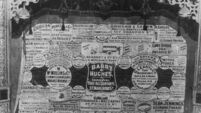
A 1902 ad for the Holly Bough. 

There were also competitions for Doll Dressing (1897); Blouse design with the promise that “the lady whose design gains the prize will have the blouse made for her in the best manner possible by a leading Cork Drapery House” (1901) and poems and photograph competitions (1908). During the First World War there was a call for Socks for Soldiers with “a prize of one guinea for the best set of 3 pairs of socks, suitable for a soldier on active service” (1919).
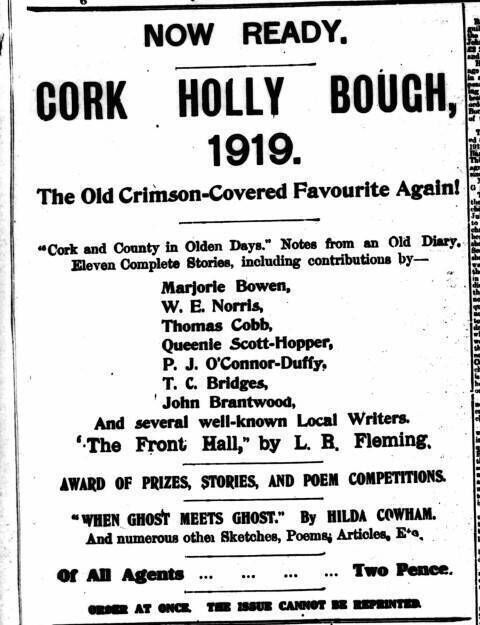
Socks for Soldiers:  During the First World War there was a call for Socks for Soldiers with “a prize of one guinea for the best set of 3 pairs of socks, suitable for a soldier on active service” 

It is interesting to note the popularity of the Christmas number was such that in 1911 and 1912 there were notices that the Cork Holly Bough was out of print and completely sold out and a plea to newsagents around the country to send back any unsold copies for credit.
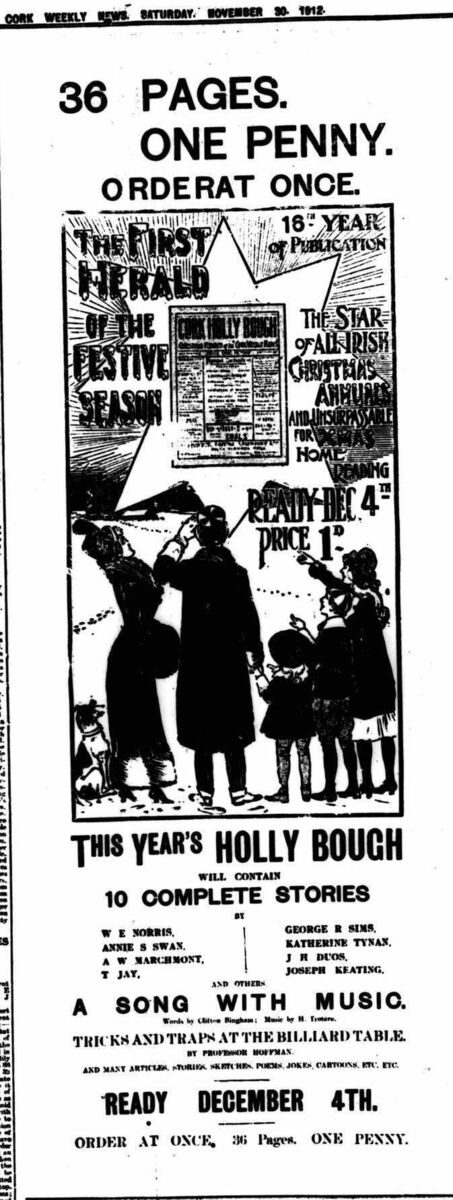
An ad for the Holly Bough in 1912. 

But why now are there no copies to be found from this time?
Local historian Michael Lenihan has some theories as to why. There was a shortage of paper during the First World War, with urgent requests for old newspapers, magazines etc to be sent to Irish Paper Mills for the maximum price.

Also, once the Christmas period was over, people tended to dispose of newspapers and annuals to avoid clutter in the home.

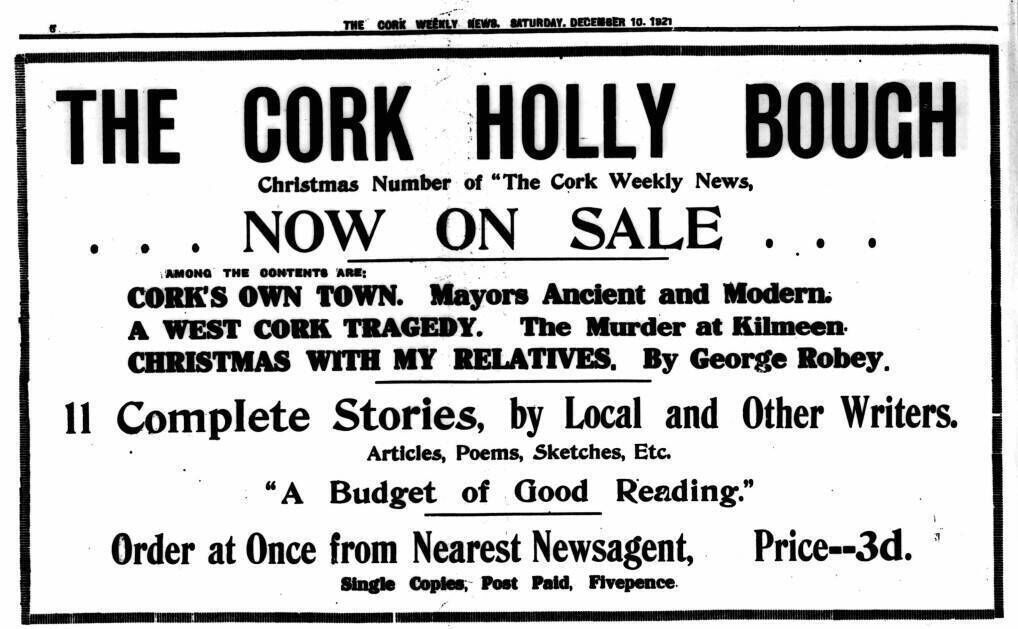
A 1921 ad for the Holly Bough 

There was a rival Christmas number published by the Cork Weekly Examiner, and as the Holly Bough was aimed at the readership of the Cork Constitution, which folded in 1924 shortly after the establishment of the Irish Free State and a growth in Irish Nationalism, were old copies of the Holly Bough thrown out due to a sense of national fervour?


Whatever the reasons for the dearth of physical copies of the Holly Bough from these early years, it is highlighted with positivity in Alan McCarthy’s book Newspapers and journalism in Cork, 1910-23 that ‘a part of the Constitution lives on the in Examiner, the annual [ Cork Weekly Examiner and Weekly Herald Christmas Number] of that paper having been rechristened the Holly Bough in 1933.

It remains a symbol of the Christmas season to successive generations of Corkonians.’

This article appeared in the 2025 Holly Bough. 

more Holly Bough articles

Mary MacSwiney Mary MacSwiney: ‘A life motivated as much by love as her political ideals’
100 years on from tragic inferno at Dromcollogher cinema  100 years on from tragic inferno at Dromcollogher cinema 
Cork's National Monument...and the friendship that helped to  build it Cork's National Monument...and the friendship that helped to  build it

More in this section

Mary MacSwiney Mary MacSwiney: ‘A life motivated as much by love as her political ideals’
Throwback Thursday: Memory of dad's coffin being hoisted from Innisfallen etched in my mind  Throwback Thursday: Memory of dad's coffin being hoisted from Innisfallen etched in my mind 
100 years on from tragic inferno at Dromcollogher cinema  100 years on from tragic inferno at Dromcollogher cinema 

Sponsored Content

Solar panels on residential roof in closeup shot. From powering the country to empowering its people
Say cheese, think Kerrygold: A new range of cheeses guaranteed to put a smile on your face Say cheese, think Kerrygold: A new range of cheeses guaranteed to put a smile on your face
Young woman managing finances at home with phone and piggy bank Government Personal Investment Account must target mainstream savers
Contact Us Cookie Policy Privacy Policy Terms and Conditions

© Examiner Echo Group Limited

Add Echolive.ie to your home screen - easy access to Cork news, views, sport and more