Throwback Thursday: Memory of dad's coffin being hoisted from Innisfallen etched in my mind
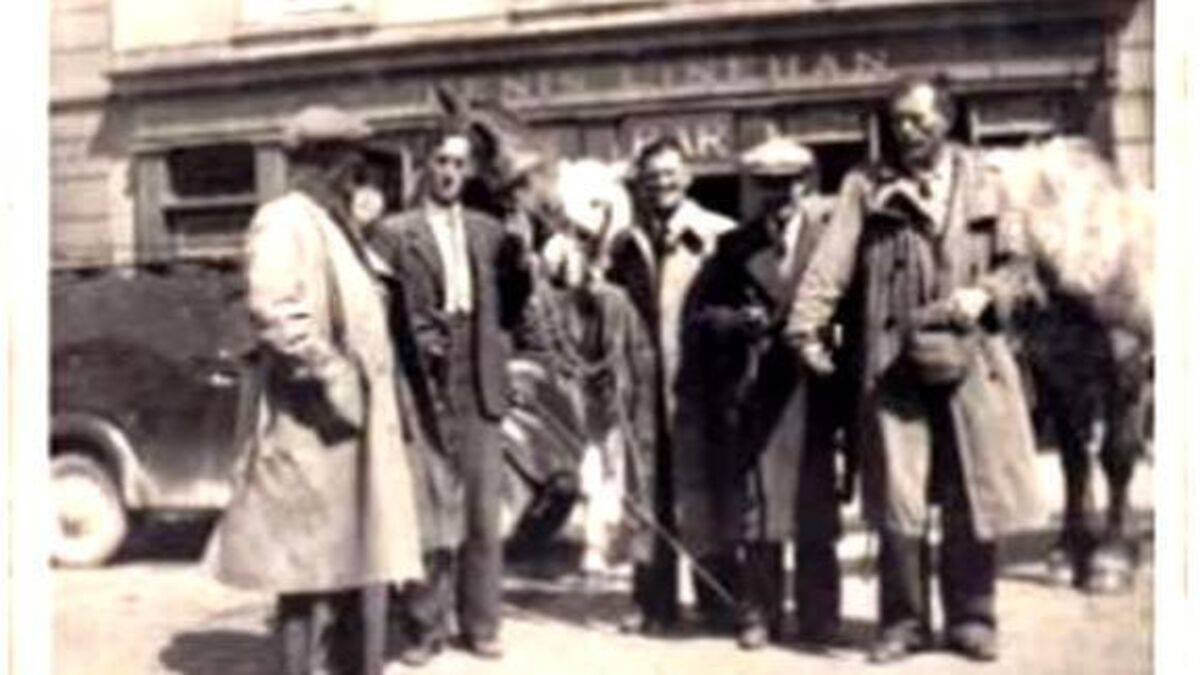
Patsy Hunter's father James holding a horse at Cahirmee Horse Fair in Buttevant. He died aged 40 while working in London on New Year's Eve, 1955, and Patsy recalls as a boy seeing his coffin arriving at Cork Docks
Some of the most enduring stories we receive on Throwback Thursday are from older readers recalling the scenes of their youth.
Back 60 or 70 years ago, Cork was a very different place. Fewer luxuries, certainly, but so much more in the way of friendliness, neighbourliness, making do, helping out, and sharing a sense of community.
We were, therefore, truly delighted to get the gift of memories from Patrick (Patsy) Hunter of Doneraile, charmingly entitled ‘A Trail of Breadcrumbs’.
What had started out for Patsy as a record for grandchildren of his own younger days turned into a wonderful book. Reading through it is to slip back into those times, when the summer days were always long and sunny, you walked the roads and knew everyone you met, and you worked on the farm or the land as well as going to school, as a matter of course.
Now in his eighties, Patsy found recalling and writing down his own past both sad and happy.
“What journey got me safely to this venerable old age? Well, like most people I might have gone down a few different roads,” begins Patsy.
“I could probably have been a baker, but my brother Jimmy beat me to the job of delivering fresh bread around the town for Lysaght’s Bakery. He eventually became the baker in our family.
“I could have been a wealthy shopkeeper. While I was in secondary school I was offered a job in a local grocery shop which, in fairness, was ahead of its time in the manner in which it was laid out, a forerunner to the supermarkets where we are now used to shopping. My mother and I decided that I would take the job.
“I left school without informing the principal, Brother Murray, and spent a few days at home waiting to begin my working life, until there was a knock on our door. One of my classmates was sent to deliver a message from the principal. I was too young to leave school, according to him, and I was asked to come back. Back I went, with never a word mentioned about the incident, and I finished secondary school. One kind and concerned person can change your life.”
Patsy continues: “I would have loved to have been a carpenter. During the long school holidays, I worked for several local contractors. I even worked for two local undertakers, at different times obviously. That would have looked strange on my CV!
“After leaving school in 1962, I was lucky to get a clerical post with Irish Sugar in Mallow. Semi-State, permanent and pensionable. I spent more than 40 years there. Believe it or not, my mother applied for the job without telling me. She even enlisted one of my cousins, a girl, to write the application letter. I found it many years later in a dusty old lever arch file.”
Patsy has very fond memories of his mother, Margaret.
“She was just one of many great mothers of her time, but to all of us she was and remains unique.
“She had two cows. At different times she also had hens, bantams, geese, twin calves, and pigs. The goslings were lovely, like little windblown balls of yellow fluff as they followed their mother to water.
“Sometimes, the cows ‘grazed the long acre’ i.e. along the roadside. My uncle had fields nearby and sometimes they fed there. In any case, they had to be brought in at night time to be hand-milked by my mother, almost a lost art now.”
What of Patsy’s other parent?
“My father, James Hunter, inherited an old house and a contract with Cork Watercourse Distillery, from his grand-uncle, to supply a quantity of rushes, reeds if you will, each summer. These were used by the in-house coopers in the making of timber casks.
“The dried rushes were used to seal the casks, keeping the precious whiskey safe and maturing inside.
“My father had two areas where he harvested the rushes. The one that I remember was just below the now disused Buttevant Railway Station, at that point where the Awbeg River meanders gently towards Doneraile, passing through Doneraile Court estate on its way, eventually joining and losing its identity to the Blackwater River.”
Patsy remembers: “My brothers and I were just youngsters then but we had no fear of wading into the river and carefully harvesting the tall green rushes which were swollen with water. Sunburn was ignored and sun cream was unheard of. We did suffer from the exposure later but it was worth it, we felt like grown-ups at being asked to help, manly even.
“The memory, which will stay with me forever is of our lunch break. We sat in the sun, facing the Cork to Dublin railway line. My father would have got a little fire going and with water from the river he made our tea in a billycan. It seems to me that he had a trick of floating a little twig in the billycan: maybe this was to help gather any foreign bodies.
“The tea, with my mother’s currant cake and blackcurrant jam, licking our fingers, tasted sweeter than honey, wonderful. I salivate even now at the thought of it.
“The chosen site for our picnic was close to the old steam trains as they crossed the Awbeg River, leaving a glorious trail of noise, smoke, and steam behind them. They never went by without a friendly wave from the driver and a shrill blast on the train whistle.
“When I pass there now, I look down at that very spot on the riverbank, remembering times past and looking away with a lump in my throat.”
Patsy resumes his memory.
“When our work was done, the rushes were loaded onto our horse and cart and brought home. We had a large haggard beside the house and there for weeks, in the summer sun, the rushes were spread to dry completely, turning from a fat lustrous green to a slim golden yellow.
Local children, cousins included, were paid to tend the drying rushes. The work was easy but labour-intensive. If the weather suited, the rushes had to be spread out, in singles, over every available space, out in the morning and gathered in again in the evening, always with a weather eye out for rain. Those long, hot days were a blessing.
“When the rushes were as dry as pepper, they were tied into little bundles, 35 in each, if memory serves me right.
“We were 30 miles from Cork but in the very early morning my father took his precious load in a horse and cart to Cork. Unthinkable now.
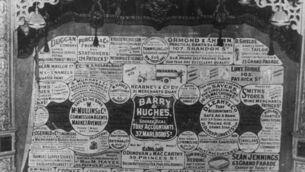
“He never came home from Cork without bringing pictures of some sort from the old Coal Quay Market. Included in the miscellany, amongst other treasures, was a large picture of Daniel O’Connell: he may have had a smile on his face when he delivered that one, as my grandfather’s name was Daniel O’Connell.
“I remember companion pictures of ‘Bringing Water’ and ‘Milkmaids’ and one of the Duke of Wellington and the Prussian army Field Marshall Blucher meeting at Waterloo. My father also brought several over-mantle mirrors.
“Now, as I reminisce, I’m sitting beneath one of the surviving over-mantles, it is a repository of family photographs including my father’s. It literally is a mirror to the past.”
Patsy moves on to a sad memory among his reminiscing.
“That union of family and nature was never again to enfold us so completely. On December 31, 1955, my father, aged 40, died in London. Like many Irish people of the time, he had gone there several years earlier seeking work. He had been in London for five years and we only saw him each year for the two weeks of his summer holidays.
“My mother accompanied him home to be buried in Doneraile where he rests in peace.
“The memory of his coffin being hoisted from the hold of the Innisfallen at Cork Docks on a cold January morning in 1956 is etched on my mind forever.
“My sister Catherine and I often speak of it, John, who was only four, has no memory of it. Someone on the quayside, possibly a docker, asked me who that was. ‘That’s our father,’ I said.”
Patsy found something that day that has remained with him for more than 70 years.
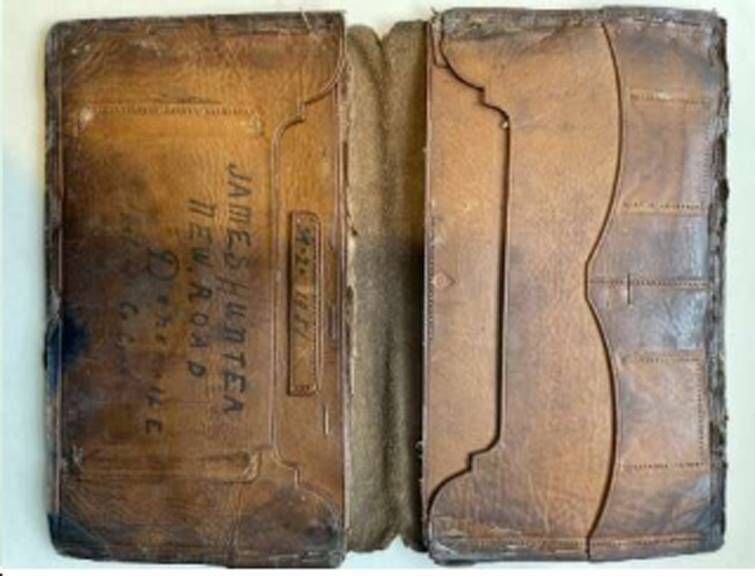
“In my father’s battered old wallet, folded and creased, was an undated letter which I had written to him in my earliest handwriting. How I wish now that I had dated it. The eldest of his five children, I was chosen by my mother to write to him. She composed the letter for me. Imagine my father’s surprise, pride, and enjoyment when my letter arrived, unexpected, at his lodgings in Kilburn, North London.
“I would like to think that it was re-read many times by him and that it reminded him of home and family.
“Nearly 70 years on I still have that wallet with his name, in his own handwriting, on it. It reads, ‘James Hunter, New Road, Doneraile, Co. Cork, Ireland – 29/2/1951’. Inside the wallet my letter is where it’s been for all these years since he put it there, dated now by time and my memories.”
Patsy moves back in time a few years.
“March 1951. The old church was silent and dimly lit, there was a lingering scent of incense and long spent candles. Above my head were ancient rafters which were witness to many generations of prayers, petitions and exhortations, on their journey to the heavens, to an unseen and all-seeing God.
“High up in the gallery, seven years old and alone, below me an archaic ceremony was taking place: my mother was being ‘churched’.
“To this day, I can still see her kneeling at the extreme left-hand side of a long marble altar rail, a lighted candle in her hand, while the priest sprinkled holy water and prayed over her.
“I didn’t know the significance then of what was happening, all I do know is that even at that age I was instinctively disturbed by what I was seeing. Had my mother done something wrong?
“This was the last ‘churching’ of my mother. She had given birth to six children, two girls and four boys.
“Churching refers to a blessing that mothers were given after childbirth and before they could be allowed to fully participate in the celebration of the Mass.
“After remaining at home for 4-6 weeks, the mother would go to the church, thank God for the birth of her baby, and receive a blessing from the priest. Only married women could be ‘churched’.
“Remaining at home for that length of time probably meant that she couldn’t attend the baptism of her child. Ostensibly, this time lapse was to give mothers time to recover after giving birth. Was this the real reason for mothers being ostracised or were discriminatory man-made laws, ignorance, and long-outdated beliefs, and superstitions at play? Yes, it seems that they were.
“‘Churching’ is derived from a Jewish purification rite, where the ‘sin’ of childbirth was washed away. It was believed that pregnancy and childbirth made a woman unholy or unclean and that this purification rite, or ‘churching’, allowed the ‘unclean’ woman to re-enter the Church in a state of grace.
“Curiously, there wasn’t a similar cleansing of men.
“The rite of ‘churching’ was dropped by the Catholic Church after the Second Vatican Council of 1962-65. Maybe the old ways were finally about to change. Was an age of enlightenment dawning? Maybe!”
Your memories are wonderful, Patsy, and thank-you so much for sharing them. Let the rest of you get going and do likewise now, while you still can remember!
Email jokerrigan1@gmail.com or leave a comment on our Facebook page: www.facebook.com/echolivecork.