Throwback Thursday: My solo flight to the UK, at the age of six
This week on Throwback Thursday, JO KERRIGAN hears memories of a boy’s flight to England in 1963, plus recalling the food on trains in bygone days
Throwback Thursday: My solo flight to the UK, at the age of six

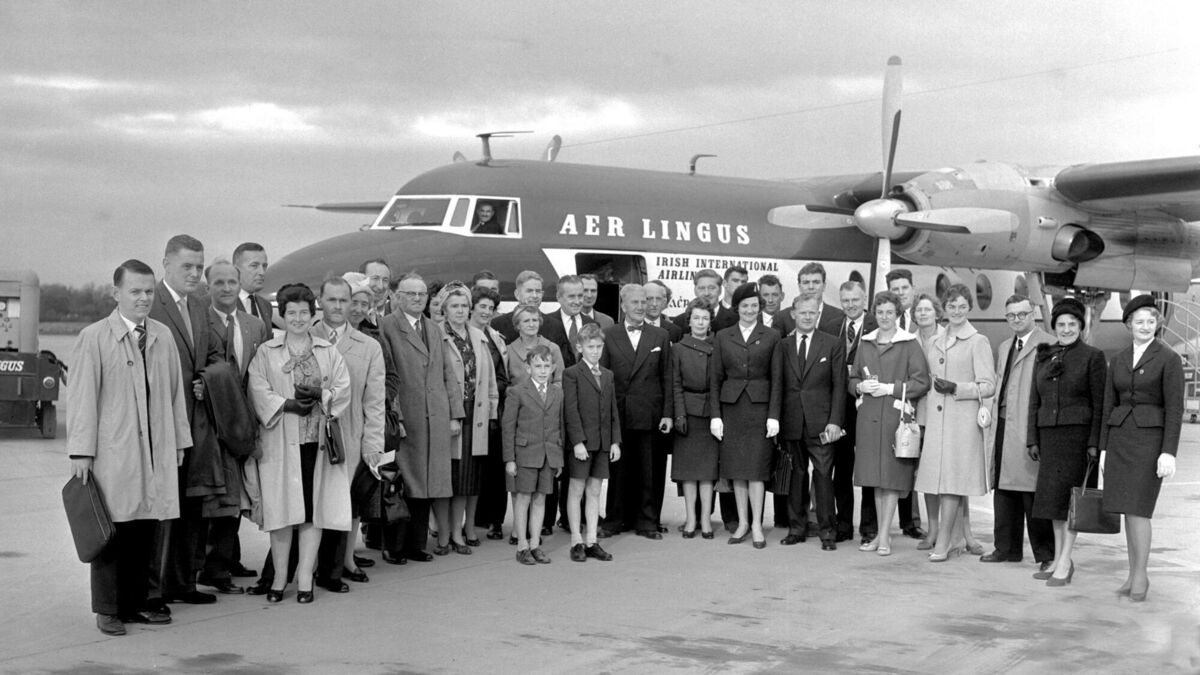
Passengers prepare for a flight to Dublin on the opening day of Cork Airport in 1961, two years before David O’Sullivan ‘s flight as a young boy

We have had a few tales on Throwback Thursday about first journeys out of Ireland. A teenage Jean McClement heading off to Germany, for example, and Brian Cronin tasting the delights of Scout camping in Scotland.
Now Corkonian David O’Sullivan has sent us his recollections of his very first journey to England, at a really tender age.

“My first trip abroad was in July, 1963, I had just received my first Holy Communion,” said David.

“I was gone from St Catherine’s, and on my way to Josie’s (St Joseph’s). St Catherine’s became an all girls school after first class which had both boys and girls. But I did get the all-important First Communion pay-out, so I had money!

“The norm at that time was a half-crown or so, from each uncle, and if you were lucky a 10 bob note from the grandparents.

“I only had my father’s parents then, as both of my mother’s parents had died. But you ended with a few quid in your pocket. Not like now, where it is likely to be hundreds of euros. And of course there was no big party, or anything like that.”

However, David continues: “But I did get a trip to Bristol, to my auntie over there, as my mother just had twins and, for some strange reason, felt it would be better to have her six-year-old busy boy out of the way for a while!

“Tess Ronan, a great friend of my mother, who was a ground hostess with Aer Lingus, ie, she did not fly, guided me through the airport as I went on my own.

“Tess was on your recent article on Cork Airport, which reminded me of this.”

David recalls: “The day I was leaving, I got a big bag of sweets and gobstoppers, to keep me quiet I suppose.

“I was put in the back of the plane (so the hostesses could keep me in sight and under control) and I can remember politely offering the gobstoppers to them. They laughed at my generosity but said no. Can you imagine a hostess with a gobstopper?

“We flew on a Vickers Viscount, which took about an hour to get to Bristol as I recall. I suppose I must have been met at the airport, but I don’t remember.

“My aunt in Bristol had two children a little older than me, and two younger. I remember they had a room in their house with no windows that acted as a play room. It was in fact their bomb shelter from the war, only 18 years before! That excited me.

“My Aunt, Finola, who still lives in Bristol, took all of us to the Farnborough air show. Now here is the real reason I was sent to England at a time when my mother had more than enough to do with twin new babies.

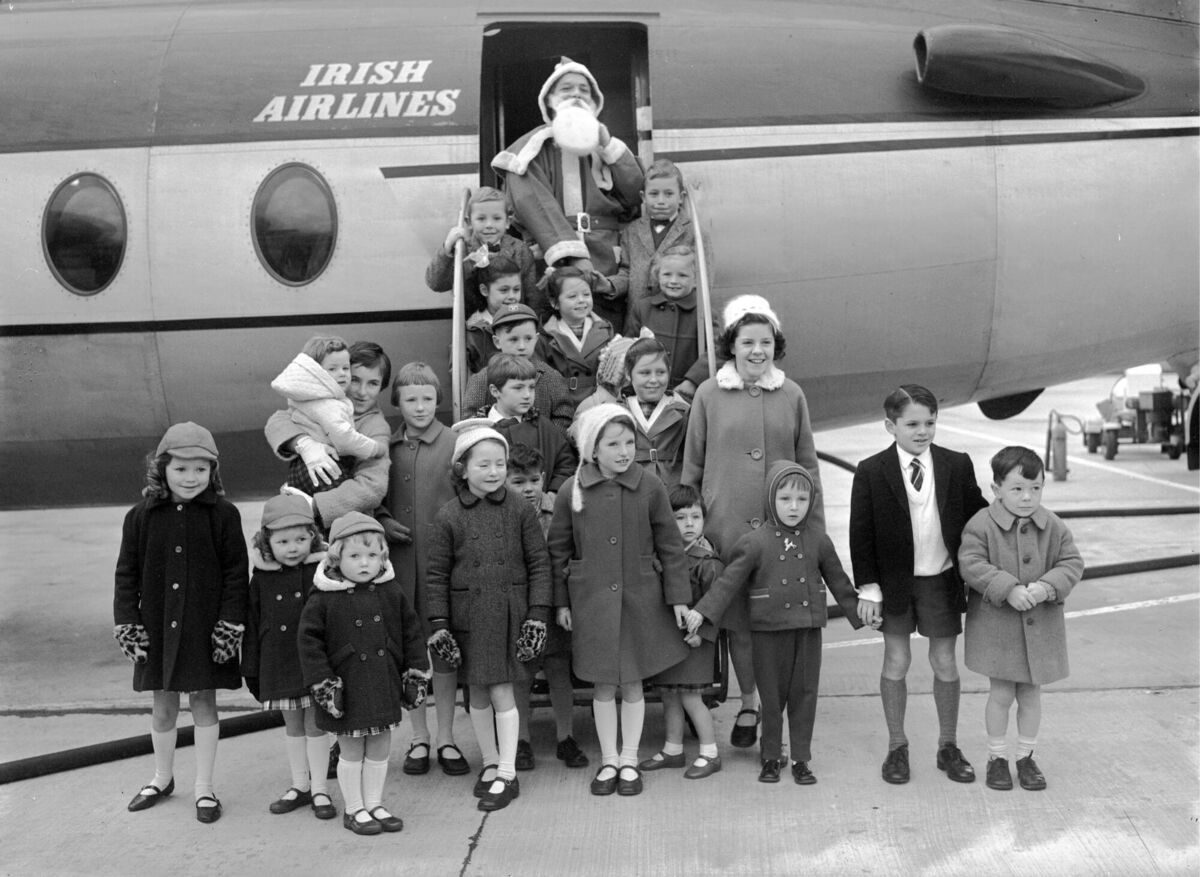
Santa meeting children at Cork Airport in December, 1963, the year when David O’Sullivan flew alone to Bristol to stay with an aunt

“Following my usual Corkonian habit of escaping and heading out to explore the big wide wonderful world, I wandered off happily by myself, looking at these wonderful planes. Even at that age I remember I was in total amazement at all the different types, etc.

“I was quite happy, but my aunt was somewhat less so! I was ‘lost’ for about 30 minutes, and caused a call to be put out over the public address system to the effect that they were ‘looking for a little six-year old Irish boy’.”

David adds: “I was totally oblivious to the excitement as I was immersed in these great planes (as I still am today, 63 years later!) I never knew I was missing until a policeman saw me, and returned me to security and my aunt.

“She must have realised that she needed a restraint system on me, as about two hours later I did the same escape trick, but only managed it for a few minutes.

“That ended our Farnborough trip, however, and we headed home. She needed a drink, I suspect…

I flew back to Cork about four days later, a new boy after my world travels.”

David continues his recollections.

“I remember, of course, those were still the days when my mother could come out onto the apron. There were people out in a high viewing area too, waving to us as if we were Tom Crean going to the South Pole and not just hopping over to Bristol.

“I can also remember driving to Shannon to pick up American cousins, which was a big deal then.

“I suspect in the early 1960s the need to transit through Shannon was gradually ending and that great airport’s glory days were almost done.

“But it was a big deal to get on a plane then, while now it is like a trip into town on the number 8 (208) bus

“However, I still dress well getting on a plane. That habit hasn’t changed. And in any case, you have just a slightly better chance of getting upgraded I think (or hope!).”

Well, that was the most enormous fun to read, David, although we do feel some pity for your mother and indeed for your aunt who was doubtless wondering how she could explain to her sister that she had lost the precious little six-year-old!

“And well done for still observing the habit of dressing well on flights. It is something we should all do.

Micheál Kenefick in Whitegate is of much the same view.

“When we were in the thatched house in the Middle Road, my mother, and indeed all the mothers in the Middle Road, would ‘get ready’ to go down to the village which was only a hundred yards away,” he recalled.

“When Kathleen, our neighbour and my godmother, would call to us when we moved to the village in 1954, she would go down Ellie’s path, up the Wellway and down the boreen as we now lived at the foot of the boreen, to avoid the village.

“A bit of that rubbed off on me as I will not go to the city without ‘getting ready’ and trying to look a bit smartly dressed.”

Micheál added: “Similarly, when we are going on a plane, as we are almost always going somewhere nice, we should make a bit of an effort and avoid the comfort gear.

“Same on the train really. Let yourself be seen as you would wish to be seen.

“Oh, but what a delight it was in the ‘old days’ to go on the train. It was a lot more than getting from A to B as quickly as possible.

“The beautiful carriages opening off the corridor where we would walk up and down to find an empty one, or join the most suited to our age, where guests already ensconced. Endless hours of fun going to and from matches in particular.

“We always seemed to have the wherewithal to visit the magical dining car and I can still taste the mixed grill (as I can still taste the wonderful bread and jam sandwiches made at home and taken along when picking periwinkles).

“Of course, the tea and bread and butter came with the mixed grill, no short changing there.

“I clearly remember John and Ned, the waiters in the dining car, sadly both gone to their reward. In an amazing coincidence, Ned is our grandson’s other grandad!”

Micheál continued: “The wonder of all wonders where train journeys were concerned were the all-in match specials. Breakfast, lunch and tea (mixed grill again) delivered right to your table!”

Hang on, Micheál, do you mean you could buy a special return ticket for going ‘up to de match’ which included sustenance en route, going and coming?

“Yes the ticket for the train included the food, but these would always sell out quickly,” explained Micheál. “I think it may have been the whole train or at least certain carriages.

“Lots of people will remember, and some may still have the large candle shaped like a rugby ball which would be on each table on the return journey if it had been a rugby final.

“There was one between four, so we would have played 45 for it, to see who got to take it home. I only remember those for rugby internationals though.

“Finally, I’m not forgetting the bar where the craic would be ninety coming from a match, and often ninety-one when we used the train for work, as there would often be a politician or two holding court.”

Now then, we need to hear from other readers pretty smartly! Who was a long-time employee of CIE back in the day? Was it you, Jerry Holt? Do you recall all-in tickets for big matches, where meals were included in the price? Did any of you actually go on one of these major trips?

Gosh, these days you’re lucky if you even have a trolley coming round to your seat, and that’s not a given on many routes.

Oh, for the days of breakfasts on the train with all the delights of a Full Irish with as much tea as you could drink, and both toast and brown bread. Are dem days truly gone? And if so, why?

We were talking a couple of weeks back about the céilís and that experienced art of ‘calling the moves’, in which both Paddy O’Brien and Cyril McIntyre excelled. And that got us wondering about those well-loved Irish dances like The Walls of Limerick and The Siege of Ennis.

Where did they first evolve, and, more importantly, where did they get those stirring historic titles?

It’s easy enough to interpret the movements when you look at a whole crowd dancing The Siege of Ennis, like they do at the Céilí Mór on the Grand Parade on St Patrick’s Day.

Long lines of couples advance towards each other, retreat, advance again, swing each other round, and then duck underneath the opposing line to face the next one.

Just so must the opposing Irish and English forces have faced each other in battle during that legendary siege. Is it that every time these are danced, we are remembering and commemorating our battles for freedom?

Back in the early 19th century, when we were still under colonial rule, restrained English and Scottish country dances were very much the thing.

The aim from the top was to impose ‘refinement’ on vulgar native dances. High kicks, finger snapping, and arm waving, were discouraged (so that’s where our straight arm step dancing came from, is it?)

By the late 19th century, things were changing, with the foundation of the Gaelic League (Conradh na Gaeilge) in 1893.

Two of the League’s organisers, Fionan Mac Coluim and J.G. O’Keefe, were running Irish language classes in London, but got another idea from attending a lively Scots dance one night. The first ever ‘céilí’ - a term borrowed from the Scots - was held in the Bloomsbury Hall near the British Museum in 1897.

‘Professor’ Patrick Reidy, a resident of Hackney in London, who had been a dancing master in west Limerick and in his native Kerry in the late 1880s, soon got involved and taught the eight-hand reel, the High Caul Cap, and the Kerry reel to eager participants.

By the early 20th century, The Walls of Limerick, The Siege of Ennis, and The Haymaker’s Jig were being danced everywhere both here at home and in Irish clubs across England.

Tell us your memories! Email jokerrigan1@gmail.com or post on our Facebook page: www.facebook.com/echolivecork.
More in this section

Cork man's World Cup adventure in London 60 years ago Cork man's World Cup adventure in London 60 years ago
Forget hurling... cricket was the first sport at St Colman’s Forget hurling... cricket was the first sport at St Colman’s
Throwback Thursday: 'I used to drive revellers to Majorca in Crosshaven' Throwback Thursday: 'I used to drive revellers to Majorca in Crosshaven'

Sponsored Content

Your local hearing care experts in Cork Your local hearing care experts in Cork
AF The College Green Hotel Dublin March 2026 The College Green Hotel: A refined address in the heart of Dublin
SETU and Glassworks set to accelerate innovation SETU and Glassworks set to accelerate innovation
Contact Us Cookie Policy Privacy Policy Terms and Conditions

© Examiner Echo Group Limited

Add Echolive.ie to your home screen - easy access to Cork news, views, sport and more