Throwback Thursday: My father was a Cork bus inspector in '60s
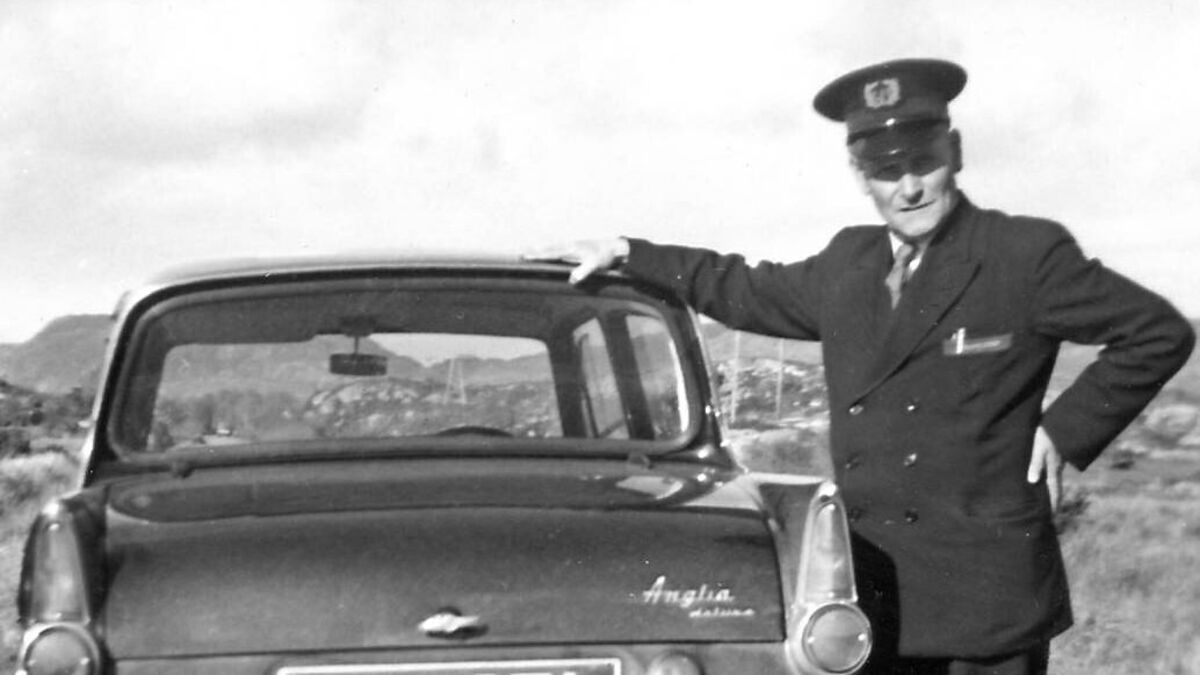
Philip McIntyre with the Ford Anglia staff car somewhere on the Butter Road, in October 1961. Picture supplied by his son, Cyril McIntyre
Throwback Thursday reader Cyril McIntyre was interested in the picture we featured last week, showing the queues of young people waiting for the bus down to the Majorca in Crosshaven on a Saturday evening in 1968, as he discovered a personal link therein.
“I think the inspector just visible on the right of the photo may be my father, Philip McIntyre!” said Cyril.
“He often supervised these special trips, and would later drive by car to the venue to check the return journeys.
“I also think I recognise one of the staff standing by the bus at the back - the man on the left by the door of the second bus is almost certainly Gerry O’Mahony, a conductor who later became a driver, was promoted to inspector and in Bus Éireann days was Chief Inspector at Capwell.
“The bus stop at the City Library on the Grand Parade was the starting point for special buses to dances and céilís in such venues as the Majorca in Crosshaven, the Lilac in Enniskeane, and the Star in Millstreet.
“It was not unusual to see up to ten or twelve double deckers heading off on a Saturday or Sunday night.”
So your father was an inspector on CIE, as it was then known, Cyril? Where did all that start?
“Well, he was born in 1906 in Virginia in Co Cavan, where his own father was a national teacher. My dad got his secondary education in Cavan College and from there was sent along with one of his brothers to All Hallows College in Dublin to study for the priesthood in 1925.
“In 1931, however, they were both expelled for being late coming back from a bank holiday weekend!
“His brother Michael emigrated to the U.S where he went into journalism. Another brother went to England and worked as a conductor in London, on the Green Line coaches.
“My father would probably have gone to England too, but when the Irish Omnibus Company started on the Dublin/Cavan route in 1931, he applied for a job as a conductor and, as they say, the rest is history.
“He was later transferred to the Waterford area, promoted to inspector in 1937, transferred to Galway, back to Waterford in 1940, and by 1941 finally to Cork.”
“He met my mother when working on the Clonmel/Dungarvan route and they were married in Waterford in 1942.”
Cyril adds: “I recently finished your book, Follow The Old Road, Jo, which I really enjoyed, and especially the references to the old railway lines and to the Butter Road from Kerry to Cork.
“My father often used that road when checking buses; after spending some time in the Blarney area he would head off through Tower and follow it to Millstreet to the Killarney route, or branch off to Naad for Boherbue or Ballydesmond on the Tralee route.”
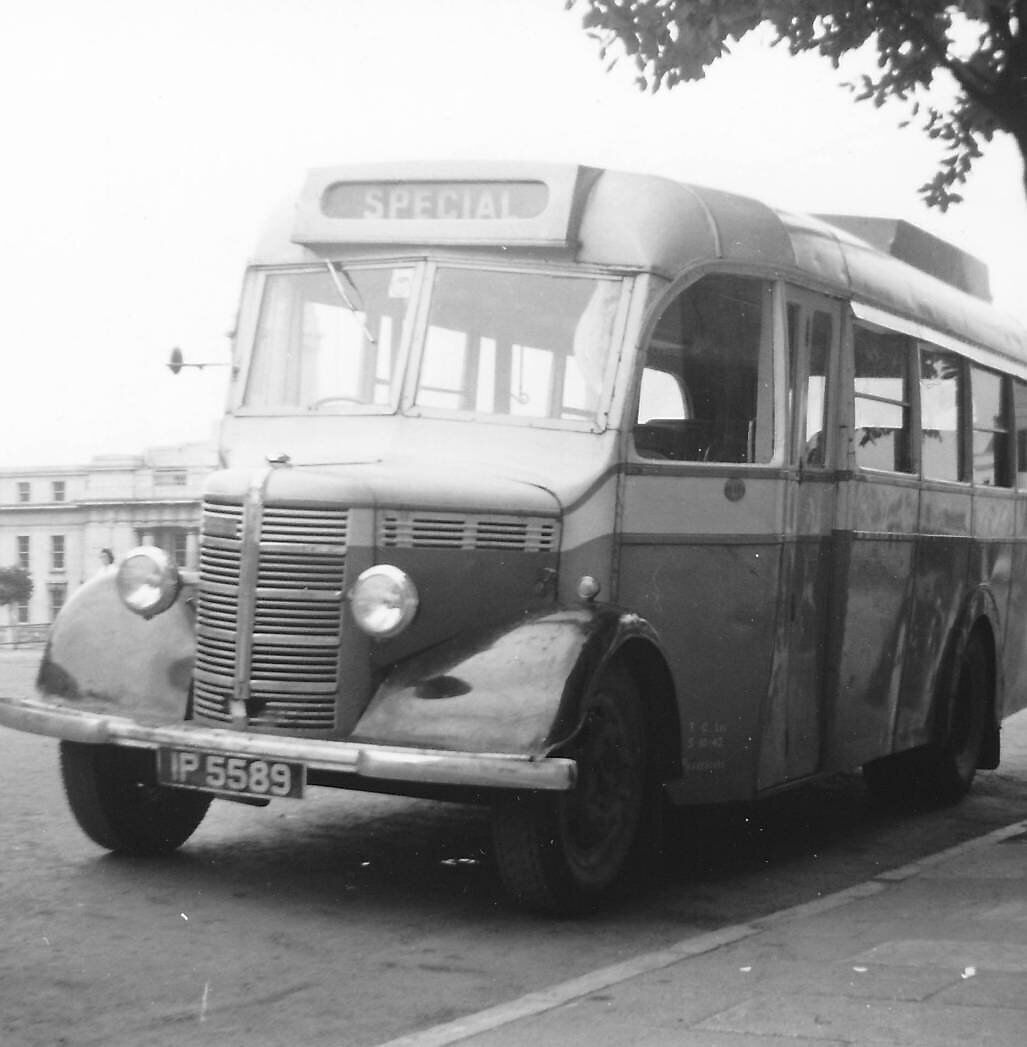
Philip McIntyre’s duties as a bus inspector were many and varied, to say the least, reveals his son.
“Checking that every passenger had a valid ticket was only the beginning. In those days there were large numbers of parcels carried by bus, all of which had to be accounted for - meat products from Denny’s and Evergreen Bacon Co, day-old chicks from Whittaker’s Hatcheries, newspapers and magazines from News Bros, ice cream in cork-lined ‘shippers’, etc.
“My father would also be involved in organising and supervising special buses for dances, GAA fixtures, race meetings, Knock Shrine pilgrimages, school tours, etc.
“Another task was surveying roads for new routes or diversions of routes to serve another village or school, as well as investigating complaints and meeting with representatives of community groups such as Muintir na Tíre, etc.”
Doesn’t that conjure up lovely images of the past? The Evergreen Bacon packages, the bundles of newspapers, even ice cream – what on earth was a ‘shipper’? A lined box, obviously, to keep the frozen product cool. This writer remembers wrapping a brick of vanilla or raspberry ripple from O’Brien’s in newspaper to get it home safely.
A feature of the country bus services, adds Cyril, was that in most towns the bus agency was a licensed premises.
“This presented temptation for any driver or conductor who might have been ‘fond of a drop’! It was of course an offence meriting dismissal to be ‘under the influence’ when on duty, and regrettably there were occasions when my father had no option but to file a report resulting in the ultimate penalty.”
Cyril says: “The key to effective supervision was the element of surprise, turning up to check where least expected. Of course, drivers had a code of headlamp signals to warn other drivers of an inspector on the road, but this was where the staff car came into its own, enabling an inspector to move from one route to another undetected.
“My father would often bring another inspector with him for even greater flexibility. This led to one of the ‘comedians’ in Capwell (and there were a few of them!) to compose some verses to be sung to the air of The Valley Of Knockanure’. I can only remember a line or two:
‘Now they’re hunting in pairs, for to catch the spares, between Rosses Wood and Blarney’
Cyril McIntyre was even able to supply us with a photograph of his father on active duty, with his Ford Anglia staff car, for which we are most grateful.
Cyril also has memories relating to another recent Throwback Thursday article, where Paddy O’Brien recalled his time as MC at céilís.
“It reminded me of my own céilí dancing days back in the early 1960s,” said Cyril.
“I started at Réalt Chaoimhín in Dún Laoi on the North Mall, an Irish-speaking youth group run by the Legion of Mary.
“When Dún Laoi later closed, we moved to St Augustine’s Hall on Washington Street.
“We also ran a Sunday night Céilí in the ICA Hall in Douglas, where I often acted as MC. I remember that we had to finish at 10.45pm, so as to get the last bus from Douglas connecting at the Statue, with the 11.15 last departures on all the other city routes.”
Ah, the last bus! Many readers will recall dashing for that one in Patrick Street after a night out.
“When I joined CIE as a clerk in October, 1961,” continues Cyril, “I spent three months at Muine Bheag (Bagenalstown) railway station in County Carlow, where there was a weekly céilí in the local McGrath Hall, run by Mai Shaw-Rea, who was a local dancing teacher.
“Having graduated from the Walls of Limerick and the Siege of Ennis to the High Caul Cap and the ‘piéce de resistance’, the Sixteen Hand Reel, she must have been impressed with my dancing, as she enlisted me to take turns calling the movements.
“So, after that first week I got free admission, as well as free transport and entry to her other sessions in Carlow Town Hall and Paulstown Parish Hall!
“Another well known organiser of céilís in that era was Liam P Foley. He ran céilí & old time dances in Inniscarra Hall, with CIE buses from the Grand Parade. He had a Volkswagen 8-seater minibus with a large illuminated ‘Liam P’ sign on the roof.
“And there was Máire Ní Chatháin, who as well as hiring CIE buses had a bus of her own, bought from J J Kavanagh of Urlingford.”
Cyril adds some important information.
“As far as I remember, a céilí where the MC called out the movements qualified as a ‘Céilí Class’ and so was exempt from the Entertainment Tax, which applied to dance and cinema tickets at that time.”
Ah, so that was it!
But where did you get that fluent Irish, Cyril, that enabled you to do the calling of the Irish dances – no mean feat?
“Both my parents had a reasonable knowledge of Irish, and while we didn’t speak it at home, they always encouraged both my sister and myself with books from the City Library.
“My mother was from Modeligo in County Waterford, a few miles from Cappagh railway station on the road to Clonmel. She was born in 1910 and when she was growing up there it was a ‘breach-Ghaeltacht’ – meaning both Irish and English were spoken there.
“Her mother was the postmistress and some of the people coming in for their old age pension had no English.
“My mother became a telephonist in Dungarvan in 1926 and later served in Naas, Mallow, Cork, and eventually Waterford.
Cyril continues: “I was very fortunate to have an excellent teacher for four years in Mayfield National School, from 1952 to 1956. Pat O’Neill, from Castletownbere, gave me a great foundation in Irish; he later became a Schools Inspector. He also spoke fluent German and Spanish.
“I remember that one year we had a German girl in the class, having come with her family as refugees on a ship called the Victory, which for several months was moored at Anderson’s Quay beside the bus station.
“It must have meant so much to her that her teacher was able to have a conversation with her every day in her own language.
“And then I was at the North Mon from 1956 to 1961. We did everything through Irish there, and that also helped with my fluency in Irish.”
Cyril says that a big event on the Réalt programme was a course in the last week of August each summer, at Brú na Gráige between Baile an Fheirtéaraigh and Dún Chaoin.
“Here, the music for the nightly céilís was provided by local and visiting musicians, including members of the Begley family from Baile na bPoc.
“It was in the Brú that I first heard Liam Ó Floinn on the uileann pipes accompanied by his father on the violin.
“In subsequent years, I often spent holidays and weekends in Dún Chaoin, staying with Liza Bean Uí Mhistéil; her brother was Seán de hÓra, a noted sean-nós singer and a maestro on the accordion playing for the Kerry set dances.
“I also remember meeting Micheál Ó Gaoithín, son of Peig Sayers. I always managed to ‘take the floor’ after ‘graduating’ as a MC, as we used to take it in turns to call the movements.”
Oh you’ve opened a treasure chest with that reference to ‘take the floor’ Cyril!
Hands up all those who remember that hugely popular Radio Éireann show back in the 1950s, presented by the one and only Din Joe. A full hour of Irish dance music with bands, singers, dancers, and instrumentalists.
Listening to Take The Floor became a countrywide unbreakable habit. The joke was that it was the only place in the world where you could learn Irish dancing on the radio!
In fact, the legendary Din Joe was really Denis Fitzgibbon, a Cork lad who went to Pres and became a great rugby player, both with Dolphin and with Munster.
Denis was a frequent participant in amateur variety shows in the early 1950s and a panellist on a radio quiz show chaired by Joe Linnane. In 1953, this led to an invitation to fill in for six weeks on a new radio variety programme. The programme was Take The Floor and those six weeks lasted for most of the next 25 years. When Denis passed on in 1998, all of Ireland was saddened.
Do you remember listening to Take The Floor? Or seeing the dreaded inspector hail the bus and come portentously on board to check tickets? Tell us!
Email jokerrigan1@gmail.com or leave a comment on our Facebook page: www.facebook.com/echolivecork.