Forget hurling... cricket was the first sport at St Colman’s
When it comes to sport, St Colman’s in Fermoy may be best known for success in hurling, but it was once more associated with a different sport, writes TONY WALSH. 
Forget hurling... cricket was the first sport at St Colman’s

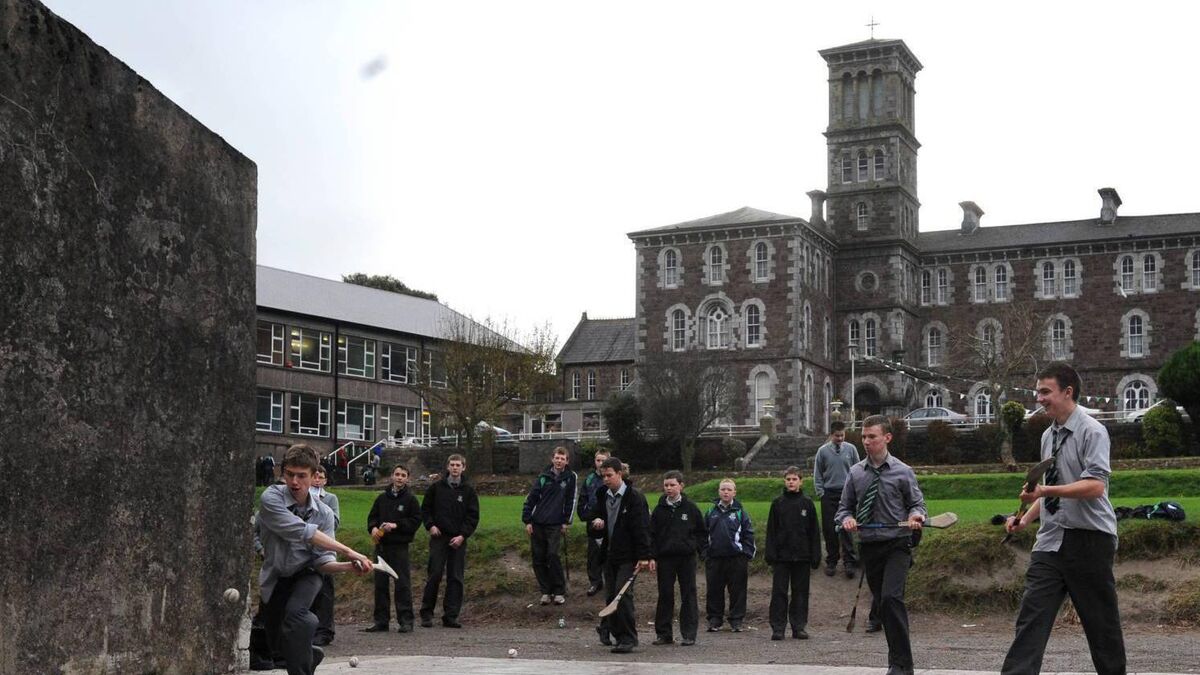
Students playing hurling in the handball alley during their lunch break at St. Colman’s College, Fermoy, back in 2008, when it was celebrating its 150th anniversary. Picture: Denis Minihane

St Colman’s identity is synonymous with sport, and the school has been actively involved in sport since its early days- perhaps best known is the success of the college senior hurling team in the Harty Cup, the Munster secondary schools senior competition.

However, the first sport to be played by St Colman’s was actually cricket.

Almost 20 years after the foundation of the College in 1858, a cricket game between a St Colman’s team and Fermoy Cricket Club was reported in the Irish Times, on May 21, 1875.

In fact, Gaelic games did not become an athletic activity at the school until the early 1900s.

The St Colman’s story began in 1856, in the era of British rule, when the Bishop of Cloyne, Dr Timothy Murphy (1849-56), devised the idea of a diocesan college to prepare young men for the priesthood. It opened for students on 20 September 1858.

Under the leadership of Dr Thomas Croke (1858-66), the first President, the college started a journey towards achieving a national status for its success as an educational institution, and for its sporting prowess.

Demonstration of the students’ academic proficiency took place at an Annual Presentation Day at the end of each school year, launched in 1859, and presided over by the Bishop of the diocese in front of invited guests. This format for the proceedings remained in place for almost 20 years.

Cricket comes to the surface again in 1877, as reported in the Cork Examiner on June 26. A game was arranged as part of a St. Aloysius Day celebration, organised by the president at the time, Dr. Stephen Wigmore (1877-1880). This Feast of Youth celebration introduced a cricket match between a team representing the Old Colmanites, and a team representing Colmanites of latter years.

Further games of cricket were demonstrated during Dr. William Hutch’s period as President (1880-1892), and this continued under Fr. William Blake’s term (1893-1901).

A past pupils’ union, the Union of Ancient Colmanites, was founded in 1884, and the format of the annual gatherings changed. After the annual general meeting in the morning, there was a cricket match between past and present pupils.

The past pupils’ reunion ran from 1884 to 1901. Cricket played a significant part in the college sporting calendar until 1901.

From 1901, St Colman’s activities and practices reflected the newly established order of cultural nationalism.

A pivotal turn around in its practices occurred, driven by the next head, Dr Michael Barrett (1901-1916). The college education and sport practices followed society change with Gaelic games, notably hurling, becoming the main focus of sporting activities. On the education side, there was an emphasis on an Irish-based curriculum with Irish language, Irish culture and arts, following the pattern of the growth of cultural nationalism.

Under the new regime, the break from the past was as sharp as it was sudden. Cricket was abandoned, and the past pupils’ union went out of existence. An anchor in the college life had gone, and the connection with the cricket matches of older times was a distant memory.

Recognition of the commitment of the school to the Irish cause came from Padraig Pearse, a signatory of the 1916 Proclamation, who visited St Colman’s in the early 1900s. Pearse was said to have been impressed by the strength of Irish within its corridors. This endorsement, coming from a significant figure within the cultural revival movement, according to Fr. Robert Forde, College historian, recognised the schools’ contribution to the teaching and preservation of Irish culture and language. Another signatory to the 1916 Proclamation, Thomas McDonagh, was a teacher there from 1905-1908 and was active in the local Gaelic League. According to John Tobin, a teacher at the school, writing in An Colmánach (School Annual) 2016, McDonagh was drawn to teaching there due to the progressiveness of Dr. Barrett, and the nature of the curriculum and the prominence of Gaelic games.

At the time, there was a Munster Inter-College Hurling Championship, in which Dr Barrett had a hand in setting up, the Cork Examiner noted on March 26, 1909. This form of competition was the norm until the Harty Challenge Cup was launched in 1918, also reported in the Cork Examiner. The cup, named after another Archbishop of Cashel, Dr John Harty, was the cup all colleges and schools sought as a prize goal to bring back to their trophy cabinets. St Colman’s viewed the challenge as almost the ultimate hurling goal.

From this background, there is little doubt that the education, cultural, and sporting practices of St Colman’s post-1901 focused on the use of Irish and the Irish language in the curriculum, the application of Irish culture, support for the cause of nationalism and Gaelic games. 

In the context of the latter, Dr Barrett’s interest in moving forward Gaelic games was a significant factor, and, also, in taking an active role in the initiative to set up a Munster Colleges Football and Hurling League, of which he became President. On the education side, the college taught all relevant subjects through the medium of Irish and, in the cultural context, participated in the activities of, and provided facilities for Gaelic League events in Fermoy.

From the time St Colman’s opened in 1858, it was a partner in the social conventions during both the pre-1900 and post-1900 periods. In the earlier period, a time of British rule and influence, the college followed the social norms of that time. Post 1900, as cultural nationalism gathered pace, the college embraced contemporary Irish society.

As for modern times, school principal Seán Lane advised that cricket has not been played at the school for in the region of 100 years now.

  • This article is based on research by Tony Walsh undertaken as part of an MA (Local History) at UCC.
  • This story originally appeared in the 2025 Holly Bough. 

more Holly Bough articles

The day a Cork footballer kissed a Lisbon Lion’s knee The day a Cork footballer kissed a Lisbon Lion’s knee
Cork's Mick Barry and his impact on the development of the Seandún Division Cork's Mick Barry and his impact on the development of the Seandún Division
The man who resurrected Cork City’s library service from the ashes The man who resurrected Cork City’s library service from the ashes

More in this section

The day a Cork footballer kissed a Lisbon Lion’s knee The day a Cork footballer kissed a Lisbon Lion’s knee
Throwback Thursday: ‘The manager stared at the wild display in horror and put a stop to jitterbugging’ Throwback Thursday: ‘The manager stared at the wild display in horror and put a stop to jitterbugging’
Cork's Mick Barry and his impact on the development of the Seandún Division Cork's Mick Barry and his impact on the development of the Seandún Division

Sponsored Content

AF The College Green Hotel Dublin March 2026 The College Green Hotel: A refined address in the heart of Dublin
SETU and Glassworks set to accelerate innovation SETU and Glassworks set to accelerate innovation
Driving Growth in Munster: How property finance is powering Cork’s future Driving Growth in Munster: How property finance is powering Cork’s future
Contact Us Cookie Policy Privacy Policy Terms and Conditions

© Examiner Echo Group Limited

Add Echolive.ie to your home screen - easy access to Cork news, views, sport and more