Throwback Thursday: A list of North Main Street shops in 1875
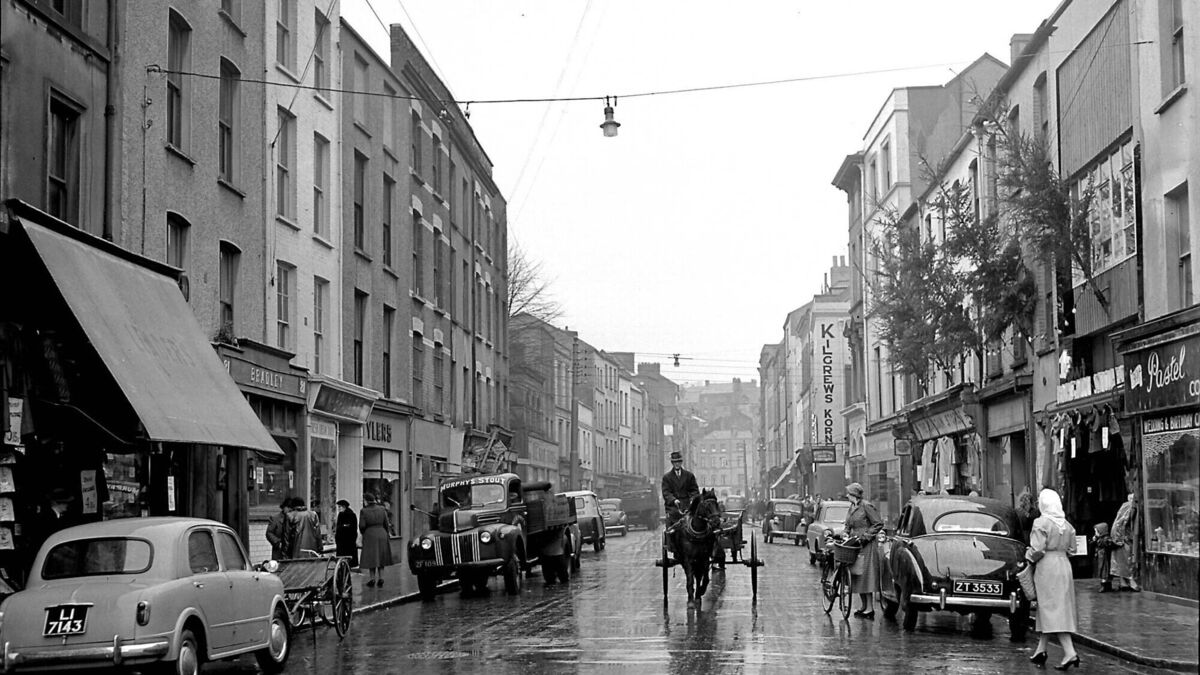
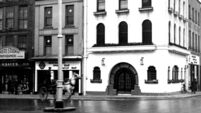
A wet North Main Street in Cork city in December,1955. Guy’s Directory from 1875 lists all the many shops that occupied the street then
In Throwback Thursday last week, Stephen O’Sullivan wrote about the legendary Rock Steps between Blarney Street and the North Mall.
Fintan Bloss, who knows that area like the back of his hand, responded quickly.
“Just a follow up to your column on March 12. I contacted Michael Brown of the Brown family mentioned in the article, and even though he remembers the O’Sullivans, he isn’t sure if he can recall Stephen.”
Well, that would be understandable if Stephen’s father moved off to the big smoke of Dublin before the lad himself was born, although the boy went back many times in later years. It’s always the same. You can take the individual out of Cork, but you can never take Cork out of the individual!
“We would be happy to meet Stephen in Dublin for a chat if he was interested,” adds Fintan. “Or if he is in Cork again, I have access to a key, so we could meet up there by the Devil’s Chair (if Old Nick allows us!)”
Now, Fintan, you know very well that Old Nick, horns, hooves and all, was a pure (impure?) invention of the Roman Catholic Church, which was trying to drive out all our old native spirits and gods and put their own in place instead.
The horns and the hooves belong to the Great God Pan, father of all nature and guardian of all life. Thankfully, we still honour him at Puck Fair down in Killorglin each August.
That was a diversion, apologies...
Back to the Rock Villas saga. Fintan has very thoughtfully attached a couple of pages from the 1941 Cork Directory.
“The Cronin at the top of Rock Villas was a piano teacher who was well known in the area,” adds Fintan.
Yes, we seem to recall several people mentioning her lessons, and the sound of music emanating from her house throughout the day.
We have to say, these old directories are utterly fascinating. If any of you take the time to go look in our libraries or online, you might start off hunting for your own area, but very soon will find yourself wandering down all sorts of laneways and heading off up tempting side alleys, following up other details of our beloved city and county.
The Guy’s 1875/76 Directory (you can find it online at the internet archive, https://dn790009.ca.archive.org/0/items/francisguyscount00guycuoft/francisguyscount00guycuoft.pdf), has so many of these irresistible pathways which just might set you off on an entirely new field of research.
Take, for example, the fact that domestic servants within the city numbered 216 males and 3,326 females in 1871, of whom 3,277 were Catholic and just 157 Protestant. Or that a lane off Wise’s Hill was known as Ropewalk Lane, indicating that this important industry was carried on there as in so many other locations in our maritime city.
Ropes of all kinds were essential in the centuries before nylon came in to ruin our shorelines and pollute our waterways. Back then, they were made of hemp, flax, or sisal and required very long spaces in which they could be twisted.
Those well off enough could enjoy the benefits of the Cork, Blackrock, and Passage Railway, operating from Albert Street:
“Trains every hour to and from Passage (six miles from Cork), calling at Blackrock, and by signal at Rochestown. Steamers, in connection with trains, ply between Passage, Glenbrook, Monkstown, Ringaskiddy, Queenstown, Crosshaven, and East Ferry.”

If you happened to have a heavy parcel for Crosshaven, then it had to be deposited at the city end before 3pm, as otherwise it would have to be left there (at the owner’s risk) until the next day.
Even more interesting, given that we have just had Seachtain na Gaeilge, is a table in that 1875 Guy’s Directory showing the number of people across the county in 1871 speaking only Irish versus those speaking both English and Irish.
The number of native speakers is surprisingly large, one would think, given the length of time we had been under English control.
There is even a table showing the number of fishing boats sailing out of our county’s harbours. Who has fisherman ancestors? This might just start you off on that family history you have always been promising yourself you would do. We’ve said it before, we’ll repeat it again: If not now, when? Time and tide wait for no man (or woman!)
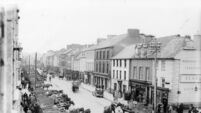
What businesses were conducted back in the mid-Victorian age on a venerable avenue like North Main Street? Here are just some of them, almost all small family or individually-run concerns:
1.Burke Mrs. Mary, vintner.
2, 3, 4 Flyn S, oil and colour merchant.
5, 6 D’Arcy Gerald, confectioner.
7 O’Neill James W, provision dealer.
8 Nawn Mrs. Margaret, draper.
9 O’ Regan John, oil and colour merchant.
10, 11 Twomey John, tobacconist.
12 Collins Miss M, draper.
13 Daly John, wine and spirit merchant.
14 O’Sullivan Richard, draper.
15 Rice William, grocer.
16, 17 Haughton B. & G. P, ironmongers.
18 Goold D. & Son, leather merchants.
19 Hayes Hannah, vintner, Hayes Daniel, hackney car inspector.
20 Byrne Edward, provision dealer.
21 O’Connor Miss E, draper.
22 Barriscale William, watchmaker and jeweller.
23 MacCarthy Bartholomew, draper.
24 Casey Edmond, haberdasher.
25 O’Halloran Edward, vintner.
26 Atkins Henry, vintner.
27 Burke John, grocer.
28 Riordan Thomas, grocer.
29 Curtin Catherine, vintner.
30 Mellefont Robert, chandler.
Back then, you could do all your shopping and meet all your household needs in just that one stretch of street, which has known busy footsteps since at least the Viking age.
I hadn’t forgotten the Rock Steps. They don’t appear as such in the 1875/76 Directory, but Rock Lane does, that nice little steeply-sloping street leading down off Blarney Street towards the Steps. Perhaps there weren’t any houses built down there yet.
But the Lane knows its history and could tell a tale or two to those who have the gift of being able to listen.
Now, here is a delightful email from Liam O’Reilly, who contacted us about a story he read recently in The Echo.
“When I am at home in Cork, I actually read ‘de paper’ as my mother buys it on a daily basis,” he says. “I was drawn to an article by John Arnold, regaling us with the story of when his mam bought a freezer.
“The picture accompanying the article portrays a happy shopper buying tripe and drisheen from ‘O’Reilly’s stall in Gurranabraher’. This is where I come in, as you may note that my surname is O’Reilly. My dad was Maurice O’Reilly, and before him his mother was Agnes Curtain.
“The O’Reillys had an abattoir in Gurranabraher up to 1937. However, Cork City Council made a compulsory purchase of the land as they wanted to build corporation houses. NIMBYs (Not In My Back Yard) were not indulged in those days.
“My grandfather, John O’Reilly, was emotionally and sentimentally attached to the land and buildings, and he argued with the council that he would not move.
“Whoever he was pleading with was not so sentimental, as he warned that my grandfather would be dragged out of there. My grandfather replied that they would take his coffin out of there. Which is exactly what happened as he died in 1937, when dad was nine years old.”
Liam says that his grandmother, Agnes, was originally from Turner’s Cross, “and as there was land and property for sale in that vicinity, they relocated over there to a place called Saint Philomena’s on the South Douglas road.

“Now and then, photos appear in The Echo featuring people working in O’Reilly’s tripe factory in Saint Philomena’s, Gurranabraher,” adds Liam, who says his family and friends enjoy reminiscing about a family history becoming a local history that all Cork people can feel a part of.”
Well, thank you so much for that, Liam, as you bring up not only a slice of family history but also a sandwich of two iconic local foodstuffs – tripe and drisheen.
Now, nowhere will you find a greater division between even members of the same family as on the tripe/drisheen front. Some will do anything to get hold of these delicacies, others will go to enormous lengths to avoid them. You either love ’em or you hate ’em, no middle road.
This writer’s mother was extremely fond of tripe cooked gently in milk, presumably something she had enjoyed since childhood, but we children, it pains me to remember, absolutely refused to let her cook it on any occasion unless we were definitely out of the house for the day, or preferably the weekend.
Photographer Richard Mills remembers from his French childhood his mother also liking to cook it according to a traditional recipe, Tripe a la mode de Caen.
“I wasn’t that mad on it,” says Richard, “but back then you ate what was put in front of you or went without!”
Now there’s the point. Tripe comes from a long way back in our Cork history, back when we were known as the slaughtering capital of Ireland, and our whole prosperity depended on provisioning the English navy both in its many and constant wars abroad and in its colonies.
That does not mean that tripe was shipped out, though, far from it. Oh no, the colonies and the warships got the good meat, together with the butter, the cheese, all the quality stuff. What was left behind was called offal, and that was where Cork’s own local foodstuffs developed, the leftovers which could be turned into a nourishing meal for those with very little to spend.
We’re not alone in this, of course – other European countries have a long tradition of using offal in inventive ways. Even today, you will find Spanish villages in the Pyrenean foothills serving bubbling cauldrons of tripe on the bar counters at lunchtime.
Once, I remember, I incautiously asked the barman what was in the pot. “You would not like it, madame,” he said politely. When I still looked curious, he lifted the lid, allowing the scent to drift past me like a wraith. I recoiled. He was correct. I did not like it.
It started as a poverty food, as indeed did fish and oysters. Now the latter two are among the highest priced on any Irish menu, and tripe isn’t far behind.
We still, thankfully, have O’Reilly’s tripe and drisheen stall in the English Market, reminding us of our past. Those who love it make special trips to purchase these delicacies.
It calls to mind that wonderful prize-winning essay at Oxford by our noted food historian Regina Sexton, in 1995, discussing the disappearing offal food traditions of Cork. Like the English with their Marmite and Spam, there are two camps here, each equally vociferous in its likes and dislikes.
No, we’re not forgetting drisheen. It looks very much like the famous black pudding (also, by the way, a popular dish in neighbouring Brittany and Normandy) but has a rather different recipe which we don’t propose to detail here in deference to your sensitivities.
Suffice it to be said that the parts of animal blood used are different, as are the herbs and spices added. No true drisheen lover would dream of settling for any black pudding.
Having to rely on waste products and leftovers to feed our families is a feature of the past. Today’s kids demand and usually get pizza (another poverty food originally) or burgers. Yet in top restaurants, yesterday’s offal is today’s special dish, with prices to match. Plus ca change, plus c’est le meme chose. The more it changes, the more it stays the same…
Let’s hear your own stories of foods and times past in our city. Email jokerrigan1@gmail.com or leave a comment on our Facebook page: www.facebook.com/echolivecork.