Throwback Thursday: 59 days of rain...should we bury the Infant of Prague?
This week on Throwback Thursday, JO KERRIGAN hears about traditions surrounding rainfall - and recalls the An Tóstal events of the 1950s
Throwback Thursday: 59 days of rain...should we bury the Infant of Prague?

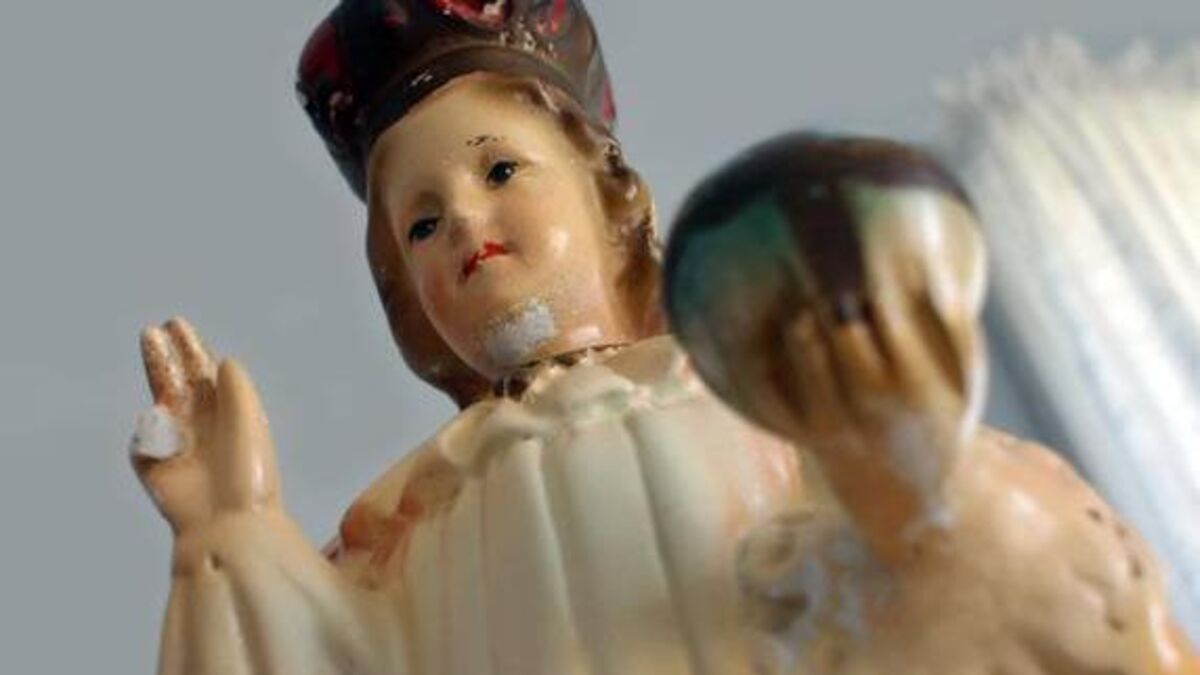
People who felt the Infant of Prague had an important role to play in ensuring a fine day for a christening, a confirmation, or a wedding, would put the statue out the night before an event. 

It may not have entirely escaped your notice that we have been experiencing just a bit of wet weather lately. Drizzle, mist, downpour, cloudburst, or just plain rain, we have been living with it for quite a while now.
To be precise, the last day that we didn’t have rain at all at all was December 29, 2025. That, assuming something seismic hasn’t happened between the time of going to press and you reading this, means that we have now had 59 wet, miserable days on the run.

When drops on gate bars hang in a row,

And rooks in a long line homeward go,

And so do I…

We have a typically contradictory tradition here in Ireland that a wet Imbolc or Candlemas at the beginning of February brings good news, whereas a sunny day betokens gloom ahead.

If Candlemas be fair and bright,

Winter will have another flight.

If Candlemas brings clouds and rain,

Then winter will not come again.

There is, believe it or not, some careful thinking behind that – apparently, if Brigid knows there will be wet days ahead, and that she is going to need more firewood, then she makes Imbolc fine, so she can go out and collect the kindling.

Conversely, if she knows things are going to get better, drier, and sunnier, she lets the day be as wet as it likes, since happier times are on their way.

I don’t know what the forecast should be if that wet season starts back in the previous December, but frankly, I would rather not think about it.

I was re-reading Shane Lehane’s delightful new book, Old Ways To New Days, on yet another wet afternoon recently, and noted that he had taken the trouble to learn from Met Éireann itself that we had rain for 52 consecutive days in July and August, 2009. Well, we’re beyond that now, and still counting.

Will it end soon? The birds, the animals, and the flowers think so. On the Link Road out of the city, the crocuses and the dandelions (I’m so glad the council is keeping them there, letting their bright yellow flowers feed the bees) are making a happy show, and the birds everywhere are pairing up and collecting nesting material. (While, according to a cat of my acquaintance, the first broods of baby bunnies are just about due to arrive, so I must understand if he doesn’t come in at nights for a while.)

As for a dry Imbolc promising 40 dry days to come – ah, cop yourself on. When, throughout history, did we ever have 40 dry days? As far as we can ascertain, that miracle has yet to occur in holy Ireland.

I remember my own father referring to – was it 1956? – as ‘the year we had the summer’. That was the exception though. I have all too many memories of damp camping on soaked stony ground, of wet feet, wet clothes, and an overwhelming desire to go and live in a dry country. If we get a week or two without much rain (‘a drizzle on dry days’), we are thankful.

As an aside, I was on the bus from Stansted to London one day a while back, and heard the cheerful forecaster on the radio say: “No chance of rain today.” I don’t think I have ever heard that on Irish radio. Have you?

Traditionally, we think of childhood as being always sunny, but was it really? Don’t you have memories of getting soaked running home from school? Of damp mackintoshes hanging over the banisters? Chilblains, sniffles, coughs and colds?

No, it’s no accident that, according to the late, great writer Manchán Magan, we have 99 words for rain in our native language, but just one for sun.

You do have to admit, though, we are far more fortunate than some countries. Look at the deserts of Africa, Arabia, the terrifying central plains of Australia. (I still remember the farmer from mid-Australia who stood in the middle of a small green field in West Cork, holding his arms up to the sky in a downpour, with an expression of incredulous joy on his face.)

I took a quick trip recently to the Canarian island of Fuerteventura which had just had a rare occurrence of rain the week before. The whole island was covered with a lavender-violet sheet of small flowers, four-petalled stocks of some species, spreading everywhere over the normally sandy dry hills.

The locals were out in force, photographing this rare phenomenon which may only occur once in every decade.

Imagine those seeds underground, waiting patiently for the life-giving moisture that would let them sprout and bloom at last? Imagine if we had to wait ten years to see the buttercups and daisies, the primroses and bluebells that we take for granted here each spring? No, we certainly wouldn’t want to suffer drought and wildfires every year. But just a little less rain – please?

And here is something else I gleaned from Shane Lehane’s Old Ways To New Days. I never knew that the Infant of Prague had an important role to play in ensuring a fine day for a christening, a confirmation, or a wedding!

Apparently, you took your household god out into the garden the evening before and put him somewhere, preferably under a bush for shelter, but where he could also see and take control of the skies, so that he could get you a clear sunny morning next day.

Others swore by actually burying the statue in the garden until the important day was over and done.

Did you know that? Can you remember anyone in your family doing it? I would really like to know more about that custom and however it came to be a determined belief here.

Burying an offering is of course a very old practice, as is tossing a coin into a stream or well, but in the case of the Infant of Prague, it is to be hoped that somebody did remember to disinter him on the following day, dust him off, and put him back on his customary shelf in the house.

A major Irish event back in the 1950s was, however, not the unending rain, but An Tóstal, which was started in 1953 to try to combat the exhaustion and pessimism that had ensued after the Emergency years, when we were also trying to forget the terrible winter of 1947, and realising that we were our own country again at long last.

More importantly, it was designed to turn us into a tourist-friendly nation, and was especially aimed at the Irish diaspora in America.

The name means The Gathering, and while in concept it was somewhat like the Festival of Britain of 1951, it was far more energetic and creative, spawning a major explosion of offshoot festivals that are still with us today.

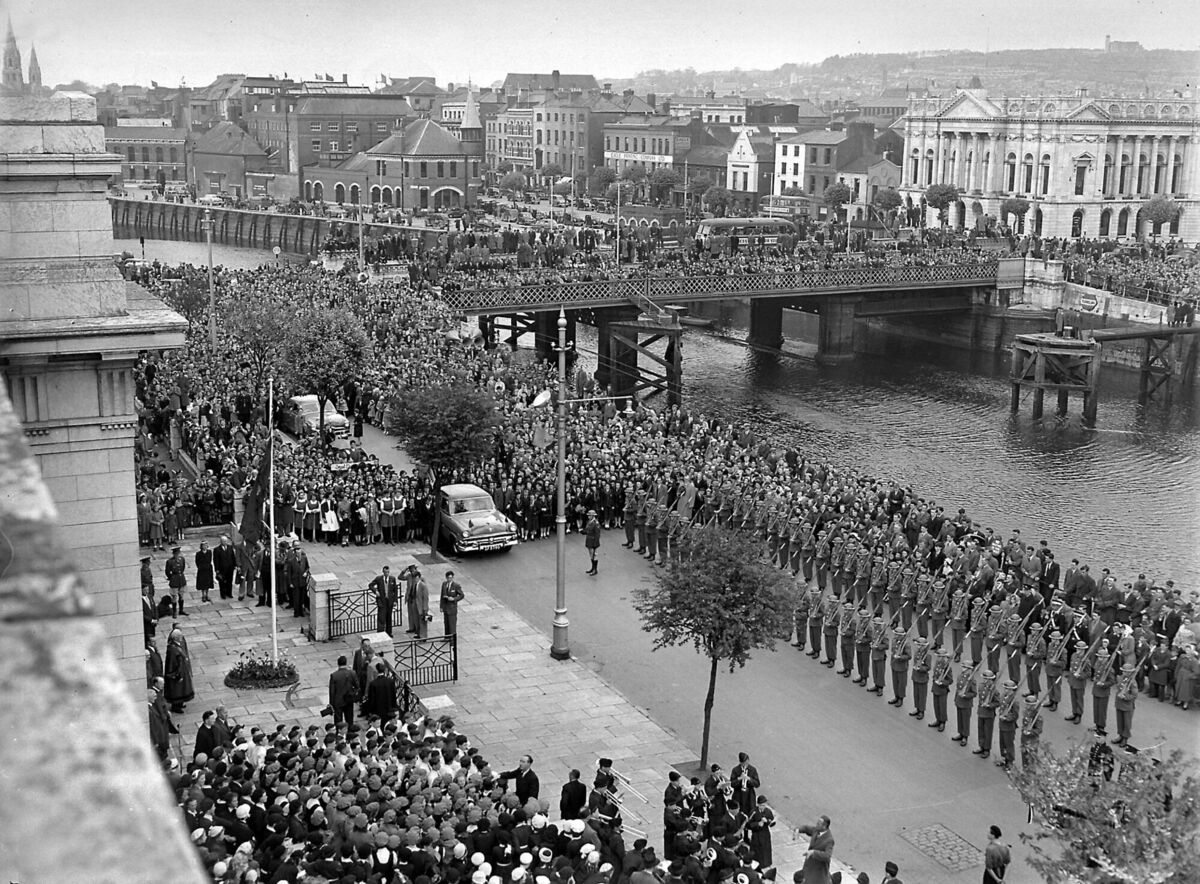
Crowds gather at Cork City Hall for An Tóstal ceremonies in May ,1955. The event ran from 1953 to 1958 and spawned many events such as the Cork International Choral Festival

The All-Ireland Drama Festival began as part of An Tóstal. The Cork International Choral Festival grew out of it, as did the Cork International Film Festival. Even the Tidy Towns, now such a huge annual event, evolved from the major clean-up which took place in every town across the country.
The Rose of Tralee Festival, established in 1959, grew out of the confidence engendered by the success of An Tóstal.

“A time of pageantry and national rejoicing in which the Irish clans from far and near come together in joyful reunion,” was how President Seán T O’Kelly described it at the opening parade in Dublin on Easter Sunday, April 5, 1953.

And it didn’t just happen in Dublin, far from it. Villages and towns everywhere got energised and began to organise their own festivals and events to lift the gloom.

This didn’t happen by government decree. It happened because everybody got together in a common cause. The time was absolutely right for it to happen.

We even had special stamps printed, showing the world that Ireland was awake, alive, and very much its own individual self, after so many centuries of colonisation.

The stamps had the same harp symbol used on the official An Tóstal flag. That harp was inspired by both the Brian Boru harp and designs in the Book of Kells. If you have one in your collection, then hold on to it with pride.

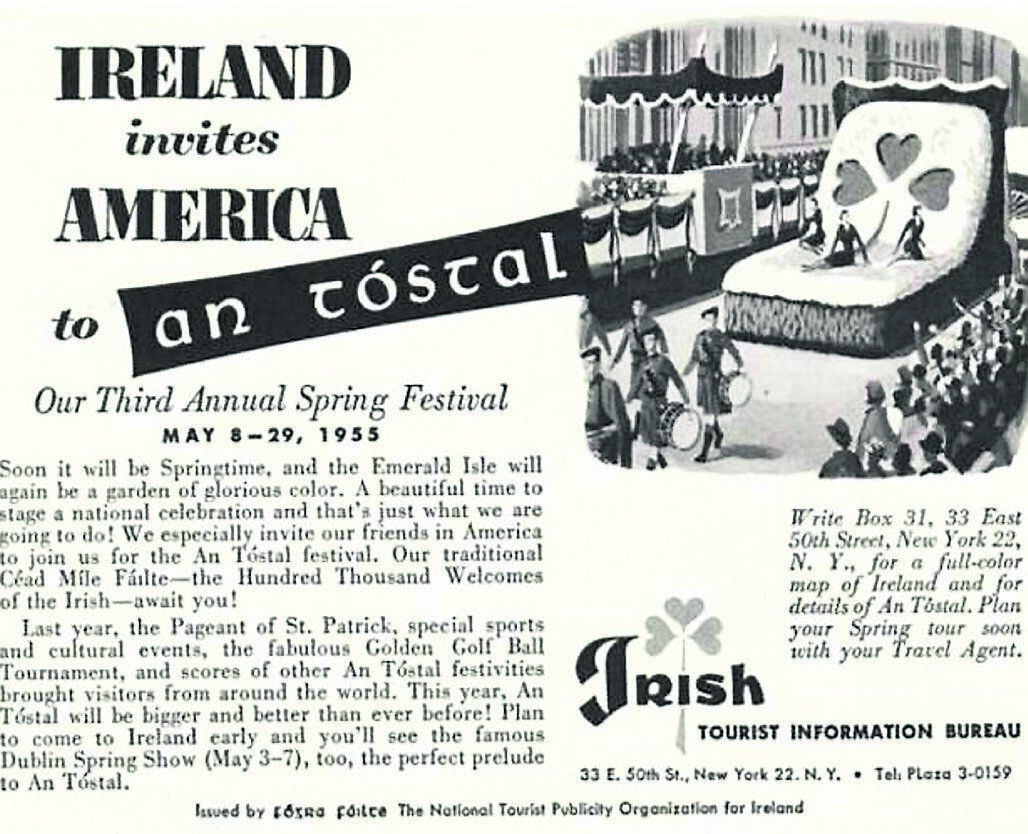
An American newspaper advert for An Tóstal in 1955

Cork played a huge part in the event, as you would expect. The Cork Film Festival, originally called An Tóstal, was created for that first year, masterminded by Dermot Breen, who was also general organiser of the festival as a whole.
As famed West Cork-based producer David Puttnam put it, it came into being, “five years before the launch of RTÉ television, 20 years before the launch of the VHS machine, and 51 years before Steve Jobs presented the iPhone to the world!”

Major musical events, like the performance of Handel’s Messiah by the Halle Orchestra conducted by Sir John Barbirolli, and involving 300 performers, became the foundation for the Cork International Choral Festival, which is now one of the highlights of our cultural calendar.

Joan Denise Moriarty’s Ballet Week, running since 1947, became a major feature of the festival in Cork and continued to bring dance to every corner of Ireland in the years to come.

The Tóstal festival itself was held every year until 1958, when it was phased out, simply because it had worked – the different events it had introduced were now prospering on their own, and gaining more tourists with every ensuing year.

In the beginning, each Rose had to be a native of Tralee, but by 1967 this was softened into the necessity to have at least some Irish birth or blood in you to qualify.

This writer was fairly young at the time of An Tóstal, but I still remember the sense of excitement and celebration as everyone got involved and showed what we were capable of.

Cork was fairly fizzing with talent and energy, and you had gifted artists like Aloys Fleischmann, Joan Denise Moriarty, Charles Lynch, Geraldine Neeson, and Dermot Breen, all giving tirelessly of their time and energy to bring the new vibrant Ireland into being.

My parents were strongly involved, helping to run events, offering up any of us who were old enough as ushers or programme sellers, placing posters in shop windows, buying tickets, encouraging others to buy tickets, doing their bit like everybody else.

We all believed in it, wanted it to succeed. And it did.

Street dancing, platform dances at the crossroads, concerts, sports... everybody got involved in just about every town and village.

We were waking up to the realisation that we were our own country again, and starting to revive the innate Irish consciousness and highly individual way of thinking, after being for so long forced to think like a neighbouring land which had entirely different ways (they were Anglo Saxon, after all, while we were Celts, which is a very different thing).

Today, we take the creation of new and exciting festivals each year almost for granted, but back then, we were far less confident, not yet quite sure of our place in this new post-war world.

Yet, to take just one example, Riverdance probably could not have happened without the example set back in 1953 by An Tóstal. And look where that has led?

Do you or any of your family have recollections of that memorable and proud event? Do share with us. Email jokerrigan1@gmail.com or leave a message on our Facebook page: www.facebook.com/echolivecork.

Read More

Throwback Thursday: Memories of the last hurrah before Lent 
Throwback Thursday: Picture brought back memories of my brother who drowned in Cobh
'Disaster struck.. and petrol seeped into our instant mash in the boot': Recalling Cork school's epic European tour 

More in this section

Throwback Thursday: Memories of the last hurrah before Lent  Throwback Thursday: Memories of the last hurrah before Lent 
The journey to building Cork's City Hall...and how it was almost developed at another location  The journey to building Cork's City Hall...and how it was almost developed at another location 
Throwback Thursday: Picture brought back memories of my brother who drowned in Cobh Throwback Thursday: Picture brought back memories of my brother who drowned in Cobh

Sponsored Content

Heads are turning for pharmacy investment property in the heart of buzzing Charleville Heads are turning for pharmacy investment property in the heart of buzzing Charleville
Charity places available for Cork City Marathon Charity places available for Cork City Marathon
Turning risk into reward: Top business risks in 2026 Turning risk into reward: Top business risks in 2026
Contact Us Cookie Policy Privacy Policy Terms and Conditions

© Examiner Echo Group Limited

Add Echolive.ie to your home screen - easy access to Cork news, views, sport and more