Throwback Thursday: Picture brought back memories of my brother who drowned in Cobh
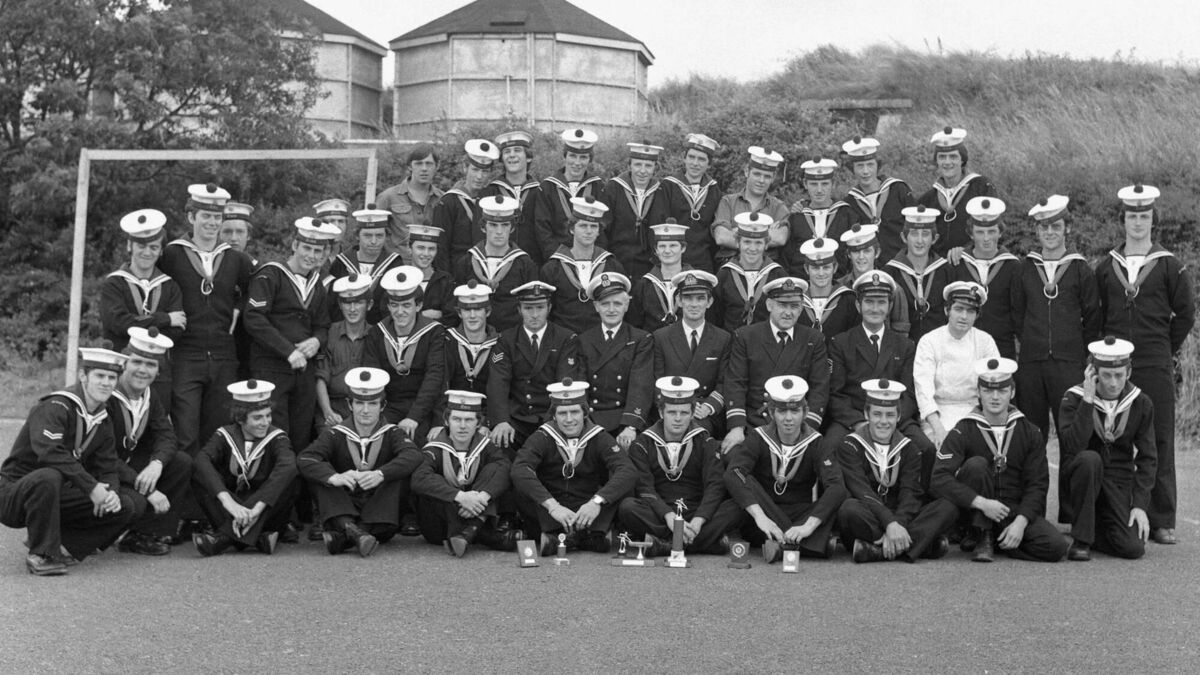
The photo of members of An Slua Muirí - the Irish Naval Reserve - at a presentation at Fort Camden in Crosshaven 50 years ago, in July, 1976, which ran in Throwback Thursday last week. A reader spotted his younger brother, Jimmy, third row, fourth in from right, behind the man in white. Jimmy was aged 16 here and ended up joining the Naval Service, but tragically died in 1980
We have recently been discussing Massey’s book shop on Patrick Street in Throwback Thursday, and indeed its other branches throughout Cork city.
It has reminded us how books and reading have always been a vital part of our lives here, for countless generations.
Indeed, it was novelist William Makepeace Thackeray no less, (Sketches Of Ireland, 1842) who commented that Cork citizens were the most book-loving people he had ever met. (He actually said ‘book-loving men’, but we will pass gracefully over that error.)
It was true, even then, when publications were expensive, and not many homes could boast of keeping a private library.
Reading rooms, coffee houses, and subscription libraries where you could read the latest newspapers or borrow texts to take home and enjoy, were much supported as far back as the 18th century.
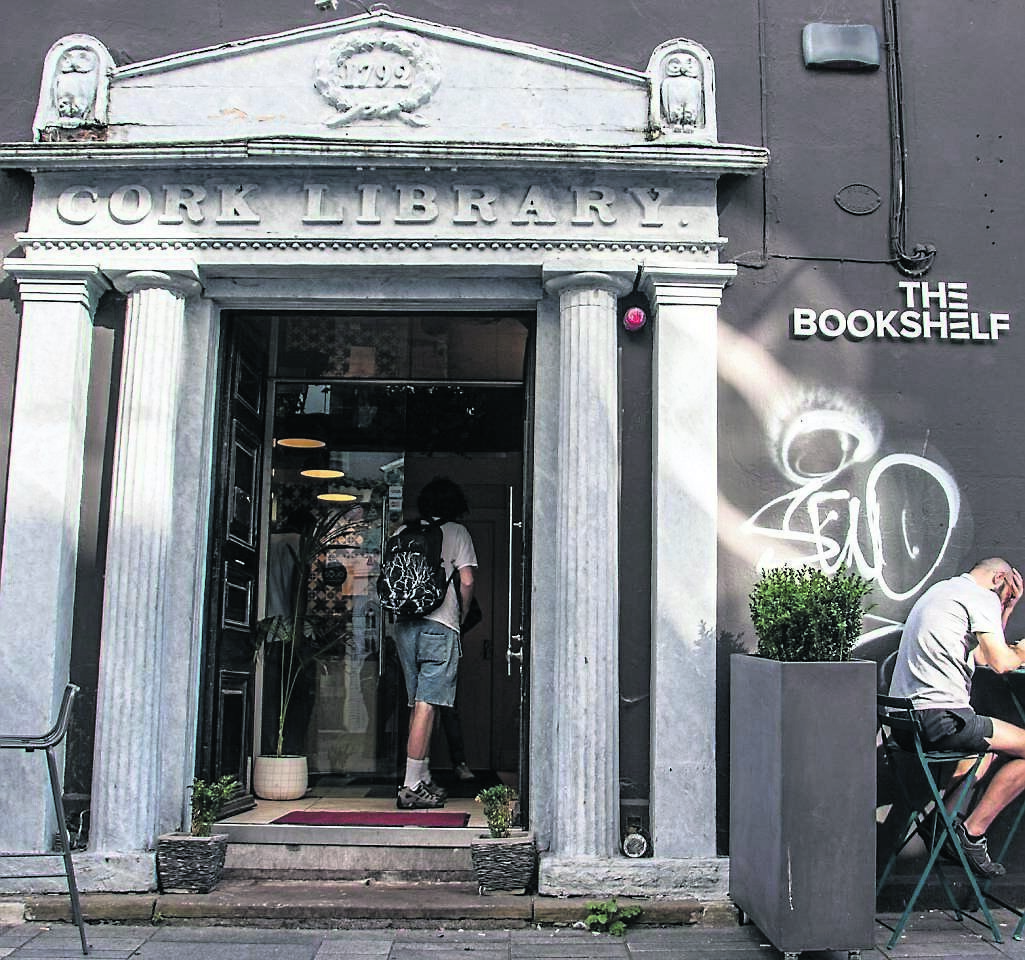
Who knows the wonderful old entrance doorway to the Cork Subscription Library on Pembroke Street, just before it meets the South Mall?
That was founded as far back as 1792, and didn’t close until 1918. Happily, the operators of the current café in that venerable building have chosen to call their welcoming establishment The Bookshelf, thus continuing the long-held tradition of browsing over your coffee. (No, I don’t know if the women were as welcome there as the men, but knowing the Cork female of the species, one would imagine they would have a hard job keeping them out!)
For those who could not face the fatigue of descending to the city and actually sharing a space with the hoi polloi, there was always the convenience of the London-based Mudie’s Circulating Library, which, operating in conjunction with Irish bookshops, would send boxes of the latest three-volume novels (East Lynne, Lady Audley’s Secret, The Heir Of Redclyffe) up to those imposing homes on the hills above the city.

Places like Cowley & Stewart’s Select Library in Dublin’s Nassau Street, Ford’s Circulating Library in Lismore, and Size’s Library in our own Paul Street, were all receiving constant deliveries from Mudie’s throughout the 19th century, for onward transmission to their subscribers.
What did that cost you? Quite a bit by the standards of the time. Ford’s of Lismore, for example, charged as follows:
Terms. Two Sets per Week, per Annum... £1. 1s. 0d. Two Sets per Week, per Half-Year... £0.12s. 6d. Two Sets per Week, per Quarter-Year, £0.7s. 6d.
They, along with all the other circulating libraries, warned that if one volume in a set were damaged, the subscriber was liable for the full cost of the three.
(Three-volume sets were common in the earlier days of novel publishing, and authors often had to extend or indeed ‘pad’ their works to reach the required word count. This writer counts among her prized possessions M. E. Braddon’s Only A Clod, in three volumes.)
Clearly, these terms were well outside the means of the majority of Cork city’s population (where many were not sure where the pennies for next day’s food were coming from), rather the system was reserved for the well-to-dos of Montenotte or Lover’s Walk. One wonders how the hard-pressed horses on those delivery carts managed the trek up to such locations with heavy boxes of books on board.
Cork’s first public reading room opened in December, 1892, in the Crawford on Emmet Place, and proved enormously popular, with up to 500 visitors every day.
The lending service, some seven months later, was even more of a success, with the library having quite a job to provide enough books to meet demand.
It was later moved to what became the Carnegie Free Library on Anglesea Street, opened in 1905, but which came to a sad end in the Burning of Cork by British forces in 1920. Some 15,000 books were destroyed in that conflagration.
In 1930 came the wonderful City Library on the Grand Parade. Built on the site of former warehouses between Tuckey Street and Kifts Lane (is that still there, or has it disappeared, like so many others of our laneways?), it was to become a familiar destination which played such an important part in the childhood of so many Cork children.
Can you remember when you first went to the City Library? Did your mother or father bring you in for the official registration and signing up, promising to obey all the rules and regulations, and to take especial care of the books entrusted to your care for a week?
How many books were you allowed to take out? And do you recall having to pay a fine when you brought it back late?
Heaven forbid, did you ever damage one and have to own up at the tall counter to a forbidding librarian?
“I was really silly once,” admits Katie O’Brien. “I was only about six at the time, but already an avid reader. Somehow – you won’t believe this – I left a slice of bread and butter between the pages of an Enid Blyton Famous Five book I was reading.
“When I discovered it the next day, I was horrified. The butter stain was awful! Fortunately, my mother had been well trained in her day. She used brown paper and a hot iron first, and then a piece of soft cotton with a gentler iron. It nearly rectified everything, leaving just the slightest browning stain.
“I closed the book neatly and handed it back, fingers crossed. I was lucky in that there was a queue behind me and the librarian just flicked through it, checked the date stamp, and returned my ticket. Whew!”
In the Kerrigan household, we were fortunate indeed in that our parents had a book shop, and we were accustomed from babyhood to a library at home, always packed with every kind of publication, from Greek grammars to children’s stories.
We read everything we could lay our hands on as soon as we were able to spell out the words.
There was a high old Dickensian counting desk – my father probably bought it down on the Coal Quay – and we used the slippery little editions of Greek texts to help us slide down it, usually hitting the floor with a bang.
Years later, an Oxford don asked if I was familiar with the works of Thucydides and I replied without thinking, “Oh yes, we used to slide down them at home.” I don’t think he was amused. But then, he didn’t know Cork.
Now to a poignant story from reader Sean O’Sullivan, triggered by our recent piece on Brian Cronin’s time in An Slua Muirí.
“I read with interest the Throwback Thursday article which featured the Irish Naval Reserve (Jan 29), and was delighted to see a picture from 1976 there, as my young brother, Jimmy, was in that picture (third row, fourth in from right hand side, behind the lad in the white top).”
Sean added: “He would have been 16 at the time and he went on to join the Naval Service when he was 17 and was a serving member until his untimely death in 1980.
“It brought back many memories, and it was ironic that this picture appeared on the last Thursday in January as that was the day we discovered he was missing all those years ago.
“He was presumed AWOL by the naval authorities, but had in fact fallen into the tide in Cobh, late on the previous Friday night, January 18, 1980.
“It was in a time before mobile phones; in fact, it was a time when many homes were waiting for telephones to be installed.
“He was an enlisted seaman and served on the LE Fola, and when not at sea he would divide his time between the Naval Base in Haulbowline and his home in Ballinlough.
“He had not been at home over the weekend, and when I called to see my mother, she was a little concerned that he had not been back.
“I left it a day or two, and the concern grew. I decided to call to see what or where he was.
“We had a brother-in-law, Tony, also serving in the Navy. We called to the base to check with Tony, and then it transpired that Jimmy had left there on Friday for Cobh, and later had left some colleagues in Cobh to catch the ferry back to Haulbowline. He never made that ferry.”
Sean recalls: “After further discussion with the authorities in Haulbowline, a decision was made that we would have to report him as a missing person. We then had to go to the gardaí in Cobh to report this, but it could not be published until the Saturday as, back then, a person had to be missing for seven days before it could be made public.
“After a number of days, I was advised by Naval personnel that it was possible that Jimmy had drowned and that we might be looking for a body.
“The Naval chaplain of the day, Fr Michael O’Brien, had called to see my mother on several occasions while we were waiting for news, as she held the hope that one day Jimmy would walk in the front door.
“Then followed four weeks of searching the harbour by friends and colleagues of his, work colleagues of mine from Esso, friends of the family, and people we never met or knew.
“The Naval service had a constant look-out in the hope that the body would be found. Eventually, in the middle of February, a body was found and taken from the river near the Whitegate refinery.”
Sean added: “Now this comes back to the phones. My mum did not have a phone, the nearest contact was her next-door neighbour.
“I was visiting my mother when a call came from Cobh gardaí, and fortunately I was in a position to take that call. I was given the news that a body had been recovered, and it more than likely was Jimmy, but would I make my way to the City Morgue where the coroner would meet with me.
“I had to go back to my mother and break it to her that it was possibly Jimmy, but we had to be certain, and we were needed to confirm his identity.
“Our Uncle Terry, Gerard, his twin, Tony, his brother-in –law and I headed for White Street to meet with the coroner. On his advice, we did not view the remains but our uncle, who had been a fireman, volunteered to identify the body and we were assured that it was Jimmy.
“Then it was time to organise a removal and funeral.
“We had made the initial formalities when the Navy liaison officer called to see us. Our wishes were respected, and Jimmy was given a full military / naval funeral.”
Sean remembers clearly that sad occasion, almost half a century on.
“Memories of the removal were walking up Wallace Avenue behind a hearse with what seemed like all the Navy on either side in single file and the white tops of their hats bobbing in the dark of the night to Our Lady of Lourdes Church.
“Requiem Mass the next day was celebrated by Fr O’Brien, and his concelebrant was a Fr Conleth OFM. Cap, the priest who had married our mother and father in that same church in 1951.
“Jimmy had full military honours with the Army band from the Southern Command in attendance for the final walk to St Michael’s Cemetery.
“There was a volley of shots from the firing party and then the Last Post from the army buglers before final prayers, and he was laid to rest with his father, who had died 16 months previously.
“It is interesting the memories a photo can generate.”
Sean, thank you for sharing that very moving experience with us. No-one can read it without feeling sympathy for you and your family, especially your mother who had been widowed such a short time earlier.
Share your memories, happy or sad, with us. Email jokerrigan1@gmail.com or leave a message on our Facebook page, www.facebook.com/echolivecork.