Throwback Thursday: Memories of the last hurrah before Lent 
This week on Throwback Thursday, JO KERRIGAN looks back at common practices at the start of Lent, and hears memories of Cork’s second-hand bookshops.
Throwback Thursday: Memories of the last hurrah before Lent 

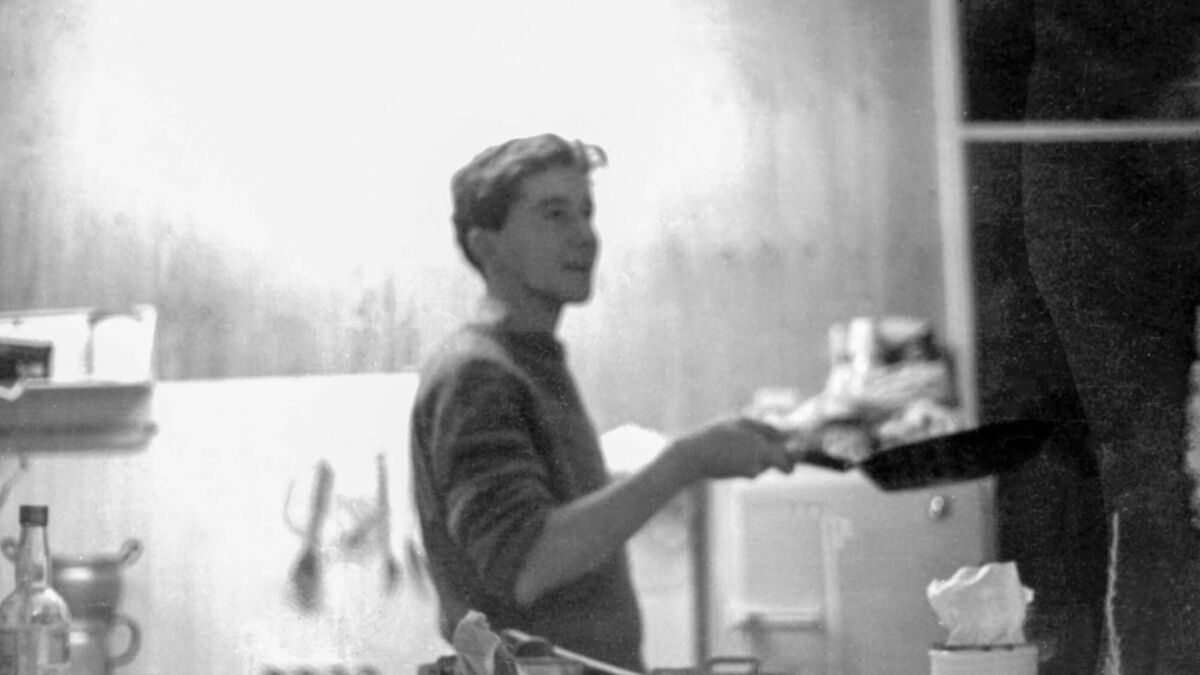
Richard Mills tossing pancakes in his younger days. 

Well, what a week this used to be in the days when the Church ruled with an iron hand, and households trembled at the sight of the parish priest striding up righteously to the front door.
You wouldn’t want to go back to those times with their unbreakable rules and unbelievable cruelties to the unfortunate who had made mistakes, but this week, above all, was serious.

Tuesday was Shrove (the word coming from ‘shrive’ or receiving absolution after making confession). But it was also, from way back, honoured as Pancake Day, the last hurrah before the 40 days of fasting and penitence which mark Lent and which lead, at long last, to Easter and the celebration of the Resurrection.

In earlier times, the fasting before Easter was indeed no virtuous effort on the part of the faithful, but a grim aspect of real life in early spring, when most of the winter stores had gone, and there was very little showing above ground as yet. It was only when times got a lot better, and restocking the kitchen cupboard was just a case of nipping down to the supermarket, that the virtue of abstaining from chocolate biscuits, the nip of hot whiskey, or milk in your tea, became something to strive for.

To better resist temptation in the 40 days before Easter Sunday, good housewives made sure they used up all the comforting resources on Shrove Tuesday. Milk, eggs, butter – what else would you do but make pancakes?

Do you remember your mother making them? Were they thick or thin? Did you enjoy them with lemon and sugar (traditional) or with cream, Nutella, raspberries, or even ice cream (very modern). And did you all sit eagerly round the table, banging spoons, and demanding your personal plateful?

It pains this writer to remember that six of us (five children and an equally eager father) did just that, while our mother patiently laboured away at the kitchen stove, turning out one pancake after another. That’s the thing, you see. Unless you have a commercial-sized kitchen, you can only make one at a time.

Popped onto a plate, then the batter was poured for the next one. By that time, the first has gone down instantly, and the child is demanding the next, never mind his or her siblings awaiting theirs.

Why, oh why, did I never get up to help? You just didn’t. You took it for granted that your mother actually liked spending her entire time in the kitchen preparing these treats, and wouldn’t have it any other way. But it’s a source of shame to me now, many decades later.

If there are any youngsters reading this today, you are probably wondering what I’m on about. Sure, doesn’t Mum pick them up at Dunnes or Super-Valu? What’s with this making them at home? Well, there was a time, children, there was a time…

I nearly forgot to mention the skilful tossing of the pancake. Could your mother do that, or did she play safe with a palette knife? Photographer Richard Mills remembers his own mother not only executing the flip most efficiently, but also teaching him to do it. That’s a French upbringing for you! Here, very much against the wishes of the said Richard, is an actual photo of him doing so in his younger days. Make the most of it, you won’t see it again! (Had to wrestle it from his hands.)

When the last traces of pancake batter had been used up, it was time for those who hadn’t already been to go to confession, so as to face Ash Wednesday shining in virtue.

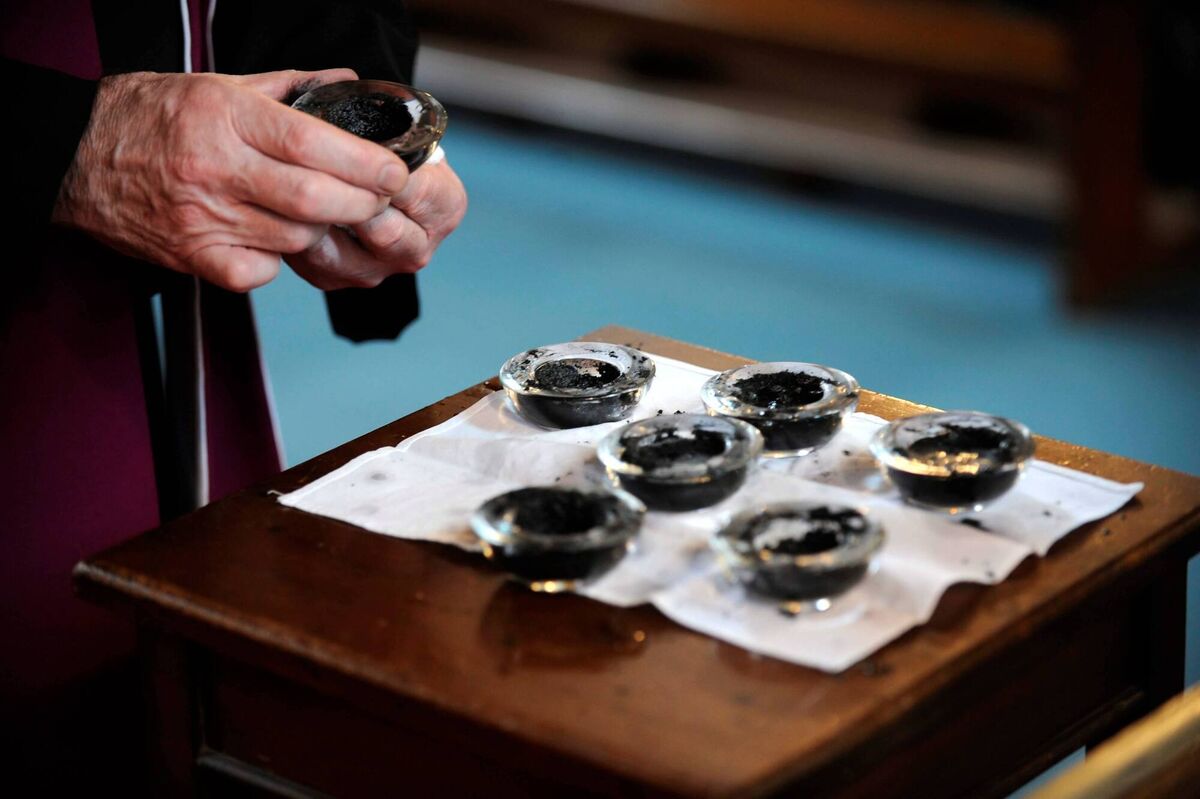
At school in Cork back then, it was very much the thing to appear with a big black circle of ash on your forehead on the Wednesday morning. Indeed, several children were suspected of ‘topping it up’ during the day, since ash, by its very nature, doesn’t hang around long. It’s a reminder, says the Church, that we are all ash, and will return to ash in due course. However, the custom of using ashes for powerful practices goes back a lot further than the religion of Rome.

It was commonplace for people to have ashes on their foreheads heading to school on Ash Wednesday. Picture: Dan Linehan

In ancient Ireland, it was the custom to kindle ritual fires at important times of the year – Samhain, Imbolc, Bealtaine, Lunasa – and also in times of need, when plague or crop disasters or other issues threatened.
When it was time for cattle to be moved to the hills for the warmer season – booleying, as it was called – they would first be driven between two of these fires, so that the smoke would bless them and also remove any mites or ticks that they had acquired during the winter.

At the great ritual fires, every household in the community had to extinguish its own fire and only rekindle it with the embers from the ritual one at the end of the ceremonies.

After this, the ashes were placed in the corners of crop fields, on the doors and lintels of houses and stables, and used to mark the clothes of small children to protect them from evil spirits. Those ashes were believed to hold great power and benefit, rather unlike the somewhat negative approach taken by the Roman church. Indeed, don’t you take the ashes out of your fireplace and spread them in the garden, to benefit the soil? Far better than something you buy in the garden centre!

Well, here’s to the 40 days of the Roman Catholic Lent. If you have memories of fasting, going to early Mass, making a determined effort to stay off chocolate, coffee, sweets, then let us know!

Now, here is a delightful bit of history from one P. S. O’Hegarty, about the second-hand bookshops of Cork. Not today’s outlets, but way back in 1941.

For this treasure, I have to thank Frank Roche, who sent me a link to The Bell, a literary magazine, with none other than Seán Ó’Faoláin as founder and editor. It’s a rare glimpse into our city’s commercial past.

“I mean, of course, second-hand bookshops, or stalls, as the case may be. They have character, individuality, crabbedness sometimes, but the dust in them is the dust of the imaginations of centuries of humanity. A second-hand bookshop is a contemplative oasis in the crudity of this progressive age, with the added delight of a possibly unique discovery in any pile.

“The new bookshop is, on the other hand, indistinguishable in spirit from a grocer’s shop and has about as much character.

“Well, it was fifty agus years ago, and I was a small boy of eight or nine. It was Christmas time, and I had a whole sixpence in my pocket. What to do with it? I could buy six Deadwood Dicks, or three of the large Twopenny Aldine Boys’ Library. I could reel you off the names even yet: One Eye the Cannoneer, or Marshal Ney’s Last Legacy, The Pilgrim Sharp or The Soldier’s Sweetheart, Wild Riders of the Staked Plain, or Jack the Hero of Texas. Or I could buy a Sixpenny Marryat at Wilkie’s in King Street.

“Before the Free Library started in Cork in 1892, Routledge’s Sixpenny reprints of Marryat, Mayne Reid, Fielding and Lytton were a godsend. But I wanted to buy a book, and to be a real book it had to be bound, so off with me to Massey’s in Winthrop Street, where there was a Sixpenny Box at the door.

I hunted that box through and through and several times over. Twice, the dark-eyed Miss Massey came out to look at me with amusement, but I was determined this time to buy a book. They were, even to a boy who could read anything, a very unattractive lot, and I hesitated a long time, finally exchanging my precious sixpence for an odd volume by the Abbe Raynal – East and West Indies - in the hope I would find something about pirates in it.

“One penny would have been ample but then, as now, the Masseys had no serious competition in the second-hand book trade in Cork.

“Anyway, I went home as proud as could be, with a real book, a bound book, that I could read any time. I still have it.

“The Masseys had another shop - they still have it - in Patrick Street.

Sam Massey was then the presiding genius there, while old Nassau Massey was still alive and vigorous, not taking a regular, active role, but stamping in now and again and overseeing Sam. He was the old patriarch, master of his house and of his business and of his sons.

“Sam Massey was easygoing. He had been a bit wild as wildness went then had been to America, and loved arguing and disputing. Equally, he loved getting other people arguing. So that 84, Patrick Street, in the evenings, was a rendezvous for the disputatious and the eccentric after the outer door had been closed and the shop was officially shut.

“Sam would sit right at the back, pipe at full blast, his chair tilted back against the shelves, with the gang about him, arguing, while I prowled round about the shop.

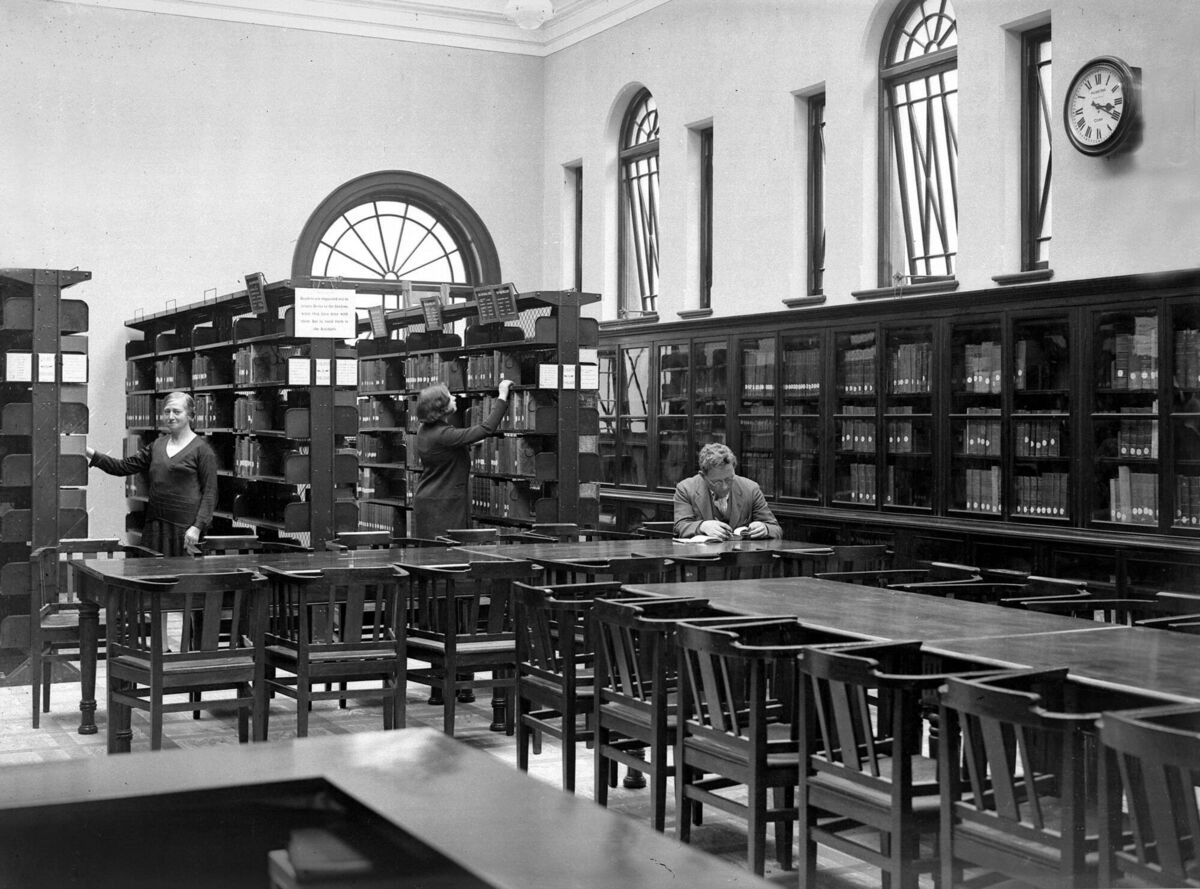
Interior of the Cork City Library at Grand Parade in 1930. One reader wrote of the value of Routledge’s sixpenny reprints of Marryat, Mayne Reid, Fielding and Lytton before people had access to libraries.

“There was lovely Johnny (Walsh, I think) and Connolly the Water Bailiff (father of ‘ Fox’ Connolly, who went mad on Shakespeare, and became an actor), Ulick Fitton, many others whose names I hardly heard, and later on Jenkins the jeweller, Joe Woodward the auctioneer, and Dick Sisk the builder were added.”
“There was another character impossible to forget. He had a job in the Cornmarket, and he always wore a top hat, swallowtailed coat and striped trousers. He was henpecked and was always, when not arguing with lovely Johnny, trying to goad Sam into obtaining for him the works of Rochester, Roscommon, and others of the minor eighteenth century poets, which Sam never did.

“I remember his defence of wearing a top hat. ‘This hat,’ he said, ‘costs me 25/-, and it does me in comfort and respectability for twelve years. Then I get it cleaned and done up for 8/- and it does me in comfort and respectability for another twelve years. Where will I get any other headgear as cheap?’

“Sam Massey also remembered his motto on the never-failing subject of woman. ‘Use women, Mr Massey,’ said he solemnly and slowly, ‘but don’t marry them.’ He finishes with three golden rules for booklovers:

1: Never buy a book, or at any rate keep one merely because it has a reputation. Buy the books you like, whether they are collected items or not.

2. Never pass a bookshop if you have time to go in and look around. I know, you were in there yesterday, and there was nothing. But one of the books you want may just come in at any odd moment. There is always the chance.

3. Never leave a book if you really want it. In nine cases out of ten, if you come back the next day, you will find it gone.

Now isn’t that a wonderful recapturing of an older, more peaceful Cork? Thank you for sending me that, Frank.

And the rest of you, whether it’s bookshops or pancakes, let us have your own memories! Email jokerrigan1@gmail.com or leave a message on our Facebook page: www.facebook.com/echolivecork.

Read More

Meet the collectors who have amassed 100,000 match programmes, coins and thimbles
Throwback Thursday: Picture brought back memories of my brother who drowned in Cobh
Throwback Thursday: Pies and pints...Life of a Cork barman in ’70s

More in this section

Throwback Thursday: Picture brought back memories of my brother who drowned in Cobh Throwback Thursday: Picture brought back memories of my brother who drowned in Cobh
Meet the collectors who have amassed 100,000 match programmes, coins and thimbles Meet the collectors who have amassed 100,000 match programmes, coins and thimbles
Throwback Thursday: Pies and pints...Life of a Cork barman in ’70s Throwback Thursday: Pies and pints...Life of a Cork barman in ’70s

Sponsored Content

Charity places available for Cork City Marathon Charity places available for Cork City Marathon
Turning risk into reward: Top business risks in 2026 Turning risk into reward: Top business risks in 2026
Top tips to protect Ireland's plant health Top tips to protect Ireland's plant health
Contact Us Cookie Policy Privacy Policy Terms and Conditions

© Examiner Echo Group Limited

Add Echolive.ie to your home screen - easy access to Cork news, views, sport and more