Throwback Thursday: 'My brakes failed when I tried to stop for the garda, and we ended up in the ditch'
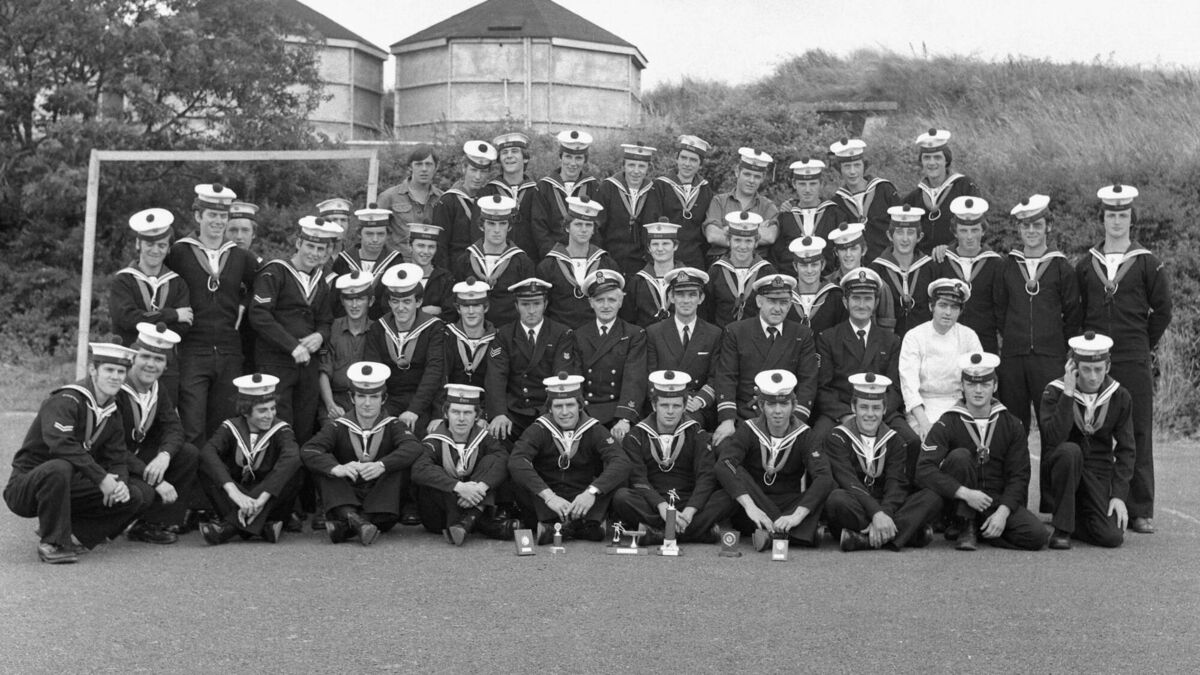
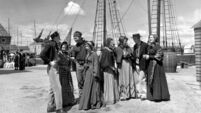
Members of An Slua Muirí - the Irish Naval Reserve - at a presentation at Fort Camden in Crosshaven 50 years ago, in July, 1976. A reader has fond memories of his days with the organisation in the 1950s.
So, do all the nice girls love a sailor?
It appears so, as this week on Throwback Thursday, reader Brian Cronin trawls into his memory banks, and recalls his time in the Irish naval reserve.
“My seven or eight years as a boy-scout played a very important part of my ‘growing up’ years,” he says.
“However, in 1957 at the age of 15, I decided on a dramatic change. Many of my scouting friends had decided to join the FCA - our Army Reserve - and I was intrigued by their tales of learning how to handle firearms, practicing their skills on a shooting range, and the whole notion of being prepared to defend one’s country if necessary.
“I had become friendly in my CBC years with one Rory Delaney (who later died tragically, in that Aer Lingus crash near the Tuskar Rock in 1968). Rory was a year younger than me, very good-looking and charming, great company and the heart-throb of many a girl.
“He suggested I join him in An Slua Muirí - the Irish Naval Reserve.
“I acquired my new naval outfit from Lawsons in MacCurtain Street and joined Rory at the regular weekly meetings of the Slua in Collins Barracks.”
Brian recalls the discipline required when joining that organisation.
“Each Tuesday evening before heading up to Collins Barracks, my sister Rosemary would paint my white gaiters and polish my boots before my mum inspected me!
“I chose to join the Signals division rather than the Deck or Engine Room, and found that my scouting knowledge of Morse Code came in useful, as indeed did semaphore.”
He continued: “There was a certain pride in donning the crisp uniform and representing the Slua Muirí throughout Cork.
“Marching through the city, we often caught the admiring glances of passers-by, especially the local girls, who seemed particularly fond of a lad in navy blue!
“The camaraderie extended beyond our peers; both family and neighbours would marvel at our commitment and the sense of adventure that came with serving in the reserve.”
Some Sundays, they would drive down to Fort Camden in Crosshaven in army lorries, Brian recalled.
“Here, we mastered the art of sailing in whaler rowboats, or be taken out to one of the naval vessels anchored off-shore.
“There we would visit the engine room and other parts of the boat and learn how they operated at sea.
“We were taught the basics of navigation, including how to read nautical charts and plot courses, which was both challenging and exciting for young recruits like myself.
“Teamwork was essential,” says Brian, “and the camaraderie that developed among us during these exercises forged friendships that lasted well beyond our days in uniform.
“The sense of discipline and responsibility instilled by the officers left a lasting impression on me, shaping my approach to challenges in later life.”
Brian also has fond memories of the summertime activities with the organisation.
“Each summer, the Slua spent a fortnight in Fort Camden. We spent most of our days on the water, either in the large whaler rowboats or on board one of the naval vessels.
“It was a great opportunity to get to know other members of the Slua.
“I recall a few of us one evening going down to the Majorca Ballroom dressed of course in our smart naval uniforms. The Majorca wasn’t quite as spacious a ballroom as the Arcadia (which of course was right next door to my home on the Lower Road), but it was particularly memorable for me as it was my very first dance.
“As usual, the boys were lined up on one side of the ballroom and the girls on the other.
“Having plucked up sufficient courage, I crossed the floor and asked a particularly attractive girl for a dance. To my consternation, she declined because she was ‘all sweaty’ from too many previous dances, but suggested I ask her sister instead.
“Fortunately, her sister turned out to be a gem and, realising that I had never danced before, patiently took me through the steps of an old time waltz.
“I rememered being thrilled to bits, and only stepped on her toes on a few occasions! The dance ended in a ‘cheek to cheek’ and she even gave me a kiss on the cheek to round off the memorable evening!”
Brian continues to delve into his wonderful memory bank from his time with An Slua Muirí.
“On another evening, I decided to cycle up to Cork (in full uniform) to visit my mum who was anxious to know how I was faring (no mobile phones in those days!)
“On the return trip, disaster awaited. Night had fallen, I was conscious that I didn’t have a light on my bike, and was anxious to get to Camden as soon as possible.
“I was travelling down Carr’s Hill outside Carrigaline at full tilt when suddenly a garda stepped out from the roadside, signalling me to stop. He had noticed that I didn’t have a light on the bike!
“Unfortunately, my brakes failed at the vital moment and we both ended up in the ditch. His cap went one way and mine the other.
“I’m not sure whether it was because I was a member of the defence forces, or perhaps he saw the humour in the situation, but luckily he let me off with a caution!”
Brian continues: “Many years later, I renewed my connections with the Naval Service, if indirectly, because my wife Anne’s father, Frank Twohig, was very much a navy man.
“During the ‘Emergency’ of 1939-1945 (World War II in every other country), he was a captain in the Irish Army but was transferred to Haulbowline in 1945 and was amongst a group of officers in the newly-formed Irish Naval Service. He achieved the rank of Lieutenant Commander before his retirement many years later.”
Brian kept up another connection to navy life in his adult life.
“In 1985, I decided that our Blue Haven Hotel needed a large clock on the street-facing front and I commissioned Chris Stokes, the renowned Cork City clock maker, to design one which apart from giving the local time would also show high and low tides each day.
“It was to be the only one of its type in the country. Frank was very chuffed when we asked him to officially unveil the clock.”
In 1995, President Mary Robinson came down to Haulbowline to attend a ceremony marking the 50th anniversary of the Irish Naval Service.
Brian says: “I discovered subsequently that my father-in-law felt disappointed, having been a veteran, at not receiving an invitation to attend the big day.
“On contacting the Commander of the Naval Service in Haulbowline, it came to light that he was still officially categorised as an army officer and wasn’t officially on the roll of the Naval Service until the following year.
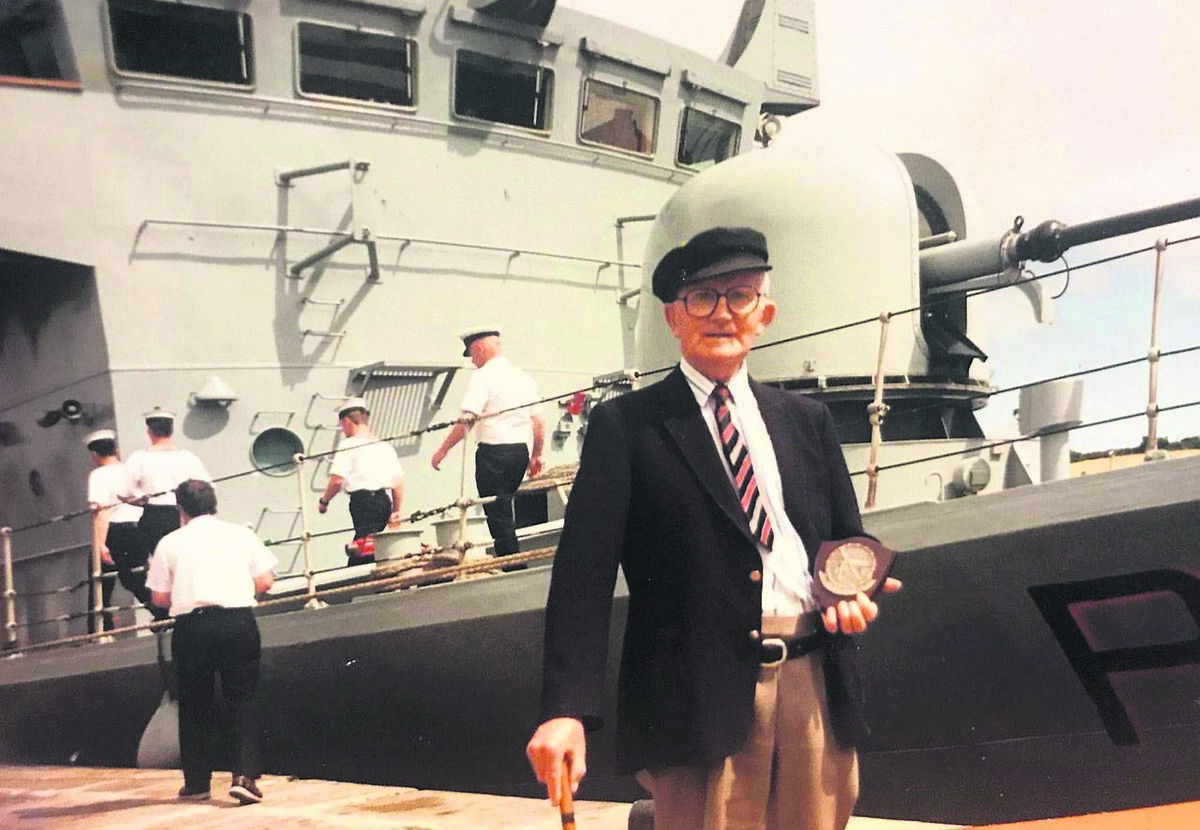
“Some years later, though, the Navy made generous amends for the oversight. They contacted me to say that the Naval Service ship L.E.Orla was being twinned with Kinsale the following weekend, and could I arrange for my father-in-law to visit the ship?
“I kept it a secret until the last minute and when we arrived on the Pier Head ‘to view the vessel’ as he thought, we were delighted to find two lines of sailors with their officer lined up alongside the ship.
“Frank was duly piped aboard and given a tour of the vessel. He was then presented with a commemorative medal before departure.
“On visiting him in hospital during his last illness in 2001, his last words to me were, ‘Tom, make sure they get it right on the paper - Commander D.F. Twohig - retired’.
“When he died shortly after that, the Navy again surpassed themselves by sending a guard of honour to carry his coffin into the church at the funeral, and then arriving back the following day to escort the coffin to the cemetery before a bugler played The Last Post and presented my mother-in-law with the tricolour.
“It was a very proud moment for all of the family, and hats off to the Irish Naval Service.”
What great memories, Brian, and what an exceptionally nice gesture by the Navy. Good lads!
Now, do you remember we mentioned the old Massey’s bookshop on Patrick Street last week? Reader Frank Roche has written to say that he doesn’t remember that particular establishment (well, it was a while back, Frank!) but did come across the Massey family when helping a friend trace one of her relations - a Peasley, who had emigrated to America.
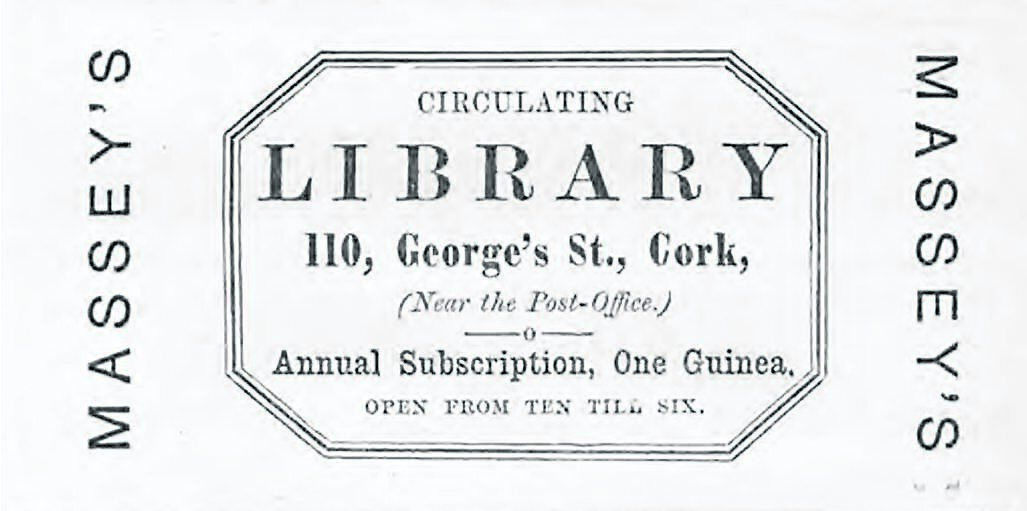
“The shop at 84, Patrick Street was opened by Nassau Massey in 1872, but it was not his first shop, and Nassau was not the first bookseller in his family,” reveals Frank from his detailed researches.
“In 1852, Nassau Massey of George’s Street (now Oliver Plunkett Street) married Jane Peasley, whose address was given as Passage West.
“Jane’s family were ship builders and owners based in Passage West and Carrigaloe. In the wedding record, Nassau’s father was named as Samuel Massey, also a bookseller.
“I also noted that Nassau was baptised in the South Parish on September 21, 1823: parents Samuel Massey & Eliza Fitton. That makes it likely that Nassau’s father was the Samuel Massey of George’s Street who appears in Pigot’s 1824 directory.
“The earliest record I saw of a Nassau Massey bookshop was in 1863 at 100, George’s Street. Within four years, he was advertising three shops - at 32, Cook Street, 41, George’s Street, and 110, George’s Street.
“The last, in particular, is interesting because it was on a prime site on the corner of Winthrop Street opposite the Post Office.
“By the early 1870s, he was also operating private lending libraries at 110 George’s Street and 56, South Mall, and had taken up residence at Upper Clifton House, just off the Old Youghal Road, so it would appear that the book business was doing well. (The location is now Murmont Lawn, but older readers might remember it as Hayes’ Lane.)”
Frank continues: “In 1872, Nassau Massey, by then described as bookseller, stationer and librarian, opened the store at 84 Patrick Street - again in a prime location. He also advertised that his ‘Munster Circulating Library’ at 110, Georges Street, could offer ‘a large stock of school and college books, new and second-hand’.
“His other branch - by then changed to 13, South Mall - could, he said, ‘supply all the latest novels and magazines’. In fact, the Massey bookshops were advertised repeatedly in the Cork Examiner in the 1890s, offering a free mail-order service. Their shops were then at 84 Patrick Street and at 17, Winthrop Street.
“By 1907, they again had three shops in operation in Patrick Street, Cook Street, and George’s Street. By then, several of Nassau and Jane’s nine children were involved in bookselling. His daughter operated a shop in a number of locations before settling at 10, Winthrop Street. Nassau Massey died in 1912 aged 89 and was buried in St Joseph’s alongside his wife Jane who had died eight years earlier.
“Of the Massey children, at least three - Samuel, Elizabeth and Ernest - were involved with the Cork bookshops (and all lived in Upper Clifton - as did their brothers Nassau and Bernard), while another brother Edward had a bookshop in Dublin. None of those six married - other Massey siblings who emigrated to London and Boston had families.
“Eventually, there was only one Massey shop remaining, at 84, Patrick Street. The last surviving bookseller was Ernest, and it is likely he was the man your correspondents remember. He retired in 1956 and the building was put up for sale. After his death two years later, the Massey home at Upper Clifton and its 20 acres of land were sold. The house was demolished and part of the Murmont estate was built on the land.”
Well, what a splendid bit of research, Frank! Get out there, the rest of you and do likewise, then let us know! Email jokerrigan1@gmail.com or leave a message on our Facebook page: www.facebook.com/echolivecork.