Life at Cork’s now obsolete Queen’s Place
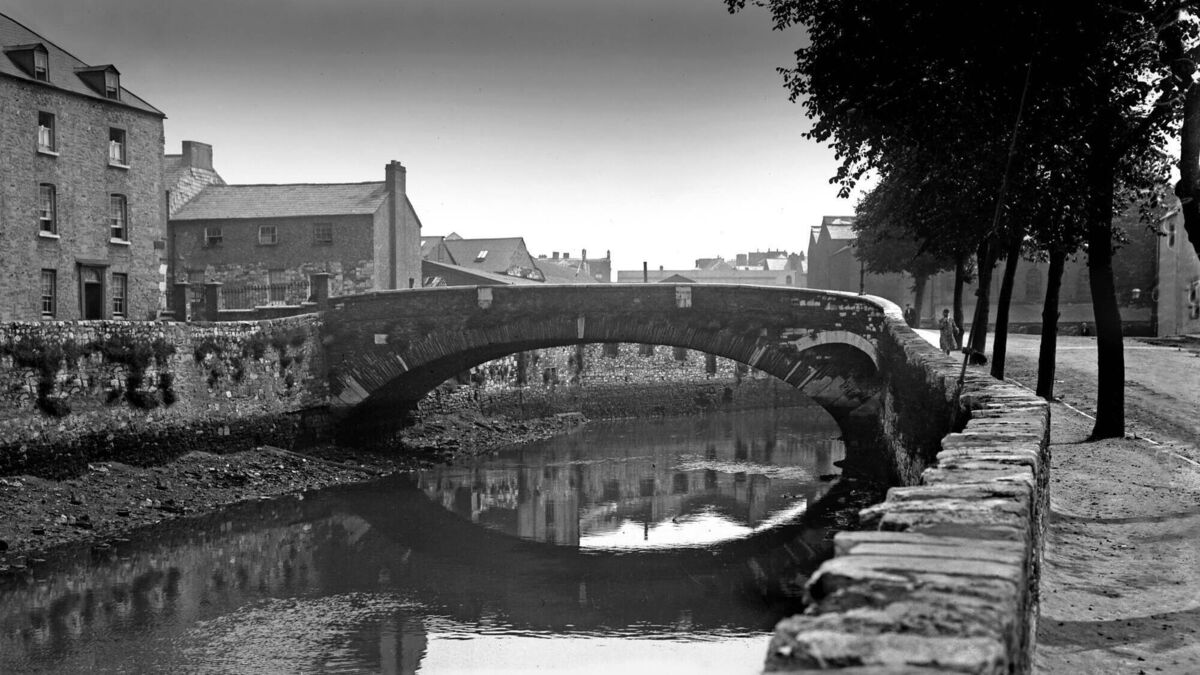
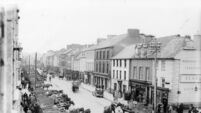
Clarkes Bridge, on the south channel of the River Lee, pictured in April 1928. On the left is Queen’s Place.
Now vanished, the site is presently occupied by the Social Services Offices, Hanover Street.
The terrace formed just one part of a property lot which included five more houses at Clarke’s Bridge and two on Hanover Street. The lease for the whole was set from March 25, 1784 for a period of 450 years.
Prominent in the early history of Queen’s Place was the Dunscombe family, a wealthy Cork dynasty whose primary seat was at Mount Desert (now a Bon Secours care village). They may have been involved in its construction, and certainly Parker and Christopher Dunscombe were responsible for leasing the houses in the early nineteenth century and resided there themselves. Parker died prior to 1834 and his “relict” (widow), Jane, died at home on the terrace in that year aged 52. Christopher was at No. 2 and when its furniture was auctioned in 1832 the inventory included: Christopher may also have passed on and in 1836 No.2 was functioning as a school run by Mr. and Mrs. Upton, who “assured parents who would intrust their children to their care that the most unremitting attention will be paid to their care”
In 1847 it was the furniture of No. 1 that was up for auction. There was another “8 Day clock” and among the more unusual items to our 21st century sensibilities were . A palliasse, for the unacquainted, was a straw mattress.
When Cork was thoroughly tax assessed in 1852 by Griffith’s Valuation, a Sarah Reynolds was given as the ‘Immediate Lessor’ of all four houses but may not have been the actual owner. No.4 was empty at the time and noted as not having any outdoor space. The others had yards and accordingly, carried slightly higher valuations, No.2 having the highest at £12 10s. Margaret Vincent leased No.1, Mary Fitton No.2, and Harriet Buck No.3.
The Fittons were long-time residents at No.2 and of Richard Fitton’s unmarried daughters, Jane died at home at No.2 in 1863, Elizabeth in 1868, Mary in 1873 aged 85 and Hester in 1878 aged 92. One of these, “Miss Fittons”, was a fundraiser for the Cork Ladies Anti-Slavery Society in the 1840s.
By the 1850s many property owners in Ireland were so mired in debt and tied up in financial knots that the Incumbered Estates Commission was set up to iron out difficulties. In 1856 the Commission ordered that the estates of Leslie Craggs O’Callaghan be sold. The order indicates that he was the owner of Queen’s Place at this time. The list detailing his ‘portfolio’ gives houses and premises in Hanover Street, Wandesford Street, Queen’s Place, Christ’s Church Lane, Wood’s Lane and on Redhouse Walk in the Mardyke. Additionally, he had land at Carrigrohane, Clashnascoub (part of Ballinure), and at Ashgrove in the Barony of Fermoy.
The lot encompassing Queen’s Place, Wandesford Street and Hanover Street was advertised for sale in the years following but was slow to go. Various adverts held out the carrots of a net profit rent of near £120, the fact that 375 years of the original term had yet to run, and that some of the houses were underlet and capable of yielding more rent. A sale notice from 1861 noted that the Queen’s Place lot was now with auctioneer R.B. Evans on the South Mall. It described the terraced houses as “large, comfortable and in excellent order”. Almost eighty years old then, three had been recently re-roofed and £200 had been spent on the improvement of all four over the previous ten years.
The sale saga continued to 1867, by which time the lot was with Mr. Marsh, also South Mall. The yearly rent profit was now £141. At Marsh’s auction a Mr. Corbett put in a bid of £500 but this was not considered enough and the lot was withdrawn. It was then grouped with smaller lots in Nicholas Street, Prince’s Street and Blackrock for a total of £1,000. But as there was no bidding this was withdrawn and the bona fide interest in the Queen’s Place lot was sold to George Perrott for £910. This suited the Perrott family of the neighbouring Hive Iron Works well and added to their business interests.
We have a description of the interior of one of the houses from four years later in 1866 when it was up for re-letting. It was “fit for a respectable family” and consisted of a drawing room, parlour, four bedrooms, comfortable attics (for servants perhaps), kitchens, pantry, coal cellar, a large yard, and had the luxury of piped water. Applications were invited by Thomas Babbington, Estate Agent, Marlboro’ Street. In 1870, J.W. Richey had lately vacated it and William Perrott had it ready to re-let. Mr. Richey was a Timber Merchant with business premises on Wandesford Quay and had moved to Sunday’s Well. He died there in 1918 aged 83.
The houses of Queen’s Place continued to be occupied by people at the higher end of the social scale. When Francis Guy’s Business and Residential Directory for 1875 was published. No.1 was renumbered as No. 8 but there is continuity in surname from Griffith’s Valuation with Buck still at No. 3 and Fitton at No. 4. Frederick Buck was a soap manufacturer with an operation located on Phillip’s Lane. This is also an obsolete address, it ran between Grattan and North Main Streets. In 1867 his wife Margaret contributed 10 shillings to a fund for the widows and orphans of the fishermen drowned in a marine collision off Cork Harbour in July. Fred and Margaret had a lodger in the form of a military widow named Isabelle Jappie. She died in 1891 aged 90. Fred was witness to her death and he died himself died three years late in 1894 at 78 at “Snugboro”, Old Blackrock Road. William Fox is listed for No.2 in 1875 and was a Minister of the Independent Church on George’s Street, now Oliver Plunkett Street. A fine late-Georgian construct, this building still exists. Preceding Fox at No.2 was another clergyman, William Griffith.
A distinct social shift was gradually occurring in houses like those at Queen’s Place across Ireland’s cities. They were, in effect, becoming tenements and we see this clearly for Queen’s Place. In 1892 it was the turn of No.3 to give up its glories under Marsh’s hammer, many of the items listed for auction, possibly, never having left the house for 100 years or more. Among the more intriguing this time were: “
The houses, while probably always hosting some lodgers and sub-tenants, were increasingly subdivided for letting. Adverts for the terrace between 1875 and 1895 offered variously, “the upper part of a house”, “a cheerful drawing room and 1 or 2 bedrooms”, and “cheap, large, airy front room”. In 1896 Michael Martin at No. 1 was described as “Lodging House Keeper”.
There were still attempts to preserve gentility. A “small family” at No.1 was looking for a girl to fill the position of General Servant in 1888. Applicants were asked to call between 2 and 4 pm. As late as 1911 a young lady pianist at No.3 sought engagements at evening parties and clubs. Respectable ones no doubt.
The inevitable result of the changing socio-economic trend at Queen’s Place shows clearly at Census Night 1901 when 35 individuals in eleven households were recorded for the four houses. They were still rated as “1st Class” on the basis of building materials (for example, use of slate rather than thatch) but that is not necessarily an indication of the condition they were in. Old slate roofs can leave in the rain too. All four still had large front windows (eight each) letting in light but we do not know what condition the frames were in. The residents were now relatively transient renters and their occupations suggest mixed economic circumstances. In 1901 they were the following: Bootmaker, Carpenter (2, with one unemployed), Clothes Dealer, Cook, Civil Engineer, Dressmaker, French Polisher, House Painter (2), Housekeeper (8), Milliner, Railway Porter, Servant, Shop Assistant (3), Shopkeeper, Tailor and Warehouse Porter. There were just three children, aged 1, 2, and 3, with the next youngest aged 20. There were eight people aged 65 and over, and just two, in total, were born in counties other than Cork. There were 31 Catholics and 4 Protestants.
The lettings at Queen’s Place changed considerably in terms of tenants, households per house, and rooms per letting by the time of the next census ten years later in 1911. That shows an increase to 43 people, with the density of occupation all the greater as No.2 stood empty. In 1911 the residents were in the following mixed occupations: Accountant (2), Beggarman, Civil Engineer, Commercial Clerk (2), Cook, Gardener, Housekeeper, Labourer, Pensioner (3, army, police and old age), Plumber, Postman, Seamstress, Servant, Shop Assistant (4), Tailor and Teacher. There were eight children, aged from 7 to 15. There were a comparatively high number of people aged over 70, six in total. . There were 39 Catholics and 4 Protestants. Three individuals lived alone in one room, one of these was James O’Connor, a blind beggar given as aged 50. The most populated household was Timothy Courtney’s with 14 people over 8 rooms. Timothy was a 48-year-old police pensioner with a wife, two sons and 10 boarders. Just four people in total were resident at Queen’s Place for both 1901 and 1911. These were Alice Cotter and her sisters, Lizzie and Cresentia, and Lyndhurst Purcell, all in No. 3. Alice ran her household and her sisters were shop assistants. Lyndhurst was a widower and the Cotters’ tenant in 1901 but had a room of his own in 1911. He was some 25 years older than they and a Civil Engineer originally from Mallow. Lyndhurst had married Frances Wolfe, a widow, in Dublin in 1868 and he died in 1920 at Verdon Place, St. Luke’s aged 85.
Accidental outbreaks of fire reflected living conditions and did their bit to hasten the demise of Queen’s Place. In 1929, the Fire Brigade rushed to No.1 on foot of a phone call made from O’Sullivan’s Pharmacy on nearby Washington Street. The Flynn children were suspected of being trapped in the building and engines went from both Grattan Street and Sullivan’s Quay. When they arrived, several of the firemen entered the building through smoke and flames to the two rooms involved. It was soon discovered, however, that the children had managed to make a safe exit. It was suspected that the fire was started by the overturning of a paraffin oil lamp. After half an hour, the fire was under control, but Captain Ring left a man on duty until the children’s mother got home.
The last references indicating residency at the terrace date to 1963. In February of that year, David Mahon of No.3, was the proud recipient of a Royal Life-Saving Society merit award from Lord Mayor Sean Casey. David was employed at the Eglinton Street baths, and the presentation, there were five in total, was made at a ceremony in City Hall.
Finally, on the shortest day of 1963, “No Luck” (also of No.3) drew the 10th winning ticket in the British Legion (Cork Branch) Christmas draw.
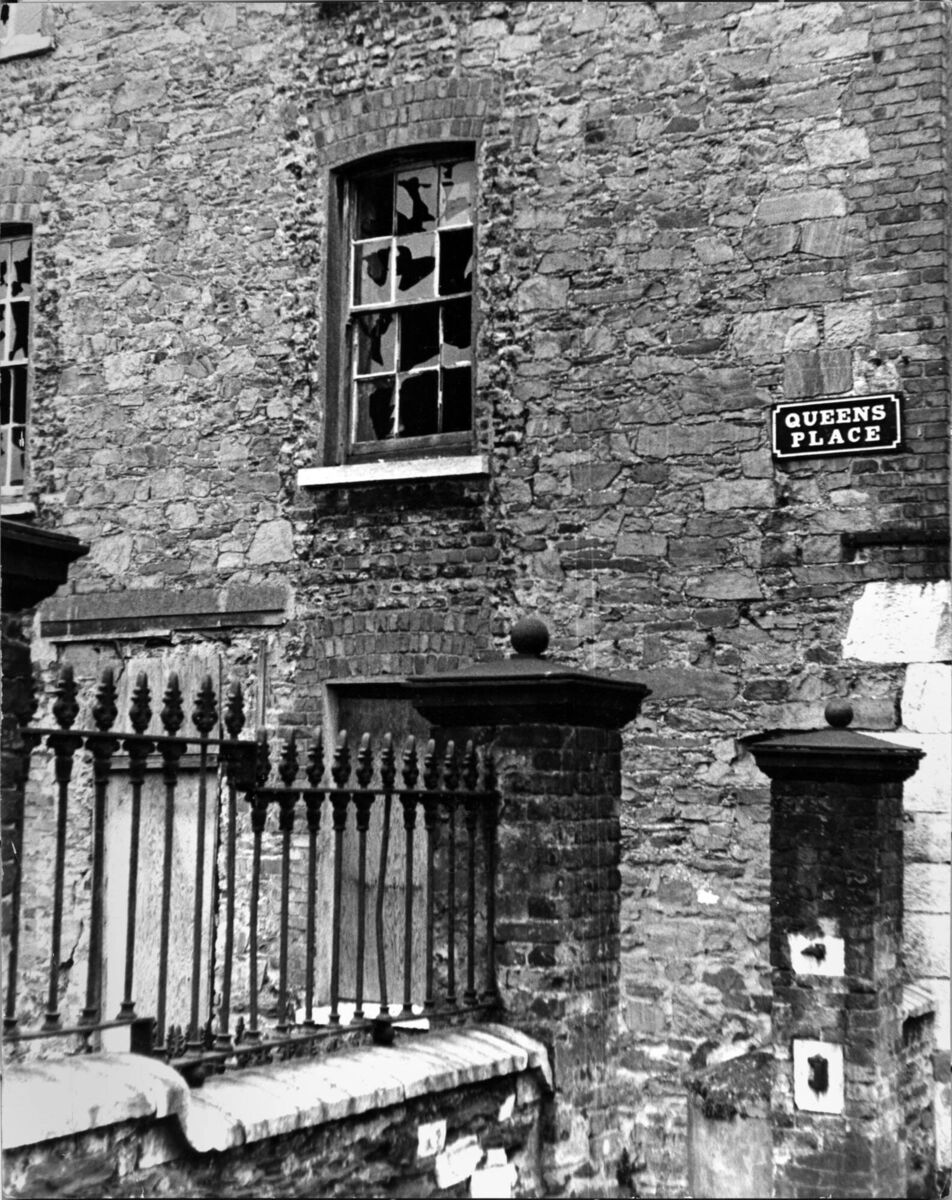
Soon the venerable houses of Queen’s Place would decay to such an extent that they were no longer habitable and in 1968 they were sold by the Perrott’s to Cork Corporation for £500. The same sum that was rejected for them and the other houses in their lot in 1867.
Three years later, citizens in the Middle Parish started a development association at a meeting held at the Matt Talbot Hall on Grattan Street. Vice-Chair, Tom Newman, stated “we must make 1971 ‘Marsh rebuilding year’”. Councillor Pearse Leahy was elected an honorary member of the association and told the meeting that he had proposed to Cork Corporation that Queen’s Place be converted into flats for old persons and newly married couples. It was centrally located and had a traffic-free area at its front. He felt old people should not be congregated all by themselves but inter-mixed with people of other ages. A petition was decided upon but, alas, this effort to save the houses didn’t succeed.
Demolition work began in October 1974. What did it matter, and did anyone remember, that there were still 260 years to go on the original lease? In 1976 the Corporation pushed ahead with plans to turn the site, and a number of other vacant lots, into carparks. A Corporation spokesman said on April 4 that work would soon begin at the Queen’s Place site and there would be room for 33 cars. The site continued to function as a carpark until 1989 when it was closed and work began on building a new Labour Exchange, now known as Social Services Offices.
Memories and associations lingered on with a Cork address that was no more, and the memory of which was rapidly fading. The Gardaí at Union Quay appealed in 1980 for any information on a pale blue Ford Escort “stolen from the Queen’s Place”.
Finally, dogs and other pets featured, and experienced love too at Queen’s Place, but also suffered their trials and tribulations. A small terrier puppy, black with a tan head, got lost in 1886. Mr. Nicholson at No.3 was happy to bestow a reward if found and brought home. In 1914, the same fate befell a dog of a later canine generation. This was Jimmy, a cross between a wire-haired terrier and a sheep dog, again there was a reward if the peregrinating pooch was returned, this time to No.2. Finally, in 1952, also from No.2, a white terrier with golden ears went walkabout in Fitzgerald Park. Again, there was a reward on offer for the dog’s return.
This article appeared in the .