Throwback Thursday: Do you recall St Brigid’s Day Biddy Dancers?
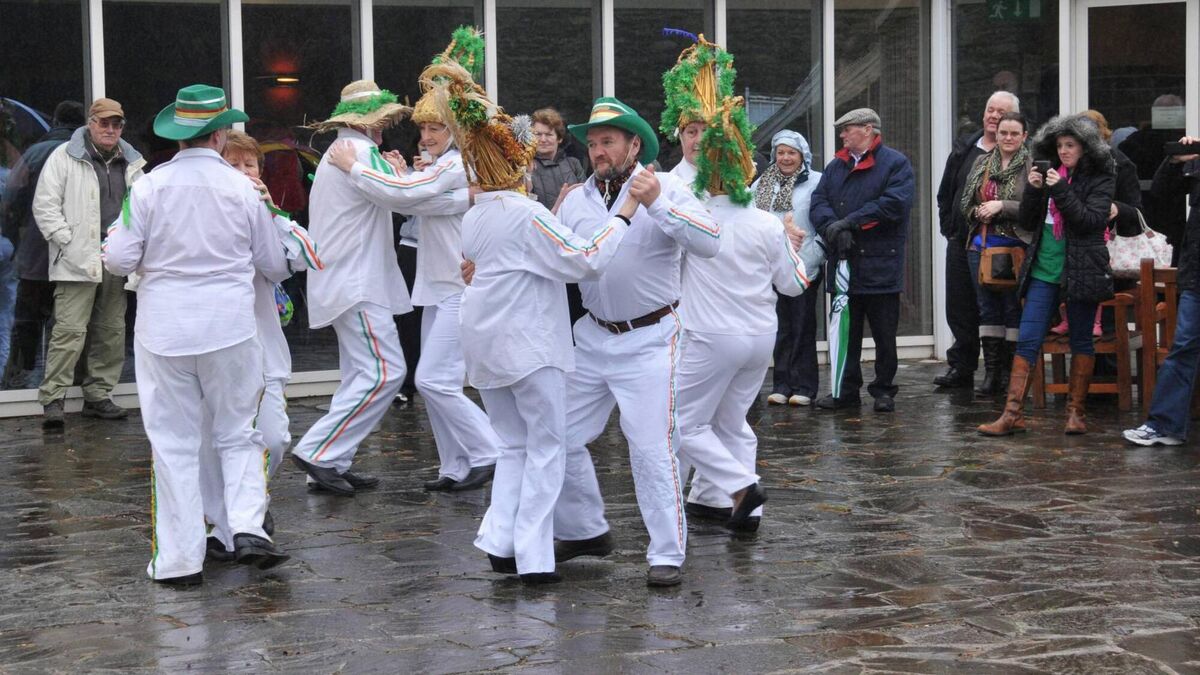
Biddy dancers at Muckross in County Kerry in 2012. It is a tradition long associated with St Brigid’s Day on February 1. Picture by Richard Mills.
IT’S February 1, Imbolc, St Brigid’s Day! The coming of spring in Ireland, historically when lambs were born and milk was once more available after a lean winter.
Brigid was one of our most powerful goddesses, long before the male-dominated Christian church came across from Italy and denigrated her to the role of gentle nun. Back in the day, she was honoured everywhere on this day by the Biddy Dancers.
Have you ever seen the Biddies? Once they were as well known as the Wren Boys at midwinter, but today they are mostly found only in Kerry where they visit houses and pubs, dancing to celebrate the importance of the goddess, usually carrying a ‘brideog’ or doll to represent Brigid herself. If you have memories of seeing them, do let us know!
Now, it didn’t take long for somebody to respond to that picture of a girls’ class at the Model School sent in by Michael Quinlan last week. See here.
If you remember, Michael said: “I don’t have an exact date but I would guess it was the early 1940s. My sister, Nuala Quinlan (4th from left in the back row), is in the photograph. It was sent to me by my niece, Patricia McMorrough, who should get the credit for unearthing it.”
And very pleased we were to receive it too, and to give credit where it was due, both to Patricia who found it, and to Michael for sending it in to us.
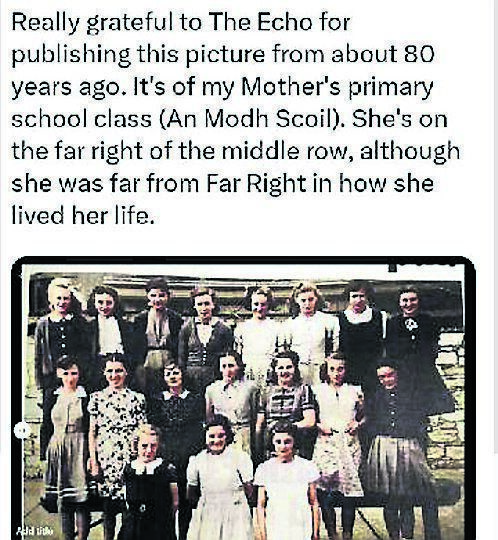
Even more pleased was Green Party Cllr Dan Boyle, who commented delightedly on Twitter (or as they try to call it now, X): “Really grateful to The Echo for publishing this picture. It’s of my mother’s primary school class (Ad Modh Scoil). She’s on the far right in the middle row, although she was far from Far Right in how she lived her life.”
So now we know two of the young ladies in that picture. Nuala Quinlan, 4th from left in the back row, and Sheila Scully (Dan’s mother) on the far right in the middle row. Any more coming up? Have another look and see if you see a face you remember.
It is a wonderful feeling to discover a face and a person from the past. Always worth checking old photos. One person may not be able to recognise someone, but chances are, another onlooker might!
Photographer Mike English seems to have been thinking along the same lines, since he has sent us a delightful picture from the Echo of some four decades ago, of children playing on Sarsfield Road.
“One of the lads in the attached photo sent it on to me this week,” said Mike. “He had saved it since it appeared in, I’d guess, Southgate, an Evening Echo supplement which used some of my stories and pics in the mid-1980s when this pic was taken of the lads, from Summerstown, Sandymount and Southbury Road in Glasheen/Wilton, messing around near Sarsfield Road. My thanks to John Hegarty, who kept it safe over the last 40 years or so.”
Where are those carefree kids now, wonders Mike, and what are they doing? Harassed fathers of children who are now themselves experiencing those carefree days of youth? Big businessmen, flying off here, there, and everywhere? Running a restaurant, designing computer programmes, writing poetry?
Have a look and see if you recognise anyone!
Tim Cagney has written to say he enjoyed our observation in last week’s Throwback Thursday about people in Cork loving to dig further and further into the antecedents of someone they have only just met until they can place them with that classic phrase, “Oh sure, I know who you are now!” - often followed by the revelation of a tenuous family connection.
“This phenomenon is not, of course, restricted to the confines of Cork,” says Tim.
“It may well be worldwide, though certainly linked to that strong native desire we all seem to possess to ‘place’ fellow Irish, wherever they may be met.”
“A few years ago,” adds Tim, “my wife and I were in France, on a river-cruise. One evening at dinner, we got into conversation with a couple, and mentioned the subject of hobbies and interests. I told them I was a hobbyist writer, which - of course - prompted the inevitable question ‘what do you write about?’ I replied, ‘Well, I once wrote about a cake, known as a Chocolate Slice.’ The response was totally unexpected. ‘Oh, you must be from Cork!’
As far as I can recall, the individual was a Cork native, now living in Limerick.
And presumably still hankering after that wonderful confection formerly made by Thompsons, now still in production by, as far as we know, the Old Mill Bakery, who took over those closely-guarded recipes by special arrangement when the great old bakery closed its doors in the 1980s. And aren’t we all grateful to Old Mill for keeping up the tradition? (Before you ask, we are fairly certain you can get them in the Douglas Court Shopping Centre, or you could last time we looked. Do let us know if you go along and find them.)
But it does reflect that Irish urge to establish the credentials, so to speak, of those they meet on the street or in the café. It’s something instinctive, built into us millennia ago, when a stranger in your close-knit community was an exception, and you needed to find out fairly quickly if they were friend or foe, relation or raider.
“Back, then you really did know everybody in your townland, your region, and we didn’t travel further afield without a very good reason, so a new face on the lane or in the settlement was cause for concern until you discovered that it was, after all, only the brother of Brigit who had married Seanin Rua last year, coming across to see how she was doing and bring her news of the family. “Oh, I know who you are now!”
Now, back to the recognition of old photographs, in this case, the exact location in which it was taken. Frank Desmond was annoyed that in the Throwback Thursday of January 18, we made enquiries about the identity of those pictured on the cover of Old Ireland In Colour, showing a hayfield scene in Wilton, but didn’t do the same for a UCC protest picture from the 1960s.
“This Throwback Thursday piece is strange, in one way at least. You discuss a previous picture and where exactly in Wilton it was taken. However, you show another picture but neither state nor enquire as to exactly where it was taken.
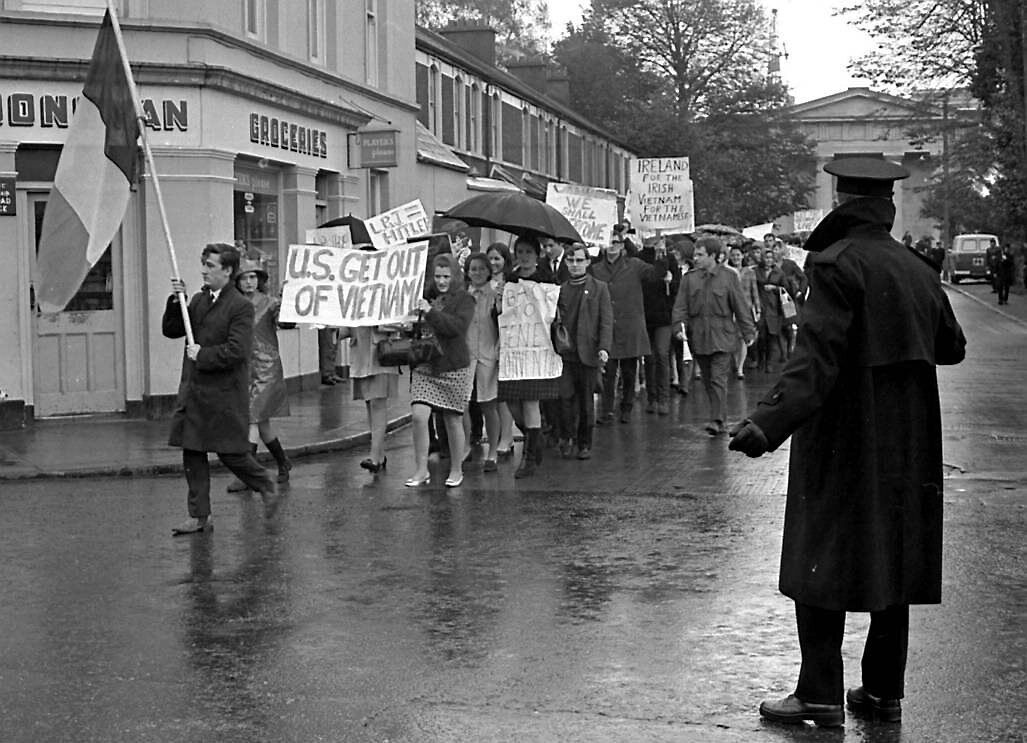
“I refer to the picture of UCC students protesting against the Vietnam War in 1967.
“Nowadays, at the corner of Highfield Avenue and College Road there is a Daybreak convenience store. I wonder whether that is where the GROCERIES store in your photograph was at the time ?”
Well, Frank, in the first place, we were sent that cover picture of the hayfield by Mary O’Leary, who did herself raise the query about where it was and who was immortalised in it. We asked readers, and even Mike English, acknowledged expert on the local history of the Bishopstown area generally, couldn’t quite pin it down. But we live in hope!
As regards the UCC picture, this was taken from our archives to illustrate life in UCC at the time that Johnny Campbell was missing a great many of his lectures to experience the heady delights of playing in the beat clubs of Hamburg. The date the picture was actually taken (November 20, 1967) was in the caption.
However, it seems you are actually hoping to establish where exactly that picture was snapped, so we will throw this one open to other keen-eyed readers of Throwback Thursday.
Do you think it is taken on that corner of Highfield Avenue and College Road? Can you remember the shop that was there then? Did you, indeed, visit it for the essential extras of everyday student life? If so, what did you buy?
It’s all part of the jigsaw that we build up on these pages each week, reflecting life in the Cork of yesteryear, and everybody loves reading the little details. Often, these spark memories that they thought had gone, and there we are, off on another wonderful trip down Memory Lane.
Checking up on when Thompsons actually closed (regarding the chocolate slice reference above), we were reminded that, back in the good old days, there were innumerable bakeries in and around Cork, supplying households with those loaves of every type - skulls, ducks, baskets, pans large and small, Viennas, and so many more. Plus, of course, buns and cakes.
This writer’s family patronised Donnelly’s, founded in 1920, with premises on Shandon Street. They delivered bread in the most wonderful high-wheeled horse-drawn vehicle right up to the 1960s.
Donnelly’s were in fact one of 13 bakeries on Shandon Street, hard though that may be to believe in these days of closures and disappearances from one week to the next.
Then there was O’Shea’s, established by Henry O’Shea in South Main Street. He had learned his skills at a bakery in New York before returning home and setting up his own business to supply his native city (as well as becoming Lord Mayor).
Sir Henry’s nightclub, opened on that selfsame site in 1978, was named in his honour. And then there were Fitzgerald’s, Hosford’s, Currans - so many more, each with its own loyal clientele.
Bread from your chosen establishment always tasted ‘right’, and that from down the road wouldn’t do at all, even if it was closer.
How many readers can remember being sent for the bread, and being quite unable to resist nibbling at the crisp crust on the way home? We are all familiar with those pictures of little French children carrying home the baguettes three times a day, but here in Cork we had our own experience with the seductive aroma of crisp golden brown loaves, fresh from the oven, and wrapped in that light brown tissue paper characteristic of bakeries back then.
We are emphatically not talking here about the ‘sliced pan’, which actually made its appearance in England as far back as 1928 (when it was advertised as “the greatest forward step in the baking industry since bread was wrapped”, hence giving rise to that catchphrase - “the greatest thing since sliced pan.”)
Interestingly, the UK banned its production during the war years, since it made use of prohibited products - the wheat used in its dough, the steel in the industrial slicing machines, and the wax paper for wrapping the loaves.
No, we are talking about real bread, made by dedicated bakers who normally started their day in the wee small hours so as to have the still-warm loaves ready as the shops opened.
Fortunately, the scent of new-baked bread can still be experienced in Cork, and long may it remain so. (Sadly, that similar unforgettable aroma - of coffee beans being ground in the window of Woodford Bourne’s - has gone, but its memory remains.)
Tell us your own memories! Email jokerrigan1@gmail.com. Or leave a comment on our Facebook page: https://www.facebook.com/echolivecork