Hold ye front page! Cork headlines from the 1700s
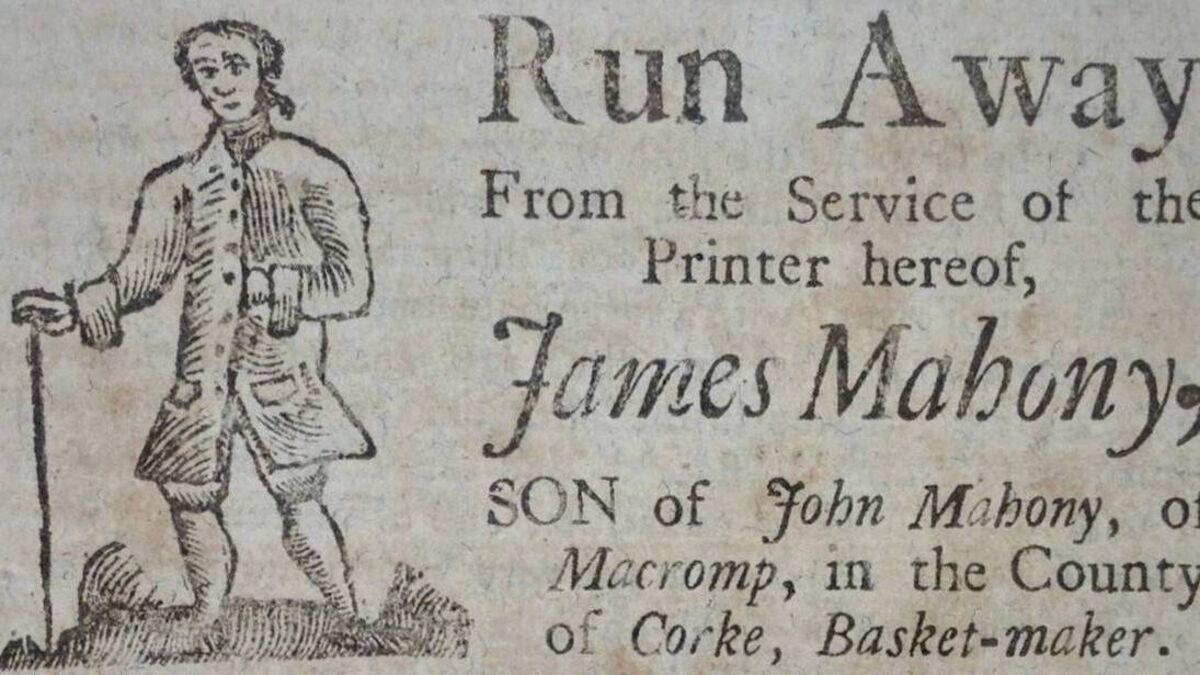
A story about a slave fleeing his Cork master in The Corke Journal on Friday, March 1, 1754
IN the 1600s, newspapers began appearing with regularity in European countries.
The first English versions surfaced in London in 1621, and the first daily, the Daily Courant, ran from 1702 to 1735.
Cork’s earliest surviving newspaper is The Corke Journal, dating to 1753. Copies can be seen in the city library and it was printed on paper of such quality that pulp fiction from the 1960s has deteriorated more.
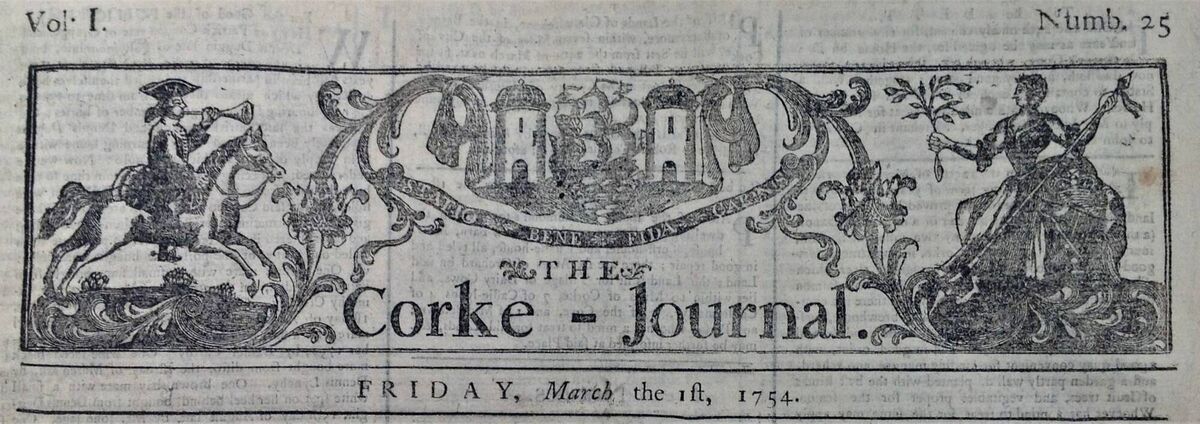
The Journal was published by Eugene Swiney, and its ornate banner proudly displayed Cork’s coat-of-arms and motto. It had a mix of international, national and some local news, and that and its ample advertising tells us much about Cork 270 years ago.
Naturally, there are no photos, but the few illustrations give us a glimpse into that era, such as signs for city businesses. The vast majority of people were illiterate and shop or inn signs explained their line of business.
These signs for three establishments feature repeatedly in February and March, 1754.
The Half Moon And Three Stars
A John Coppinger was ensconced here, between St Peter’s Church and Skiddy’s Castle on North Main Street - today’s Vision Centre and Adelaide Street.
He was what was termed a clothier and announced he had just returned from England with a great range of men’s and women’s wear. He was also supplied from Dublin with Irish-made goods, and invited those “so kind to favour him with their commands” to come visit, and rest assured that they would be well served and he would “make it his study to give them content”.
The Three Nuns
Over at the Three Nuns on Hammond’s Marsh was Albert Curry, at a location now occupied by the Mercy Hospital and its vicinity.
A draper, he manufactured some of his own stock and was keen to match the standards in fashionable Dublin in price and quality of goods and service.
Albert was making considerable efforts to achieve this and promised those Cork citizens who gave his shop “a Tryal” that they would find his “dealing no less agreeable than his goods”.
The Harp And Crown
Here, we find James Collins, whose premises was as central as could be in 1700s Cork, near the Exchange at the North/South Main Street and Castle Street juncture, focal point for Cork’s civic and commercial life. It also housed the city’s clock.
In his advert, Collins informs the public he has returned from purchasing trips to Dublin and London and his drapery is in a position to supply a bewildering variety of goods. Among them English drabs, superfine Irish rugs, livery cloths, serge denims and barragons (cotton summerwear). Plus, common hair shags (a choice of feathered, flowered and plain), nankeens (cotton cloth) and swanskins.
Also, clergymen’s beaver hats, velvet and silk shapes, English bombazines, and rustles and pink stuff for petticoats. How about rock spun poplins (fine fabric), or a choice from a great variety of buttons - gilt plated, livery, cut jet, and death’s head?
Guns for Hire (and Sale)
Venturing newly into business at this time as a gunsmith was William Collins, who opened his shop under the sign of the Cross Blunderbusses, next to John Coppinger in North Main Street, and had a large assortment of gun and pistol work and all the materials for firearms.
He was determined to supply as good work as any in the Kingdom and had taken on the best hands on the best wages.
North and South Main Street was the city’s main artery, as it had been since Viking days, the thoroughfares of Patrick Street, Grand Parade and South Mall having not yet been established.
Opposite St Peter’s Church on North Main Street was the sign of the Unicorn, where Peter Eason was another with new stock in, for hardware.
His advert listed a mixed bag of 92 items, including, silk whip lashes, inkles and bobbins, Dutch needles, Irish garters, sealing wax, tea table bells, bone and buckhorn knives and forks, spring penknives, snuff dishes, shoe buckles, fountain pens, cock spurs, scissors, nut crackers, brass, bone and paper inkpots, nutmeg graters, keyrings, spectacles, wig springs, punch ladles, prayer books, spelling books and history books and “several other goods too tedious to insert”.
Salmon and Cider
Closing the door behind us and making for Goold’s Marsh, we get a whiff of fish at Connor McInerney’s Salmon House. Here you could buy pickled salmon for six shillings a keg, or split and salted salmon sides, and no better job to quench the resulting thirst than Cork cider.
William Coppinger, at Barryscourt, Carrigtwohill, produced his own cider at 40 shillings a hogshead - or 408 pints. It could be had from Joseph Coppinger in the city but, when empty, the hogsheads were to be returned. No doubt, Joseph, or his servant, would carry them back to Barryscourt on horse and cart.
Another Cork cider producer, Thomas Beale, suggested empties be sent to him, which he would fill and send back for 30 shillings. He offered to ferment his “syder” as “ruff as required”, “with choice wildings mixed with the apples”.
An alternative to salmon was available from Robert Ross at the Turk Head Tavern, whose ‘Chop House’ aimed to “furnish gentle- men with agreeable eatables”. His accompanying porter was nine months bottled and he would sell none that was bottled for less. It cost five pence the bottle.
‘Carry out’ cost four shillings sixpence for two six packs, the bottles to be returned.
James Mahon, on Hanover Street, also sold alcohol but dealt in more mixed goods too. Indeed, one can see the beginnings of an iron foundry on a street that would long be associated with it.
James offered choice rum and brandy, along with indigo, rape and linseed oil and “iron of all sorts”. He also had in fine Cadiz salt and new Alicante wine.
Or, if one’s taste was more inclined to French, one could get in on the bidding for 12 hogsheads of Château Haut-Brion, which had been sent over from France and were ready for auction in a cellar outside the South Gate (base of Barrack Street) at 1pm on August 23, 1754. The wine could be tasted any time before the sale.
On a Health Kick
It wasn’t all alcohol in Cork, folk liked their health kicks too.
There seems to have been a craze for German spa water. William Campbell, an apothecary (predecessor to a pharmacist) near the North Gate, “had fresh German Spa Water in small flasks”, and medicated candles.
Booksellers Phineas and George Bagnell had stocks of spa water along with their books and stationery. Cornelius Sullivan, bookseller on Castle Street, also sold wallpaper, with “the most beautiful London patterns”.
Minerals for the body, minerals for the soil, John Connor had “right good” rock lime at 1s 2d a barrel, and was willing to deliver “anywhere within the gates”. He would meet customers as far as the lower green in Blackpool, but anyone who would go to his kiln at Gillabbey, where he produced the lime, would benefit from a price reduction. John also had a quantity of “well saved hay” to sell at Mr Flack’s “country place at Ballyphehane”.
Another lime dealer, Richard Welsh, had bulk quantities at Ballybricken, Ringaskiddy, ready for convenient transport on the waters of Cork Harbour. Price 12d per barrel.
Lost and Found
The Corke Journal of the 1750s also ran notices from people in one spot of bother or another.
John Punch, a farmer in Ballinvuskig, near Donnybrook, in the city’s South Liberties, had lately bought a bay horse from one William Devereux, who had since been confined in the gaol at the South Gate for horse stealing.
Mr Punch now suspected his horse may have been stolen and was issuing notice that anyone laying just claim to the animal could have it returned on paying all associated expenses.
A guinea was not to be sneezed at - the equivalent of 21 shillings, or one pound one shilling - and two were on offer from George Morgan, who was trying to find a gold watch lost between Douglas and Cove Lane. Another precious item, a sword mounted with pinchbeck (brass resembling gold) had been lost somewhere between Cork and Kinsale.
The Trouble with Servants
Servants, eh? Can’t live with ’em, nor without ’em.
John Norcott’s man, Thomas Boulton, absconded from his house on George’s Street (now Oliver Plunkett Street) with his brandy and rum in August, 1754, and scaled a 10ft wall to get away.
Mr Norcott put up a guinea reward to anyone who brought him to justice. Be on the look-out for a “low, swarthy, ill-featured young man, very much marked with the small pox. With a flat turned up nose, wearing his own hair (no wig) and brass buttons”.
Another runaway servant, James Mahony, 18-year-old son of John Mahony, a basketmaker in Macroom, was described as having a “down, sullen look” and “a lubberly idle way of walking”.
Cork was a hub of international shipping and indicative of this is a report of a runaway from a ship anchored in the harbour. In this case it was a black servant, the “property” of Captain Carroll.
Anyone who brought him to Widow Cotter in Cove, or to Silvester Ryan in Cork would be paid four guineas. There was also a reward for the capture of whoever rowed him to shore.
Hell Hath No fury...
Domestic troubles also made it into the newspaper. Wives were the responsibility of the husband, who was obliged to honour any debts if she ran away.
Cork woman Mary Granell placed a notice in the Journal, saying she never had any intention to elope from her husband John, nor run him in debt. It was her in-laws she had received very ill treatment from, which obliged her to seek refuge in her father’s house, and she placed the notice to acquit herself of any unwarranted scandal.
Finally, a bizarre occurrence befell a family one Sunday night at Castlemacauliffe, a townland between Newmarket and Boherbue. Timothy Connell and his wife went out, leaving the door of their cabin ajar. A badger entered and made its way to where the children were asleep. Whatever possessed it, it attacked them, biting one on the back and arm, another on the cheek, another on the finger.
When Timothy returned, he fetched a pike and killed the possibly rabid badger stone dead.