Remembering the dawning of the age of the 'Supertrain' in Cork

In 1972, a new service began which promised to take rail travellers from Cork to Dublin and back in de luxe comfort, recalls PAT WALSH
Remembering the dawning of the age of the 'Supertrain' in Cork

TLAP OF LUXURY: he interior of the Supertrain with waitress service

HALF a century ago, two major events in the history of railways in Ireland took place.
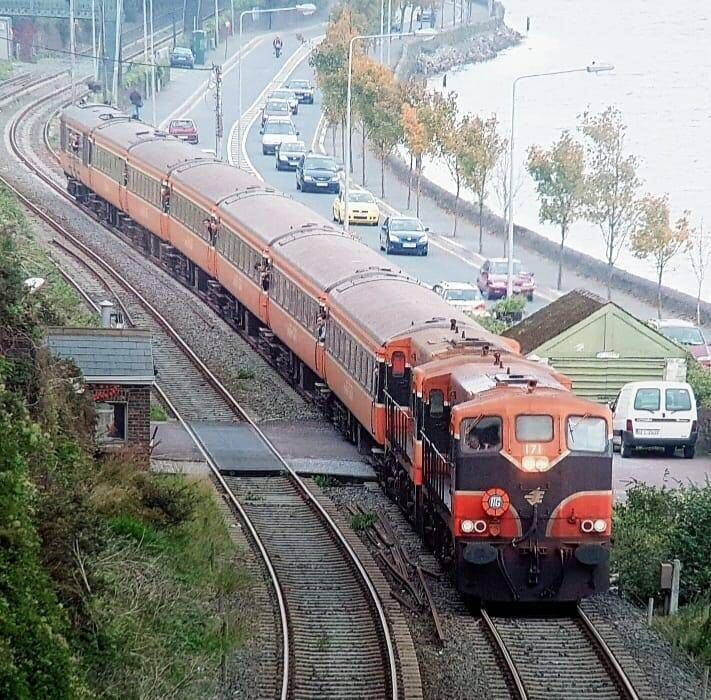
In March, 1972, the student Interrail pass for travelling around Europe was launched, and in December, the age of the ‘Supertrain’ dawned. Dubbed ‘the Trains of Tomorrow’, Ireland’s first ever air-conditioned carriages went into service on the Dublin Heuston to Cork line on December 4, 1972.

To promote the new departure, CIE embarked on an aggressive advertising campaign and also introduced uniformed hostesses on mainline services.

Although substantial investment had followed the nationalisation of CIE in 1950, much of its passenger rail coaches bordered on antique for the following two decades.

A local rail enthusiasts’ special in 1965, for example, had in its make up an old six-wheeler which, although seldom used, dated back to Victorian or Edwardian days, but was still officially on CIE’s books.

As the ’60s progressed, the Government realised their purchase of a modern fleet of steel-bodied coaches from Cravens of Sheffield, which arrived between 1963 and 1967, would not be enough to meet growing demands for a more frequent and faster national rail service.

Consequently, CIE purchased yet another fleet of coaches, more advanced than anything that had hitherto run over the Irish rail network

Ordered in 1970 at a cost of £2.5million, delivery of these carriages from British Rail Engineering Ltd began in July, 1972, when the train ferries, Essex and Cambridge, began arriving at Dublin’s North Wall.

Unlike the previous two fleets, these coaches arrived fully constructed, the others being in kit or prefabricated form, although minor work was done to some of the new stock at Inchacore Works.

In all, 71 vehicles were delivered and included generator vans and kitchen cars, as well as coaches with variations on seating spaces for first and standard class passengers.

A presidential coach was also included - but what were the features that attracted such descriptions as ‘Supertrains’, and ‘Trains of Tomorrow’?

Supertrain coaches in their latter days on an enthusiasts’ special at Tivoli in October, 2006, with driver Tommy Ryan in charge. Picture: Joe Lawton

The principal advance was air-conditioning. Prior to this, airflow through a carriage was determined by the speed of the train and number of windows open. Now windows would be sealed and a constant temperature of 20-22C would be maintained on a four-minute circuit, the incoming air a mixture of recycled and fresh air.

Noticeable from the outside but not the inside, the coach windows were smaller than those in previous stock, and had glare-reducing glass in order to minimise the visual discomfort of passing close objects at high speed.

Thoroughly modern kitchen cars with stainless steel surfaces and every appliance you would find in a hotel kitchen were fitted out at Inchacore. They were called kitchen cars, not restaurant cars as the intention was to deliver meals directly to the passengers in their seats throughout the train.

Other features included wrap-around doors that curved around the end of the carriage, maximising access and egress, and friction dampers which reduced vibration throughout the carriage while the train was in motion.

Coaches contained shelving for luggage at one end while lavatories contained shaving sockets and foot pedals for the toilet and wash hand basin.

Regular trials ran on the Cork-Dublin line in September, 1972, and on Thursday, October 26, the new coaches were introduced to the press when a special ran from Heuston to Portarlington and back.

The observations by those who travelled are ones we take for granted when railing mainline today.

“Most noticeable, prior to departure, was the instant reduction in background noise once the doors were closed, due to sound insulation. As well as the clarity of the public address system, praise was given to the ease and lack of motion as the train reached in excess of 70mph, with one enthusiast commenting that the train seemed to be merely gliding along.”

This report concluded that the train was very well lit, silent-running, and with its air-conditioning resulting in a really comfortable atmosphere.

This truly was the future for Irish passenger rail travel. Incidentally, the first revenue-earning trip by the new air conditioned stock was made on November 14 when a three-coach set operated a special run from Dublin to Cork, conveying the former U.S speaker of the House of Representatives, Mr John W McCormack.

CIE ran an elaborate TV and press advertising campaign to promote its new fleet. Marketed as ‘Supertrains’, the ads included stunning aerial shots of these trains with their streamlined profile of orange and black. Alongside the new trains, new

surfaces of black and white tiles had been laid on platforms of all the principal termini, replacing the hitherto drab surfaces of grey concrete.

Also in 1972, the re-engining of 60 locomotives with reliable General Motors units had been completed. Together with the introduction of the new trains, CIE unveiled Rail Plan 80, which envisaged shorter, faster, and more frequent passenger trains, while the rail freight division was to be thoroughly rationalised and modernised.

There was an air of confidence about the future and viability of the Irish rail network. A new ‘Super Standard’ ticket replaced ‘First Class, costing £1 more than the standard fare, irrespective of the length of the journey.

The new trains would reach maximum speeds of 75mph - although that very week, there were reports of a ‘supertrain’ in the USA being developed that would hit speeds of 300mph! Current Irish train have a maximum of 100mph/160kmh.
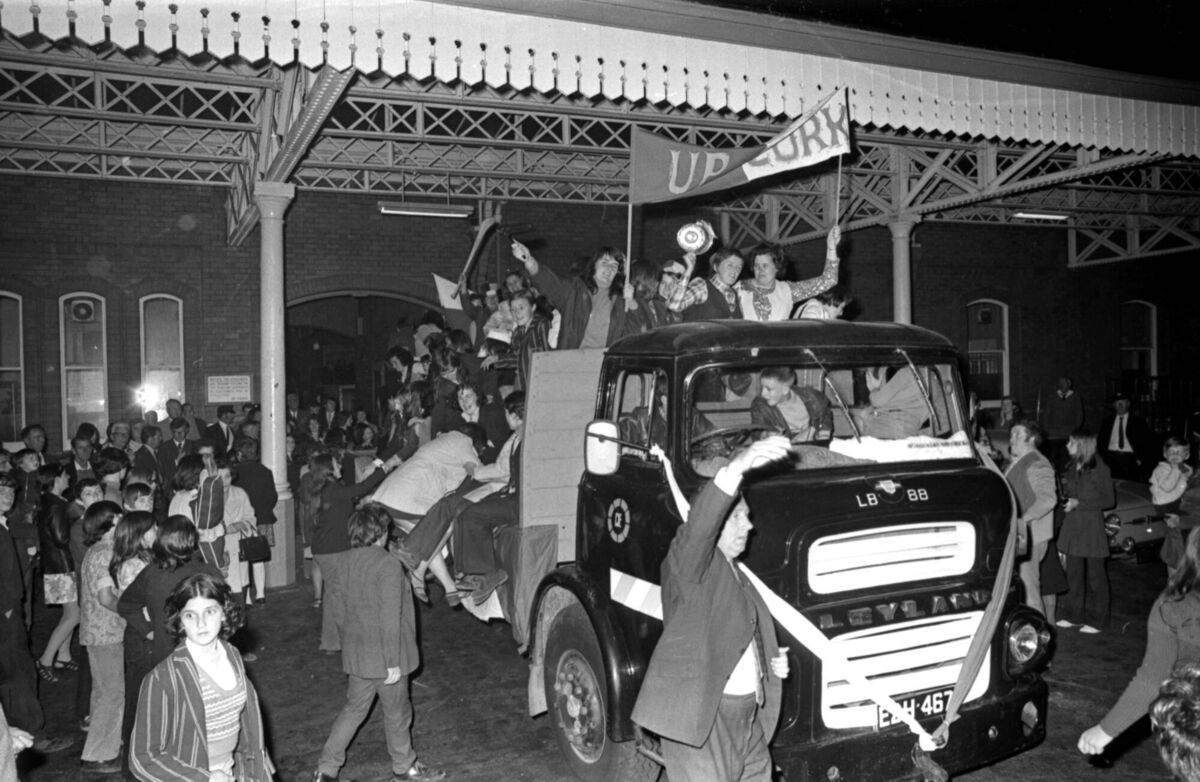
Three-in-a-row Cork camogie champions and supporters leaving Kent Station to begin their victory parade to the Victoria Hotel on September 19, 1972 - around the time the 'Supertrain' arrived

Finally, on Monday, December 4, driver Jerry Lyne - a Corkman - took the first service ‘Supertrain’ out of Dublin Heuston to Cork. On arrival at Kent Station, CIE officials and guests went to Blackrock Castle for a special lunch, at which it was announced that Cork would soon have an hourly rail service to Dublin.

Mr J.J Byrne, General Manager of CIE, led the speeches, deputising for its Chairman, Mr T.P Hogan, who was attending the funerals in Dublin of two bus workers killed in a spate of bombings in the capital.

In a rather back-handed compliment to the new service, Lord Mayor of Cork, Cllr Sean O’Leary, said CIE had a “soiled image” - as an organisation riddled by strikes and not particularly concerned by timetables - but this had all changed with the advent of the new stock.

The Echo sent a reporter on that maiden journey, who gushed: “The first thing one notices about the ‘Supertrain’ is that one does not sink into the airliner-type seats. In fact, they are quite firm. A CIE official told me, ‘You’ll find that when we get to Cork, you’ll be quite sprightly’. He was right.”

While it would be some time before Cork got its hourly service to the capital, the ‘Supertrains’ were running to all principal destinations out of Dublin by Christmas, 1972, and well appreciated by the travelling public. For a while, CIE even published a free newspaper available at all principal stations called Travel Express.

In time, these coaches, as they aged, were transferred to less busy lines while newer fleets were introduced to the Dublin-Cork service.

At present, Irish Rail are awaiting delivery of yet another generation of train, the fourth serving the Cork main line since 1972, from Korea - but none will generate the excitement and expectation that accompanied the introduction of the ‘Supertrains’ 50 years ago.
Read More

Sweet Cork of thee: How I made donkey's gudge in 1960s

More in this section

Throwback Thursday: The Cork gate-crashers who tried to con Pioneers Throwback Thursday: The Cork gate-crashers who tried to con Pioneers
Throwback Thursday: My happy childhood in city’s Moores Hotel Throwback Thursday: My happy childhood in city’s Moores Hotel
Throwback Thursday: Taking a drive down memory lane in Cork Throwback Thursday: Taking a drive down memory lane in Cork

Sponsored Content

A top expert reveals the perfect wine for festive cheer and Christmas party pairings A top expert reveals the perfect wine for festive cheer and Christmas party pairings
"Without you, I would have been a goner" "Without you, I would have been a goner"
Skechers launch basketball footwear range ahead of partnership with UCC Demons Skechers launch basketball footwear range ahead of partnership with UCC Demons
Contact Us Cookie Policy Privacy Policy Terms and Conditions

© Examiner Echo Group Limited

Add Echolive.ie to your home screen - easy access to Cork news, views, sport and more