Turning risk into reward: Top business risks in 2026

Irish businesses are navigating heightened volatility across how we trade, the technology we rely on, the weather we can’t control and the workforce we’re trying to attract and retain
If you were leading a business in Ireland in 2025 and wondered when things might settle down, then you know the answer by now. They won’t.
From fluctuating interest rates and more frequent cyberattacks, to geopolitical volatility and regulatory change, 2025 often felt like trying to keep a tray of glasses steady while on a moving bus.
Aon’s latest Global Risk Management Survey (GRMS) suggests the turbulence of recent years is now a constant and that 2026 will ask the same questions of decision makers.
Four big forces are shaping our world: how we trade, the technology we rely on, the weather we can’t control, and the workforce we’re trying to attract and retain.
These forces don’t operate in silos; they interconnect and overlap. A cyber incident becomes a reputational crisis. A conflict overseas quietly disrupts your supply chain.
A weather event shuts your doors and drains cash flow. That’s why, in 2026, leaders in Ireland will need to become even better at making decisions that best manage their overall risk profile.
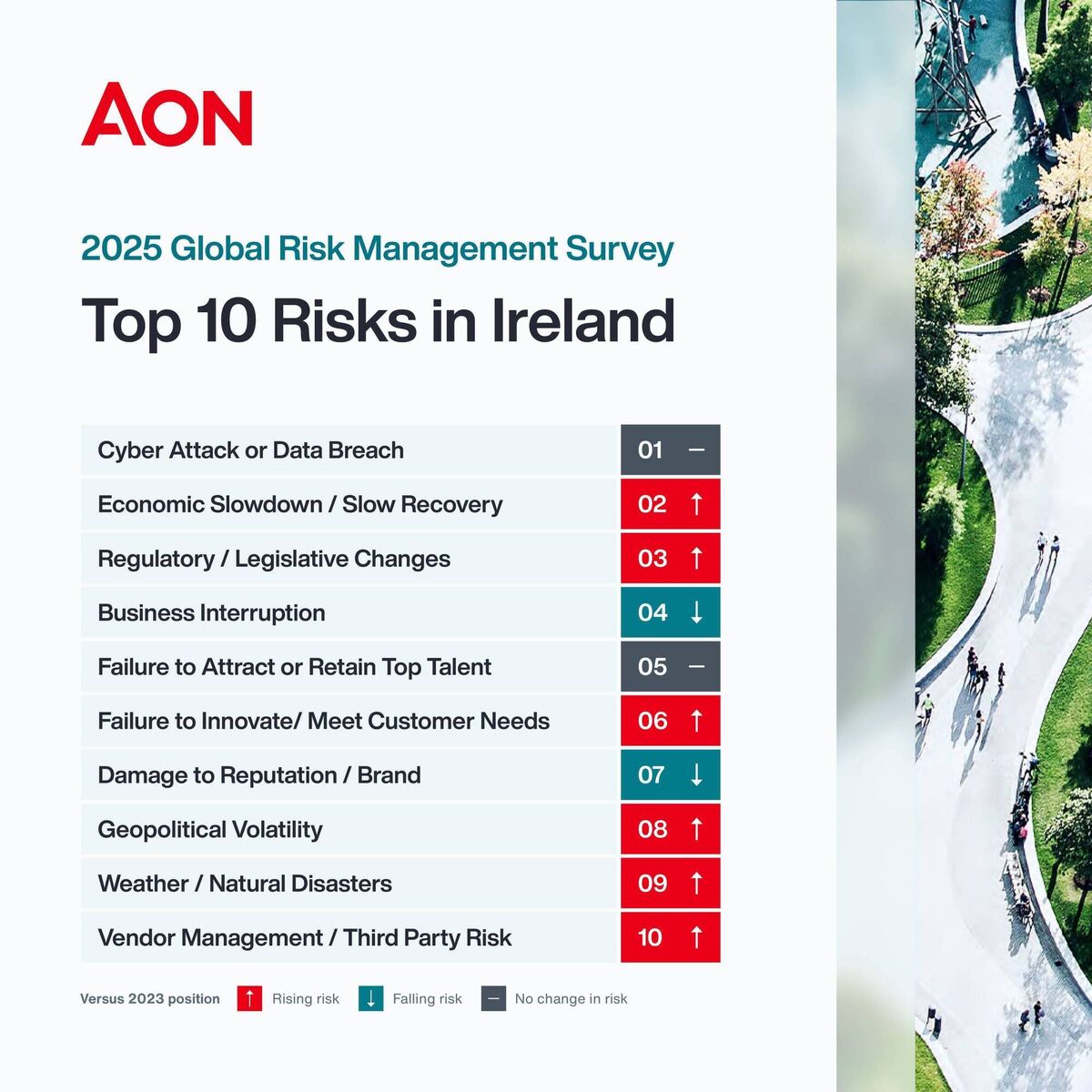
According to Aon’s GRMS research, cyber is the number one risk facing businesses in Ireland, now and over the next three years. While this won’t come as a surprise, the ever-evolving nature of cyber risk is the concern.
AI‑powered attacks are more frequent and convincing, while phishing emails are more sophisticated and harder to spot. Malware is continuously learning from your defences and adjusting accordingly.
We saw in 2025 how the financial and operational impact of cyber risk is increasing – the average global cost of a data breach has now reached €3.7 million.
This is before you count weeks of business disruption or how many customers quietly decide they no longer trust your organisation.
The EU’s strengthened cybersecurity directive, NIS2, spells out that boards have explicit responsibility for robust, tested governance against digital threats.
Aon’s cyber specialists in Ireland are clear about what it takes to manage the risk: continuous review, sensible investment in controls and decisions informed by data, not wishful thinking.
You’re only as strong as your weakest link – which might be a staff member clicking the wrong email, or a third‑party provider you haven’t fully scrutinised.
Those who manage cyber risk well don’t just avoid disaster. They build trust, protect their reputation and free themselves to accelerate growth in a digital‑first world.

Economic slowdown is ranked as the second top risk in Aon’s GRMS report. As a small, export‑led economy, the mood in Washington, Brussels or Beijing can have a direct impact on Irish business and will influence your boardroom discussions.
Protectionist trade measures, cautious consumers and nervous markets mean leaders can’t assume that yesterday’s growth story will simply repeat itself. Regular stress tests, scenario planning and liquidity checks stop being nice to have and become basic survival skills.
Protecting the budget for innovation is important – even in downturns, as it’s proven to aid faster recovery.
For the first time in 20 years, geopolitical risk sits within Aon’s top 10 risks for Irish and global decision makers, jumping more than 21 places since 2023. That’s not down to a single crisis but the cumulative effect of global trade tensions, ongoing conflicts and political instability.
Findings from Aon’s survey show that in 2025, 44 per cent of businesses in Ireland suffered a financial loss due to geopolitical shifts. That could mean disrupted supply chains, higher input costs or export markets suddenly becoming harder to reach.
Then there is the weather. Last year, Storm Éowyn was a reminder that climate change is not a distant problem. It caused big downtime in multiple sectors across the country and kept business interruption high on the risk agenda.
We now see business interruption ranking as the fourth top risk for Irish organisations, and this can be anything from property damage, a cyber incident or a failed supplier to something you never saw coming at all.
Whether it’s the impact of geopolitics or climate change, the potential frequency and severity of business interruption is significant. Considering the interconnected nature of these risks, setting a clear plan in place to manage and mitigate the known unknowns is an ongoing leadership challenge.
Overlaying all of this is regulation and people. Pension auto‑enrolment, the EU Pay Transparency Directive and other workforce‑related changes are imminent.
It’s therefore unsurprising that regulatory and legislative change is now a top three risk for businesses in Ireland for the year ahead.
Failure to attract and retain top talent rounds out the top five risks, as organisations in Ireland continue to grapple with a tight labour market.
Competitive pay is only the baseline; employees expect real flexibility, visible commitment to wellbeing, personalised benefits, and meaningful work.
At the same time, rapid advances in AI are disrupting traditional early-career pathways and talent models.
Leaders who understand their people risk and proactively invest in skills development and role redesign will be best positioned to equip their organisations with the capabilities required for future growth.
So where does this leave leaders in 2026?
Scenario planning, stress testing and honest conversations about risk appetite are crucial to building resilience across every area of operations. The good news is that leaders are not flying blind.
Data has never been more available or more powerful when used well. It helps organisations spot emerging risks earlier, understand what really drives their exposure and ultimately enables faster, better decisions that protect and grow the business.
The world in 2026 is likely to be every bit as volatile as the last 12 months, but Irish businesses have already proved they can adapt.
Leaders who are curious, learn from what others are doing well and treat risk as something to understand, plan around and even use, stand a far better chance of turning this volatility into an advantage rather than an excuse.
Supported by our talented team of risk experts, Aon’s Global Risk Management Survey brings together cross-sector insight in one place. For boards and executives who want to benchmark their own risk agenda, and turn insight into action, Aon’s Ireland report is a good place to begin.
Download your copy today at contact.aon.com/GRMS_IrelandReport