John Dolan: 50 years of Apple... and how it changed face of Cork industry
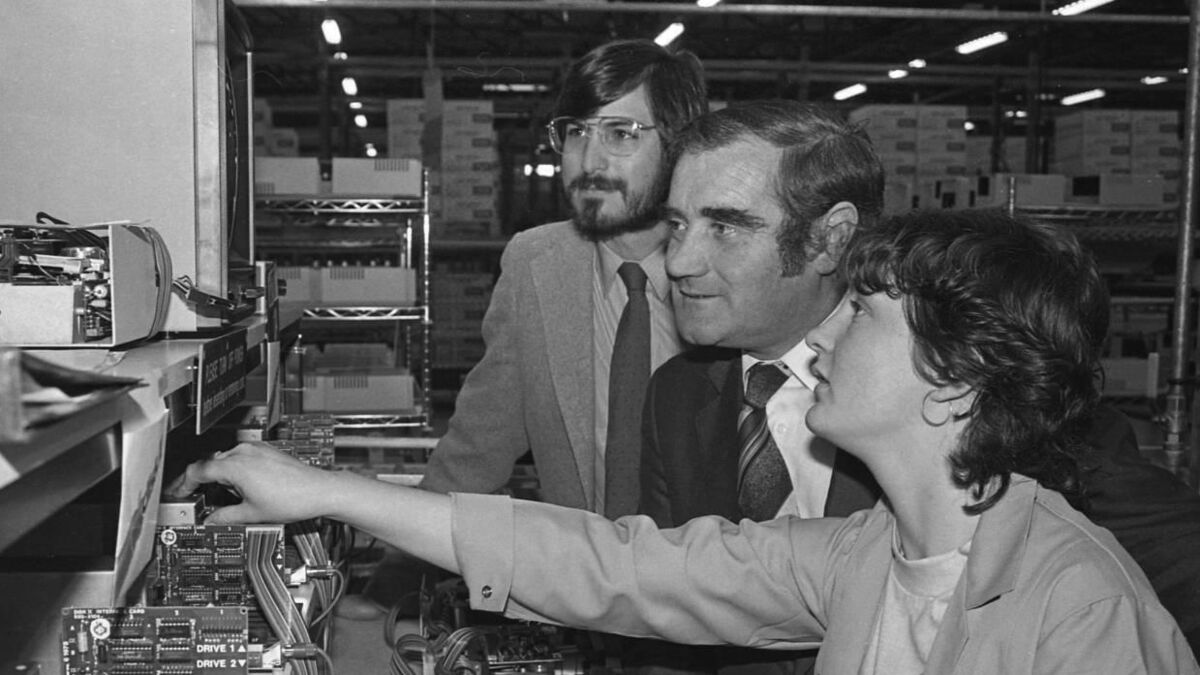
The trio had created a prototype for a personal computer, and after it was rejected by an established business, one of the men - 20-year-old college drop-out Steve Jobs - sold his Volkswagen so they could fund a start-up business of their own.
The origin story goes that Jobs was following a diet of mainly fruit and had recently visited an orchard - so Apple was chosen as the name.
The company was founded on April 1, 1976 - 50 years ago next week - and that seed of an idea, of course, went on to be a behemoth of global trade. Today, it is consistently ranked as the world’s most valuable brand, and has been valued at almost $4 trillion. That would almost fill a family car with diesel.
But it’s the importance of Apple to Cork that is relevant here on Leeside as the company’s anniversary is celebrated in the days ahead.
By 1980, the fledgling business was thriving with its mark II computer - with plans in place for a mark III - and had 1,000 employees at six plants across the U.S.
Jobs, now a 25-year-old self-made millionaire, decided it was time to expand their horizons. Apple was to go international - and Cork was chosen as its first base outside the States.
That decision, arguably, ranks on a par with the one made by Henry Ford 63 years earlier to open a motor factory in the city of his ancestors, as the most important in the history of commerce on Leeside.
In November that year, the new 42,000 square foot Apple factory was officially opened with 60 employees - but this was always to be merely the beginning. By opening day, work had already commenced on an extension to the plant, which would quickly double its size to 84,000 square feet and hire 250 people within a year.
The ultimate employment target was a mammoth 724 over a four-year period. on 180,000 square feet of premises. A colossal expansion.
The speed and manner in which Apple did its business stunned Cork’s business community, like a cheetah dashing amidst the snail-like denizens of grey Irish boardrooms.
The marvelled at the rapid turnaround - from the company announcing its Cork operation that August to having boots on the ground within weeks, and opening just three months later.
The reported breathlessly that Jobs - who flew into Cork for the official opening - didn’t want his staff to be ‘clocking in’ as if they were mere factory workers keeping one eye on the time.
“We trust our staff,” declared Jobs - you can imagine the chuckles in the dusty boardrooms of Ireland’s power-brokers at that one - “but we expect a lot in return.”
He also spoke of extending Apple’s U.S profit-sharing scheme to its Irish workforce - another innovation that would have had many Irish business moguls spitting out their tae in horror.
So, why choose Ireland? And why Cork?
A clue to this came in Jobs’ speech at the opening of the Cork site.
“It’s great to be operating in a country where half the population is under 25,” he said, adding that he hoped to source most of the materials to make the computers in Ireland.
Indeed, under 25s accounted for an estimated 47.9% of the population at the time - providing both a ready workforce and a market for Apple’s products. (Luckily, nobody whispered in Jobs’ ear that this was partly down to emigration by the generations in the decades before!).
However, what we were seeing in 1980 was much more than just demographics. It was the beginning of a turnaround of Ireland’s economy from old-fashioned heavy manufacturing to more consumer-led and high end jobs.
It was also the start of the pay-off from the policy begun by Seán Lemass in the 1960s to invest heavily in education, and to provide a ready workforce that would entice international companies here.
One interesting aspect of that original 60-strong workforce at Apple in Cork was that all but one of them was native Irish: the skills were here already, young, untapped, and eager to get to work.
This emphasis on education also attracted pharmaceutical companies like Pfizer to Cork in the years before and after Apple’s arrival.
The timing of Apple’s arrival was perfect. By 1980, Ford and Dunlop on the Marina were on their last legs, contributing to the pallor of gloom and recession that hung over Ireland throughout the 1980s.
Without the rise and rise of Apple on Leeside - along with the pharmaceutical giants - heaven only knows how Cork would have survived those difficult years.
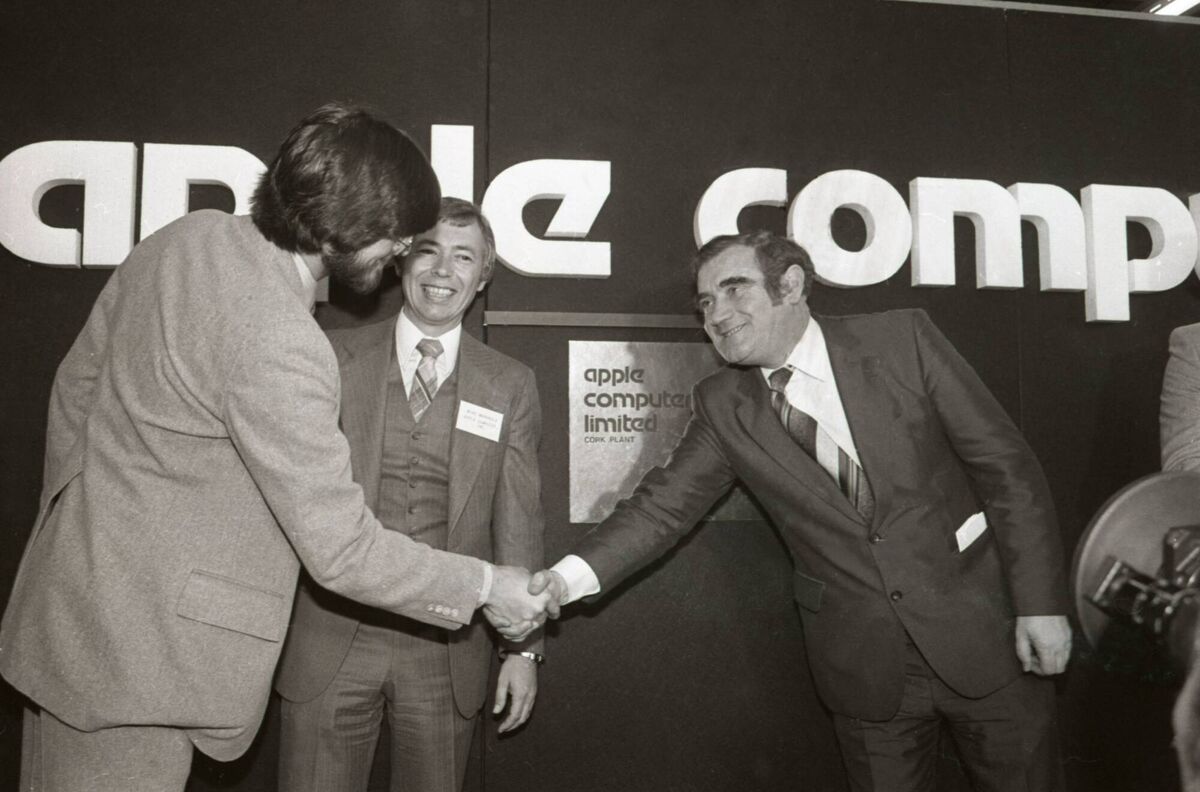
By 1980, the painful but necessary shift in Ireland’s employment landscape was evident.
More than 14,000 of the Irish workforce in 1980 was in the electronics sector, stated then Minister for Labour, Crookstown-born Gene Fitzgerald TD, as he toured the Apple site, a figure he said would rise to 30,000 by 1985.
On the very day Apple opened its Cork operation, the Echo splashed on a story about Kilbarry being an ideal site to locate some of those hoped-for jobs for the electronics sector. This became the IDA business park that now employs thousands.
Apple, of course, remains a huge component of Cork’s economy.
It now employs more than 6,000 at its Hollyhill hub, which serves as its European headquarters. A new building opened there last month to accommodate an additional 1,300 employees.
One changing element is that where Apple once employed 59 Irish in its original 60-strong workforce, there are now over 90 nationalities based there.
Jobs, the best known of the three, died in 2011, but his remarkable vision lives on.
It was all based on a simple concept: To bring technology into people’s homes.
Apple made its coin by building personal computers for business and recreational use, as well as for schools - crucially, these were both user-friendly and relatively cheap, and thus ideal for mass production and consumption.
It brought the same principles to its iPhone decades later.
“Certainly, Apple have made it big,” stated the Examiner when the Cork operation opened in 1980, “and look to the future with a confident belief that there may well be, in time, as many personal computers as there are cars and TV sets.”
Well, there are reckoned to be 2.5 billion PCs in use worldwide today, and the number of iPhones alone takes that figure to four billion - well above the number of TVs and cars combined.
Job done, I would say.





 App?
App?


