Cork Views: God can’t be proven - a leap of faith is required
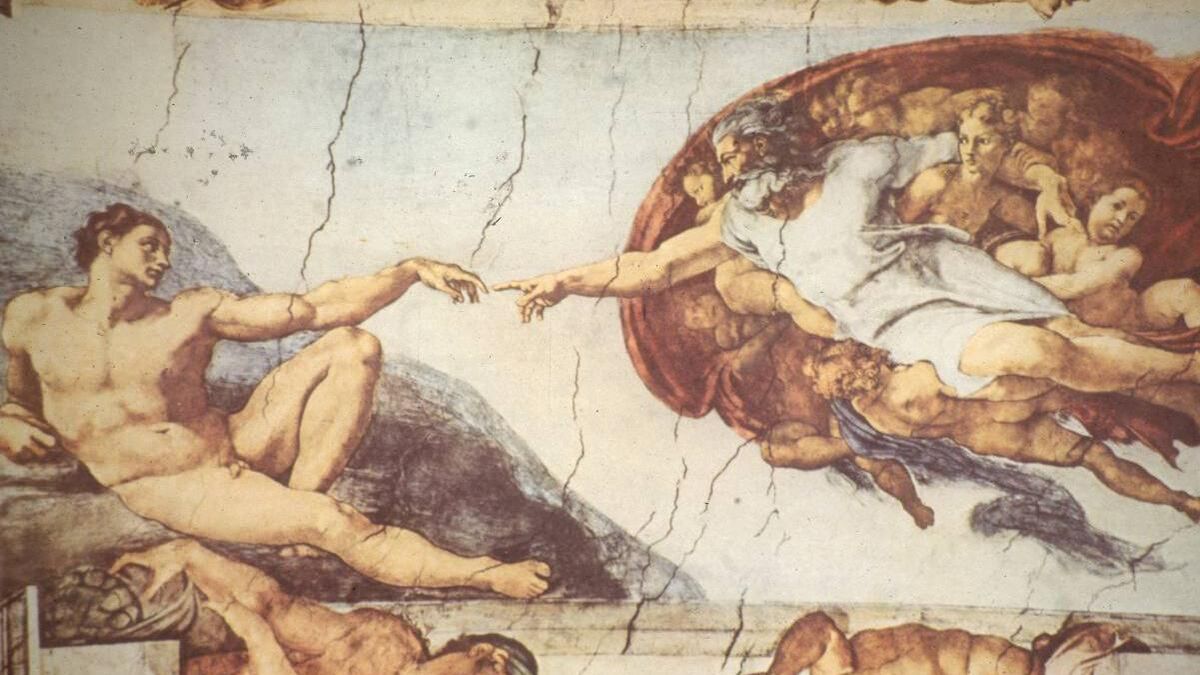
The ceiling of the Sistine Chapel depicting the ‘Creation of Adam’ by Italian artist Michelangelo
If you take God out of the equation, does life have any real meaning?
The three great monotheistic religions - Judaism, Christianity and Islam - answer with an emphatic ‘No’.
Hinduism, which has a multiplicity of gods, would also answer in the negative, while Buddhism - which acknowledges no god - offers a path to enlightenment that borders on the divine.
On the threshold of the 20th century, the German philosopher, Friedrich Nietzsche, controversially declared that “God is dead!” It formed one of the most famous covers of TIME magazine.
And in the United States in the 1960s, there emerged what became known as the ‘Death of God’ movement. But it proved to be short-lived.
So where are we in the opening decades of the 21st century - where we have witnessed a resurgence of militant atheism?
Has science - which has blossomed since the Age of Enlightenment in the 18th century - helped or hindered religious belief?
With artificial intelligence (AI) now taking us into the realm of science fiction, many of us can be forgiven if we find ourselves in a quandary.
Just recently, the Vatican issued a 48-page document entitled Quo Vadis, Humanitas? - “Where Are You Going, Humanity?” It warned that if humanity places total trust in technology, it risks replacing the ‘living God’ with a counterfeit ‘virtual God’.
Now along come two French authors (Michel-Yves Bollore and Olivier Bonnassies) - with a science background - who have produced a bestseller called God, The Science, The Evidence, which they claim presents the most up-to-date evidence for the existence of God.
It runs to 570 pages and seeks to pull together ‘evidence’ from a wide variety of sources. Their bottom line is that it is permissible to consider the question of God on the basis of science.
People of religious faith - Christians, Jews, Muslims, Hindus, Mormons, and many others - take the existence of God as a given.
But is there a scientific basis for believing in God? Can science deliver ‘proofs’? The authors of this wide-ranging book are convinced that it can.
So we get references to Copernicus, Galileo, Newton, and of course Einstein - and also to the great Russian writer Dostoevsky. He once wrote: “If God did not exist, everything would be permitted”.
In other words, without God there can be no morality. Pope Benedict XVI adopted this in one of his encyclicals.
But this is demonstrably untrue. It is akin to saying that if you are an atheist, you cannot be a moral person. Committed atheists would reject this in a huff, and they would be right.
In order to have a civilised society, communities regularly enter into ‘social contracts’ - and often do so without any necessary reference to God.
After all, the Golden Rule - “Do unto others as you would have them do to you” - predates Christianity, going back to Confucius. It goes without saying that even in avowedly communist societies (officially atheistic) like Russia and China, many individuals live by a moral code.
One of the central arguments for the existence of God is based on intelligent design. Think in terms of a watch, it works beautifully because all the pieces have a purpose and fit together and are designed to do so. Now think of a clockwork universe. Everything works, the planets don’t go crashing into each other. Why? Because an intelligent being designed it that way. Think of God as a cosmic watchmaker.
Today, a lot of scientists - and theologians - are drawn to the Big Bang theory of creation. But the Big Bang requires a cause. Something had to cause the bang in the first place. That ‘something’ is God.
“We dare to say that the picture painted by the Big Bang model is remarkably consistent with the idea of the creation of the Universe by God,” declare the French authors of God, The Science, Tthe Evidence
The alternative is a universe that is eternal - it had no beginning, it was always there - so no need for a ‘creator-God’.
The strangest part of this book (which invokes science as the basis for its thesis) are the 182 pages devoted to ‘Evidence from Outside the Sciences’. The authors turn to the Bible - but that was created by men (no women) of faith. And they summon Jesus Christ as a witness.
But here a choice has to be made between the Jesus of history and the Christ of faith. Of the former only two things are historically verifiable - that he lived in Palestine during Roman rule and was crucified. The rest is faith-based.
The big stumbling block for many people when it comes to belief in a benevolent God is the presence of evil in our world.
The appalling catastrophes of the 20th century - two devastating world wars, the Holocaust, the dropping of atomic bombs on two Japanese cities, then the other wars in Korea, Vietnam and the former Yugoslavia - these challenge the basis for belief in a beneficent Deity.
In the end - science notwithstanding - belief in God (theism) or belief in no God (atheism) comes down to an act of faith, since there is no convincing ‘evidence’ either way.






 App?
App?


