Cork Views: Look local to solve school dinners dilemma
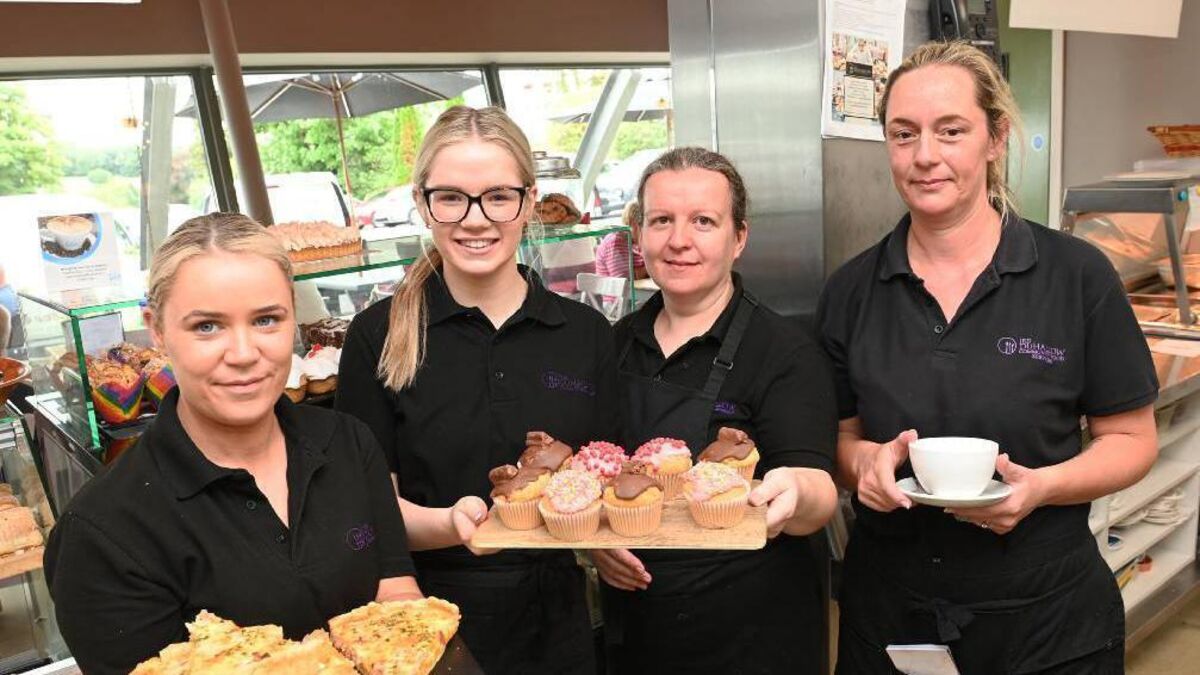
SHINING EXAMPLE: Sinead, Emily, Hannah and Aisling of Duhallow Community Food Services
Hot school meals have been the subject of heated debate since their introduction in 2019 and the subject of a recent Oireachtas committee meeting.
Now, celebrity chef Darina Allen has rowed in saying primary school meals should be sourced locally and made from scratch.
At the Oireachtas meeting, Ms Allen said she had concerns that the programme was “not fit for purpose”, it was an “industrial” one “akin to airline food” and that reheating meals reduced their nutritional value. She added that food waste from the programme was off the scale.
“‘Something is better than nothing’ is far too low a bar for a national programme relied upon by so many children for daily nourishment,” Ms Allen said.
The scheme, which makes more than half a million children eligible for hot school meals, has a budget of €300 million.
The founder of Ballymaloe Cookery School said cooking meals from scratch using locally sourced produce would “align” with the Government’s policies on a circular economy and support local farmers and businesses. She gave the example of Duhallow Community Food Services in north Cork, which she said was a “scalable” model.
Is Darina Allen right? Have we got hot school meals all wrong? With a budget of €3.20 per meal, it is a model that relies on a competitive tendering process from external agencies, making it impossible to provide a hot meal in a plastic or cardboard box that fulfils the need to be nutritious, tasty and cost effective?
Would a combination of community food kitchens and public diners be the answer?
The reality is hot school meals are just one arm of a much larger problem. The cost of living makes healthy food unaffordable for many. At the same time, half our shopping baskets (46%) are stuffed with ultra processed food often layered with salt, fat, sugar and additives. Fibre and nutrients have been squeezed out to prolong shelf life and preserve taste.
The result is 24% of the population living with obesity. That’s 1.2 million people. Yet we are loathe to introduce policies to regulate the food market, prolong life and preserve physical and mental wellbeing.
Meanwhile, in the first week in January, junk food ads were banned on daytime TV and online in the UK, as its government attempt to rein in the junk food market to tackle obesity. The move follows other regulations to expand the sugar tax to cover pre-packaged items like milkshakes and ready-made coffees.
While the UK forges ahead with “world-leading legislation” that curbs the junk food market, Irish policy in 2025 was more focused on obesity treatment than prevention.
Yet, the State’s own research estimates over 85,000 of today’s children on the island – around one in 20 – will die prematurely due to overweight and obesity; that children as young as eight are presenting with high blood pressure; and teenagers with a cardiovascular age of 60.
Despite this, a recommendation in the 2020 Programme for Government to introduce a Public Health Obesity Act, including examining restrictions on promotion and advertising aimed at children, was never acted on. The political will to challenge a profit-driven food industry is just not there.
Irish policy in 2025 involved a call for anti-obesity drugs to be more widely available to those who cannot afford their expensive prices.
But we cannot prescribe our way out of an obesity crisis. Drugs can help some individuals to drop a few kg for some time. But culture sets the baseline. Tackling obesity means making unpopular decisions to challenge the cultural obsession with unhealthy food – healthy school meals are just one part of that.
Additionally, there is a crisis of loneliness in an ageing population with social hubs such as banks, post offices and community services slashed in favour of online supports. But human connection as we age is vital to our health and wellbeing.
Imagine a future where community kitchens and public restaurants owned by communities served hot, healthy food that doesn’t break the bank. Impossible? It’s been done before.
During World War II, the UK government opened more than 2,000 British restaurants, serving 600,000 affordable meals daily, designed to meet a third of people’s energy needs.
As well as food provision, diners could be co-designed to fulfil the social functions of food, including dignity, and enjoyment. They could also be used to educate children on good nutrition and how to cook.
This concept is up and running in several countries. Turkey has 17 public restaurants in Istanbul. For a small sum, hot meals based on staples – soup, legumes, rice, vegetables and meat - are served to anyone who walks in.
Mexico City has 500 community-backed kitchens that operate as neighbourhood cafés serving hot, healthy meals everyone can afford, while community bonding builds. The scheme feeds over half a million people daily.
Now, Nourish Scotland is hoping to pilot a similar scheme in Dundee and Nottingham in 2026. Project OfficerAbigail McCall said “for other aspects of our wellbeing – water, transport, healthcare, even WiFi- we have built the public infrastructure to ensure everyone has quality. We are missing that in relation to food”.
Public diners, positioned close to schools, could provide hot school meals. Such an initiative would require public investment. But as they serve a lot of food a day, costs could be kept to a minimum while maintaining quality.
Imagine public infrastructure in Ireland that met the needs of school-going children as well as people of all ages and backgrounds, who could eat nutritious food at affordable prices in their own communities.
Duhallow Community Food Services has taken the first step in making community food kitchens a reality, a model championed by Darina Allen as a best-in-class example. There, meals are prepared daily in a local kitchen and delivered fresh to almost 30 schools across the region- supporting children’s health, local employment and local food systems.
It proves community-led solutions can deliver national-level impact, reinforcing the fact that investing locally delivers better outcomes for all. Time to think outside the cardboard box that provides reheated unpopular food – much of which ends up in the bin.





 App?
App?


