John Arnold: Like blind poet O’Raftery, we’re all hoping for signs of spring
The famous first lines from Anthony O’Raftery’s poem Cill Aodáin are well-loved and well-known across the country.
One of a family of nine children- eight of whom died from smallpox, O’Raftery was left almost blind from the disease, which was a scourge for centuries until Edward Jenner pioneered smallpox vaccination.
In his poem, O’Raftery expresses hope that the winter is over - Now with the coming of spring, the days will be getting longer / and after the feast of (St) Bridget, I will raise my sail.
In fairness, since early in the New Year that lengthening of the day by ‘a cock’s step’ has been evident.
The days are getting longer, but we’ve no sign yet of what we used to call a ‘real spring’. Then again, everything in the world is a bit trí na chéile without doubt, as Storm Chandra displayed this week.
I checked with the Met Office, Cork Airport and Carlow Weather, and the general expectation is that in the next two weeks we will have around three or four days with no rain!
Climate change cannot be denied, but in truth we’ve always had change in our weather conditions.
Back in the 1740s, the estimated population of this country was just under two and a half million. Then came the Famine of 1740/1741. This is now considered by scholars to be the last really seriously cold period at the end of the Little Ice Age from about 1400 until 1800.
Nearly two months of severe frost followed by Arctic winds and extremely low temperatures led to crop failures, animal deaths, and huge food shortages.
Back then, the ‘Irish diet’ consisted mainly of grains like oats and wheat and dairy products. The grain didn’t grow and cows yielded little milk because of the cold. Historians estimate that close to 20% of the people who lived in Ireland died in that two-year period.
Two months of frost in Ireland seems like a rarity nowadays, yet unless my memory is gone altogether winter frosts were a daily occurrence in the 1960s and ’70s.
Growing up on a farm, we were acutely aware of what season we had. Yes, autumn was the time of mists and mellow fruitfulness - as August, September and November was the ‘slowing down time’ after the land had yielded its harvests.
Of course, it was not as clean cut as August 1 until November 30 and then, hey presto, winter arrived. No, but generally speaking the seasons did have their own pattern.
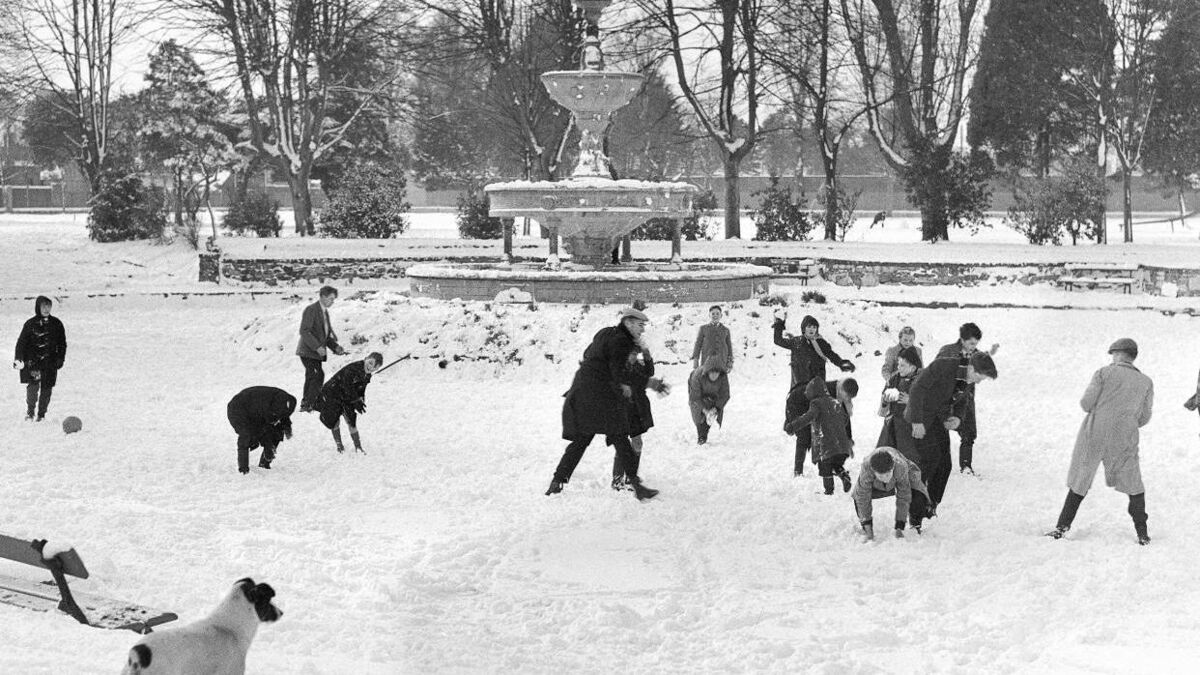
Snow - real, heavy snow - is now a rarity because of global warming.
In 1935, my mother was ten years old and attending Britway National School. That year the principal Donal Sheehan participated in the Folklores Commission ‘gathering of stories and tales’ from older people.
Mam gathered several interesting accounts from her relations and neighbours, including the following; “There was great snowfall on the 29th February, 1895. In this district and for an area of many miles, the fields and roads were in a level with the ditches. All traffic was completely held up except by skating, on account of the snow being frozen.
“No lives were lost in this locality, but great numbers of sheep, etc, were buried under the snow. Many rabbits were found dead in burrows on account of the lengthy period, the snow remained on the ground and the rabbits had nothing to eat.”
That was written 90 years ago and I’d say in the last 40 years, 1982 and 2010 were the only times we were really snowed-in.
Maybe I’m odd or something, but I always felt that regular frost and snow not only marked the winter season but were kinda healthy too. All kinds of bugs, fleas, parasites and other nasty unmentionables got short shrift when the cold came.
Milder winters mean way more colds and flus and chest infections - but I’m no doctor!
Getting back to ‘Raifteri an File (O’Raftery the Poet), well, he lived from around 1779 until Christmas Day, 1835. About 15 years ago, on TG4, I saw a beautiful film in Irish (with subtitles) about him. Raftery -Weaver Of Words starred Aindrias de Staic, and showed the triumph of genius over hardship and gave a telling insight into the life of a travelling Gaelic bard.
That title could also be given to Clare-born de Staic. Currently residing in Galway, he is a bilingual, zany, talented and musical actor. He can rap, sing, recite poetry, play many instruments, and act solo or with a cast of whoever.
Poor O’Raftery had little sight whilst de Staic can do anything and everything with his dancing eyes! Just as O’Raftery was welcomed on his ‘Rambles of spring’ each year, Aindrias de Staic gets rapturous applause every time he appears on stage. He’ll be telling his ‘Little Staic of Stories’ here in Bartlemy on Wednesday week, February 11 - the weather is bound to improve after he comes on his bardic journey!
O’Raftery wrote: “And after the feast of Bridget, I’ll raise my sail [and be on my way]”.
Sunday is St Bridget’s Day- back in 1935, Patrick O'Regan of Britway NS wrote about the Holy Well near his home. “The well is frequented for spiritual and temporal benefits and cure of all ailments. The Rosary is recited, three rounds being given and there are three stones to count the rounds. The water is applied to the affected part. It is also drunk and taken away.
“The water is also used for domestic purpose, but in this instance it is not taken from the well proper but from the stream which flows from the well. It is said that water taken out of the well cannot be brought to the boil.
“After the rounds, offerings are made; men offering money and women, beads. These offerings are placed on a small altar at the back of the well or on the limbs of trees inside the wall. Pieces of cloth are also affixed to a bush.
“In olden times, it was the custom after the rounds to repair to St Brigid’s Stone which lies south-east of the well in the field adjoining the graveyard. Prayers were said here and also at the cross on the bounding wall of the grave-yard northwest from the stone.”
The ‘rounds’ are still made at the well by the older generation.
We have no control over the weather or climate - change seems inevitable. Thankfully, some things are constant and traditions survive still and we continue to have ‘bards’ to record and recite our tales, new and old.






 App?
App?


