John Arnold: Penny for your thoughts... era of florins, shillings, and bobs!
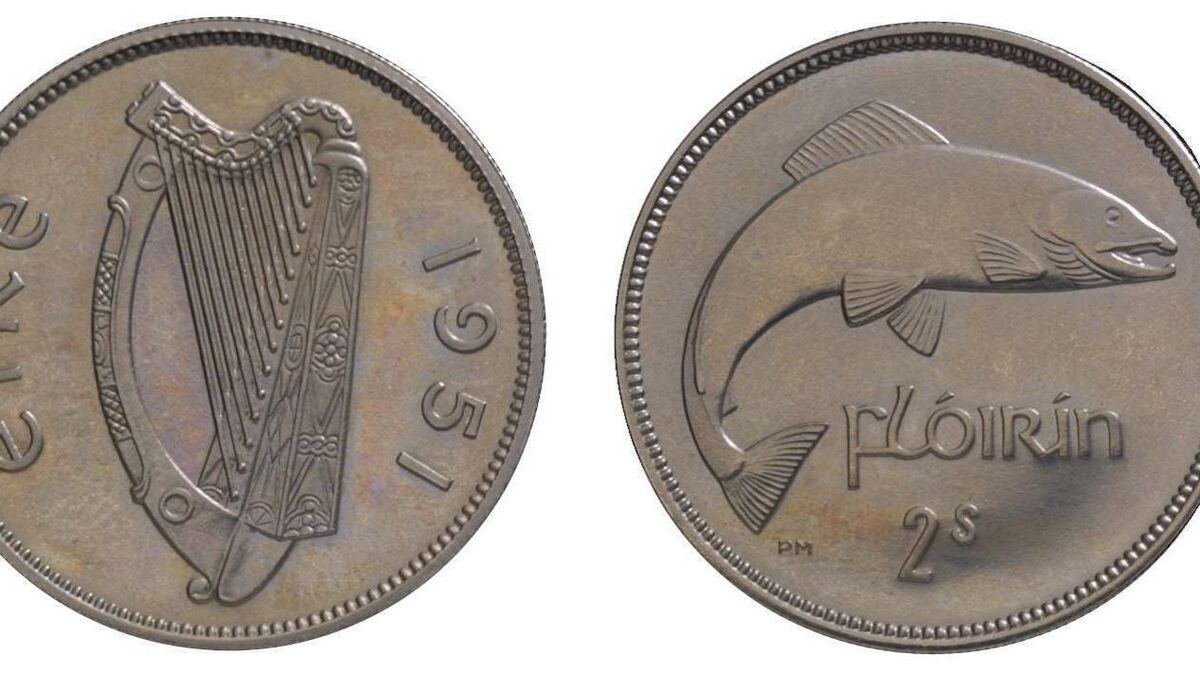
The Irish florin, with the motif of the leaping salmon on one side, the harp on the other
In fairness to us, we never actually looked for, hunted or killed ‘the wran’ or the wren - the little bird that is reputed to have betrayed the first Christian martyr St Stephen long, long ago.
The custom of Wran boys (or girls) going from door to door in ones and twos and threes seems to be practically gone now, at least in this area.
The Kerry ‘Wran’ tradition, which is still going strong, is very different in so far as it’s much larger groups, complete with musicians, that go around on December 26.
This activity is still very common in many Kerry towns, including Listowel, and this year it was revived in parts of West Limerick. Daingean Uí Chúis is also famous for its different ‘Wrans’, and if Dingle win the All Ireland Club Football Final next Sunday, ’twouldn’t surprise me if they went ‘on the Wran’ for all of next week!
We often made good money out on the Wran - it was our spending money for months at a time when the concept of ‘pocket-money’ had not yet come into common usage!
Lately, didn’t I come across an interesting small sheet of paper dating from 1968. I was 11 that year and went out on the Wran with my brothers Dermot and Donal. We were on foot as bicycles had not yet come to Garryantaggart.
Then, after coming out from a house, we’d look in the can and see maybe a sixpence or a shilling, we wrote down the household name and amount. The idea was that for subsequent years we could try and minimise our walking and maximise our takings by calling to the ‘best’ houses!
Wasn’t that good forward financial planning for ye!
One problem surfaced though because our last house - about two miles away - was Cashman’s on the Bartlemy/Castlelyons border between Fort Richard and Killawilling. This was always one of the top locations.
Tommy Cashman was a great friend of Mam’s family so we were always treated royally there. As well as sweets, cake and lemonade, a shiny half crown was always deposited in the can. Eight half crowns equalled a pound- a big fortune in those days.
One particularly good Wran day, we gathered in £7.15/6 which, even divided by three, was a huge haul.
Thinking about those days when cash was all everyone had - chequebooks were even scarce back then - I was recalling the old money as we used to call it.
I spoke just now of the half crown, which was worth two shillings and sixpence. That was the half-crown with the horse on the coin - logically, therefore, the crown should have been worth five shillings, but I never saw a crown coin!
We never used the term five shillings, only five bob - in old English currency the name given to 12 pence was ‘a bob’.
The Old Irish money that we used was the currency introduced by the Free State Government in December, 1928. For two years, a Committee under the chairmanship of WB Yeats, had researched the design of new Irish coins. Percy Metcalf was successful in the design competition. He used Irish animals and birds on the new coins.
Next down from the half crown or two and six was the florin or two shilling piece with the motif of a leaping salmon. The word florin comes from Italian.
Next in line was the shilling, ‘one bob’ written 1/-, worth 12 pennies, and represented on the silver coin by a bull.
Half the value of the shilling was the sixpenny bit also referred to as a tanner. During the reign of the English king George II, one of the head coin minters was a John Tanner - he designed a silver sixpence and some think that’s how the coin got its nickname.
The ancient Irish wolfhound had its image on the sixpence and the Irish word for the coin was reil.
A sitting hare was the animal on the ‘trupenny bit’ or threepence coin - the last in line of the silver/nickel coins. Being worth half a sixpence, in Irish, it was a leath-reil.
A hen with a clutch of chickens was shown on the copper penny, the 1d coin - I can remember in the early 1960s asking, in Woods’ shop, for ‘a penny’s worth’ of bulls eyes.
The penny coin was a big coin and if you had a fistful of pennies (pingin in Irish) you’d think you were well off.
The half-penny coin had a sow with a clutch of piglets or bonhams. The leat-pingin or ha’penny led to prices like ‘thru pence ha’penny’ or ‘three ha’pence’ .
The smallest denomination coin was the feoirling or farthing - there were four of these in a penny, 48 in a shilling, and 960 farthings in a pound!
The native Irish bir, the woodcock, is featured on the farthing. I have heard old people, some born in the 1880s referring to a time when a pint of porter was a penny in some public houses, but only three farthings in other places!
The old money was great in making things look a bit cheaper. An item for 19 shillings 19 and sixpence was way better value than something costing a pound.
I can just about remember to see farthings in use in our local shop and Post Office – the coin along with the ha’penny were withdrawn in 1969.
When decimalisation was introduced in 1971, the penny, thrupence, tanner, shilling and half-crown all became the relics of auld decency.
When the new decimal currency was introduced, many of the original animal and bird images were retained. The real ‘winner’ in this changeover was the woodcock. Having previously been the face of the lowly farthing, the bird now appeared on the 50 pence coin.
Since 1971, we’ve seen so many more changes. Going on a European holiday was a great adventure - getting francs, lira, leks and marks was an adventure in itself.
In 1981, in Morocco, I was delighted when a stallholder asked me for 2000 dirhams for some souvenir. We haggled for ages - he had no English and I had no Moroccan but I bate him down to 500 (about €40 in today’s money) and was pleased as punch.
Back in Spain, I saw the same item for about quarter of what I had paid!
From pockets full of coins, we now seem to be drifting to a cashless society. I still think cash is king but I seem to be in a minority.
I sold the animal, the buyer paid me, and in giving something back you were wishing that luck would go with the animal.
In future, I suppose sellers will just ‘tap’ a card on the animals forehead!
What about giving a child a ‘stand’ at Communion or Confirmation time? Ah sure, where will it all end at all, at all?






 App?
App?


