Cork Views: Nano Nagle centre helped me tell story of my family
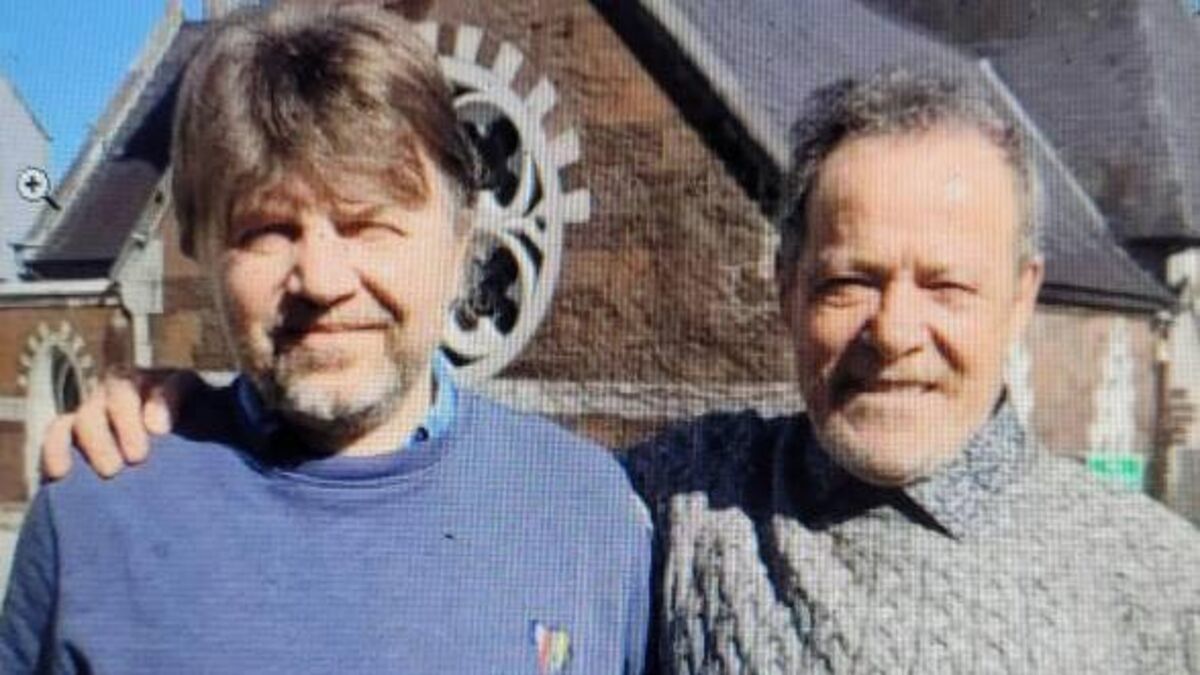
Leonid Dobrianskyi (right) with his English teacher at the Migrant Centre at Nano Nagle Place, Fabrice Fortune
More than two years have passed since I started learning English at the Migrant Centre at Nano Nagle Place in Cork city. It is an old Catholic convent, which is more than 250 years old.
I’m now close to making my old dream come true – to speak English fluently.
I had done four previous courses in the past at home in Ukraine, but every time I had struggled due to lack of speaking practice.
Our English tutor here, Fabrice Fortune, teaches us English, as well as singing in English, which helps us improve our pronunciation and immerse ourselves in the new cultural environment of Cork.
But now, I would like to tell you a story about another dream of mine, which also came true here at Nano Nagle Place.
Family story
My grandfather Petro Potapenko was born in the village of Voloske in the region of Dnipropetrovsk in Ukraine. It is 20km south of the large city of Dnipro.
My grandfather was enlisted in the army and took part in many battles of World War I. He was enrolled in the Russian Empire’s Expedition Corpus which travelled around the world before it arrived in Marseilles. He and other Ukrainian soldiers fought together with their French counterparts against the German army. One of them was his childhood friend Stephan Morar.
The journey took them inland from their native village of Voloske through the cities of Dnipro, Moscow, Irkutsk (Military training camp) and Port Arthur. Then, there was the sea route: Port Arthur, the Yellow sea, Singapore, Colombo, Mumbai, the Red Sea, Port Said, and finally Marseilles.
A lot of Ukrainians from Voloske and other places in Ukraine were involved in that military expedition.
My grandfather was wounded in the leg during the ferocious Battle of the Somme in 1916 in France, and spent a lot of time in hospital recovering from his injuries in Paris and Montpellier.
After a long convalescence, he finally came home to Voloske in March, 1917. At the same time, his friend Stephan Morar remained in France.
Needless to say, these events had a huge impact on my grandfather as he was only 20 years old. Much later he used to tell us, his grandchildren, a lot about his youth, about his trip to France, the war and other thrilling stories. This equally left a huge impression on us.
The book
When I became a student, I was interested in the history of my family. I wrote down a few stories I had heard from my grandfather Petro, my grandmother Vekla and other relatives. Some wrote their memoirs themselves.
I collected all this material together and in 2008, published a book, I Hear Your Voice, co-authored with Ukrainian historians Jury Mytsyk and Mykola Chaban. Both were also born in the village.
However, many details about my grandfather’s trip to France were still unknown to me. l was especially curious about the destiny of his friend, Stephan Morar who remained in France after the war.
My grandfather had died many years ago, but this side of his life, as a part of our family story, still hadn’t revealed itself.
The war
The years have passed. I’m retired and became a grandfather myself. Ukraine was more than 30 years independent but unfortunately war began again. The Russian army invaded and occupied our lands and cities in 2022. Mass killings of civilians began. Missile bombardments were carried out on all Ukrainian cities. I had to leave my home and moved with my wife Olga and daughter Nadia to Ireland. We ended up living in Cork city.
After five months, my wife died unexpectedly. Our daughter Nadia did her Phd in history and I began to attend English classes in Nano Nagle Place and started to write a book about Ukrainian refugees in Cork.
Two attempts
I was involved in a lot of different activities – besides the diligent study of English, I took part in long distance running with Sanctuary Runners, I sang in the Ukrainian Choir Kalyna and recorded the stories of Ukrainian refugees in order to publish a book.
All these things helped me overcome the stress of losing Olga. Slowly, day by day, l returned to collecting materials about the history of my family and went back to the story of my grandfather and his friend Stephan.
I had in my possession an envelope with Stephan’s French address on it. I wrote my first letter in English and sent it to Paris at that address. There was no answer. After that, I had to carefully plan what I would do next.
I started a correspondence with Stephan Morar’s relatives, Inna Morar and Volodymyr Morar, who were living in Dnipro. They managed to find in their family’s archive papers a new address in France where Stephan’s family lived.
I proceeded to write another letter in English and my English teacher Fabrice, who happens to be French, translated it into French. I posted the letter from the General Post Office in Cork with great anticipation.
Godsend
After a month and a half, I received an email from Oliver Morar, Stephan Morar’s grandson, which I eagerly opened. Oliver is 61 years old and has been living in Portugal, meaning that his visits to France are quite rare.
He was thrilled to receive my letter and to my great surprise, even offered me excerpts of a book his mother Maria had written about her father Stephan Morar: it told his story as a soldier in the First World War, his friendship with my grandfather and his life in France.
The name of the book in French was De Ekaterynoslav à Deuil-La-Barre (From Ekaterynoslav to Deuil-La-Barre), Ekaterynoslav being the old name of modern Dnipro.
There were a lot of details about the life of Stephan up to 1930, his long trip from Ukraine to France, and a soldier’s life in the trenches.
When I first began this venture, I had never imagined this could have happened: not only had I found my grandfather’s friend’s family, but also a book which had been written by Stephan Morar’s daughter.
Happy ending
Afterwards we exchanged emails and had a chat by phone, and yes, we spoke in English. We decided to meet and exchange books about our grandfathers, Stephan and Petro.
At the end of my story, l would like to add something which is of huge importance to me.
I spent a lot of time here at the Cork Migrant Centre in Nano Nagle Place learning English. I visited the Nano Nagle Museum many times and listened to the lectures about her as a prominent personality in the education of vulnerable people and founder of the convent.
It is no coincidence that my dreams came true here: I’m sure it is connected with the extraordinary properties of that woman and this place where she lived and did good deeds.


 App?
App?


