Throwback Thursday: Tripe? Yuk, but dad loved his crubeens!
Warning: Throwback Thursday this week contains more references to tripe, but JO KERRIGAN also hears fonder memories of crubeens, and learns about life in 1947
Throwback Thursday: Tripe? Yuk, but dad loved his crubeens!

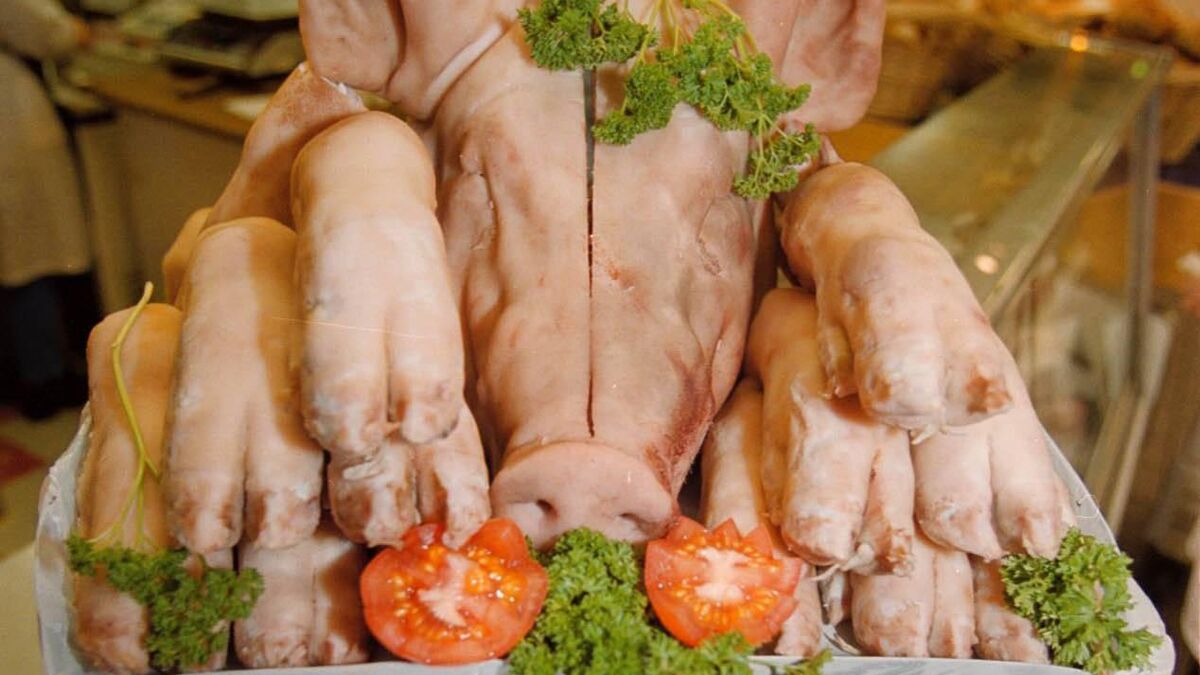
A pig’s head and crubeens (its feet) in a stall in the English Market - Jo Kerrigan wonders whether the name for the market is overdue a change!

Well, we had a few lively responses to that discussion on the famous Cork foodstuffs, tripe and drisheen, which aired last week in Throwback Thursday.
It followed the correspondence from Liam O’Reilly about his venerable family’s business, with its abattoir up in the then undeveloped Gurranabraher, and its still existing and highly popular stall at the Grand Parade end of The English Market.

To deflect sideways for just a moment, do you notice that we all, always, call it The English Market?

I met a couple of Canadian friends there recently, wanting, as you do, to show off our gorgeous indoor facility with its fountain and myriad of stalls, some dating back a century or more, and they, after rapturously admiring everything and anything, asked why we called it The English Market.

Of course, I fervently went into a few hundred years of Cork’s history, when we were heavily colonised by our neighbours across the water, and those of us with even a smidgen of an Irish accent hadn’t a hope of trading there.

They listened, fascinated, but then repeated the question with even more curiosity. “With all that negative memory, how come you all still call it The English Market?”

They got me thinking. Why do we? It’s hardly out of love and affection for those centuries of control. Is it because we’ve got used to it?

Every day you hear of street names and public places, being re-named because the older one now has bad connotations for one reason or another. But The English Market remains untouched, unaffected.

Heaven knows, I’m deeply fond of the name and the place myself, and over many years of travel in other lands, have compared their markets unfavourably with the best, the ultimate, the only real one, back home in Cork by the Lee.

I learned to call it by that name in babyhood when I was first introduced to its hallowed halls (and back then, let me tell you, that beautiful fountain was not the shiningly clean sight it is today, being used by everybody for cleaning and tidying up their produce before displaying it on their stalls).

If you have views on this (no, not the condition of the fountain back then, the name, the name!), do share them with all of us, please.

Right, back to the tripe discussion. Here are strong words from Tim Morley, along with a few treasured memories of other foodstuffs.

“Hallo Jo, you have put us off our food for the next six months with your stories of tripe and drisheen. All those threats on the fires of hell wouldn’t be near as threatening compared to spending all eternity with food like that!

“Still, for those real Corkonians, born inside the city suburbs, I remember my father (mother’s name McCarthy), who was in the same school class as that traditional Corkman, Liam O Ruiseal, man of the bookshop.

“Well, when father got a plate-load of such delicacies, such as you described them, his eye took on a glow of delight. Especially when the crubeens turned up.”

Gosh yes, let’s not forget the crubeens! Would there by any chance be any of our readers out there who don’t know what crubeens are? Hardly. It is part of our knowledge, acquired over the years of growing up in our beloved city. It is part of our culture too. Who could forget Jimmy Crowley singing:

“She sells tripe and best drisheens,

Murphy’s stout and pigs’ crubeens,

Here’s up ’em all, sez the boys of Fair Hill!”

I believe that the legendary Kattie Barry’s pub, in that side lane off the Coal Quay, sold those self same crubeens to its regulars, but never having ventured inside its doors, can’t say from personal experience.

’Twas more of a place for the menfolk, you understand. Ladies in search of a pint would go to one of the establishments nearby that boasted a snug with its own private door and a hatchway through to the bar proper.

Back to Tim Morley, who now turns his attention to other foods which he remembers with real affection.

“My mother came ‘from out the country.’ When I visited her former home, there was a lovely creamy decent-sized egg for breakfast, white or brown bastible bread (yes, baked over the turf fire), with lashings of butter made up at Boggerah mountain.

“The lady (Maggie Ned) who made this delectable stuff had a packet (via the local parish priest) sent off on special request to his lordship C.L. (Cornelius Lucey) every week.

“And those delicious local floury potatoes? I was expected to bring back a bag to Germany for our local relatives there when I reluctantly had to quit these joys once more and return to the real world.

“Well, when I pass away, I hope I will have behaved myself well enough to deserve my plain Irish food above!”

Indeed, that’s a pious hope, Tim. Pass along the dish of potatoes there, St Peter. And don’t go keeping the butter up at your end of the table!

Now there was great interest shown in the details of that 19th century Guy’s Directory of Cork we featured last week, and several people have asked for some more information therefrom.

I found an analysis of 1871, tabling where all our residents came from originally, absolutely fascinating.

Of course, by far the largest number had been born in Cork county or city itself, but it was interesting to see that the greatest total after that was from England and Wales, with Dublin coming in a good third.

The very last note on the table lists 24 Cork inhabitants who were born at sea. Now doesn’t that awaken your curiosity?

Were they travelling over from neighbouring Britain, or from further afield, the colonies and East Indies? Old pieces of information like this raise so many new and interesting questions.

But let’s return to somewhat more recent times. 1947, to be exact, since that is when a marvellous little magazine brought out its very first issue.

I discovered this recently at the bottom of a box of old books, and thought it should be shared you.

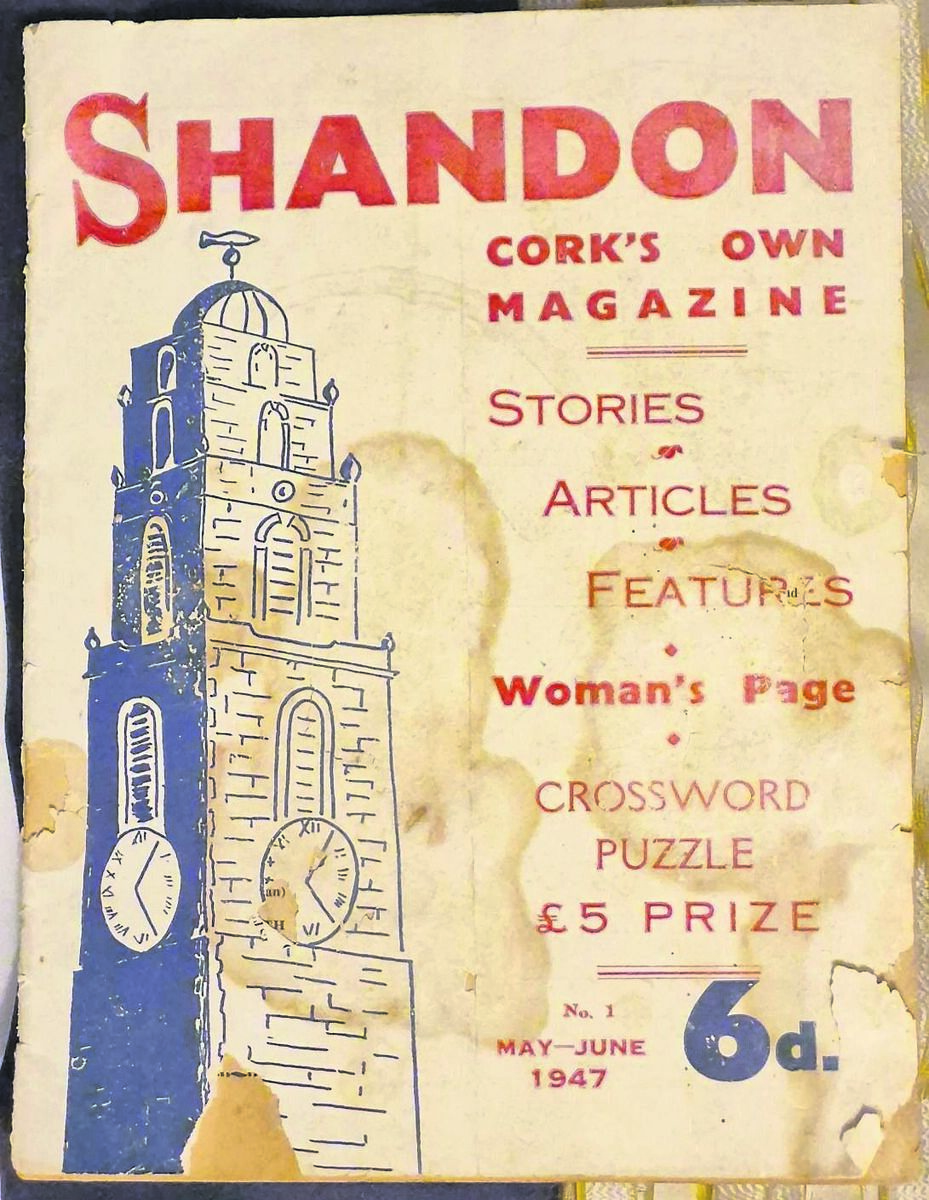
It is called Shandon, Cork’s Own Magazine, and Issue No 1, from May-June 1947, was priced at just 6d.

On leafing carefully through its delicate pages, which crumbled as I turned them, I found my own father had contributed an article on camping at the very top of Carrauntoohil amid the snow, ice, and high winds of a winter’s night. Well, he was always one for choosing the more challenging path.

It does explain why that rare copy of the first issue of Shandon survived. He rarely wrote anything down, my father, being far too busy getting out and living life, but he must have been pressured by his peers for this new venture to actually put pen to paper.

There are some lovely advertisements in the magazine by old Cork firms, including one headed ‘Rationing Difficulties’ from Simcox & Sons of 16 Patrick Street, offering to help solve the housekeeper’s problems with sourcing the basics of everyday life like bread, margarine, sugar, etc.

The cover for the first edition of the Shandon magazine in 1947, which included a mention of a certain Jack Lynch who “is good for a few years yet”, written by a correspondent known as ‘Onlooker’

We did have rationing in Ireland, right up to the 1950s, I think. Exactly why is unclear - presumably to do with supplying neighbouring Britain during the war and beyond - but anybody with a long enough memory, do please share.
All I can remember is seeing old ration books tucked away in a cupboard, but can recall nothing of dates.

There are ads from the Hanover Cycle Company, Pope Brothers, Finns Drapers, Robert Day’s, and more in the magazine.

Really nostalgic is an article by one John J. Horgan entitled ‘Cork of My Youth’, which evokes a far earlier city than any of us can remember. Here is just a snippet:

“The Cork of my youth - roughly the last ten years of the 19th century - was a Cork without electricity, without motor-cars, without telephones, without even the wireless, yet a place where two shillings would purchase as much as two pounds will now, and where we had never heard of ration books...

“I can remember the gas-man with his long pole lighting the little green gas-lamps at dusk each evening along the Mardyke and in Patrick Street, a Patrick Street where on a wet day one waded ankle deep in mud if one strayed from the stone crossings, and where in summer the dust blew in one’s face.

“I remember our childish wonder and excitement when the now defunct Muskerry Tram - or, more politely, light railway - its engine equipped with a real American cow-catcher which seemed to have come straight from the Wild West, first emerged from its terminus under St Fin Barre’s Cathedral and puffed noisily up the Western Road on its trial run to Blarney.

“I remember, too, landing from the Bristol steam-packet - the old paddle streamer Juno with its black and white funnels - at Passage, for the good, or rather bad, reason that it was low tide and there was not enough water for her to proceed to Cork...

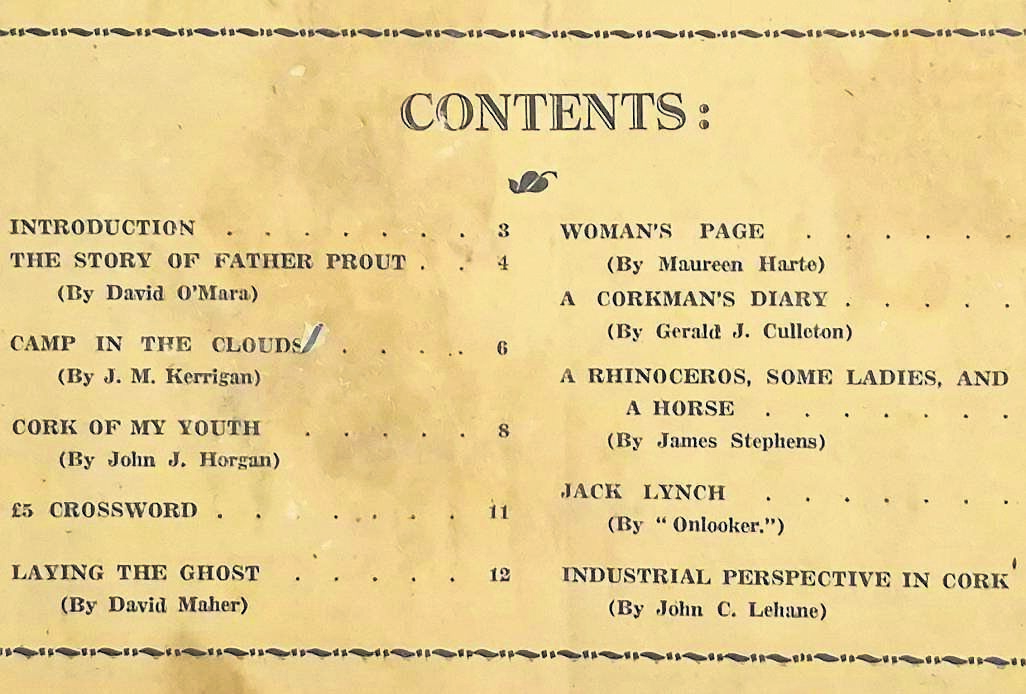
The contents page for the first edition of the Shandon magazine in 1947. 

“The horse still reigned supreme, and what a King he was. On market days, the streets were filled with the high gigs, trap, or Scotch carts of the farmers.

“Professional men and the country gentry were to be seen in open victorias or closed broughams with fine high-stepping horses, driven by old family retainers who knew all there was to be known about horse-flesh.

“Wagonettes drawn by two horses were hired to take family parties or convivial gatherings of friends to the country or the sea-side for the day.

“One famous excursion was the annual outing of the Cork Corporation to Graball Bay overlooking the harbour entrance under Fort Camden, outings which did not lack spiritual refreshment...”

What lovely images Mr Horgan brings to our minds!

A quiet peaceful city, gas lamps being lit at dusk, horses clopping gently by - but also streets ankle-deep in mud if you inadvertently stepped off the stone crossings.

Wonder where those were situated and if you can see any trace of them today? Probably not, given the number of times that thoroughfare has been resurfaced, and still continues to be.

There is another fascinating article in that first issue of the Shandon magazine of 1947, concerning an up and coming young sportsman who was slowly moving into the world of law, one Jack Lynch.

Listing his many medals, and extolling his progress, the writer - identified only as ‘Onlooker’, gives it as his opinion that the selfsame Jack is good for a few more years yet...

Let’s hear your memories of yesteryear, be it of tripe and drisheen, or long ago hurling matches, a trip on the river, or a lost back street of our city.
Email jokerrigan1@gmail.com or leave a comment on our Facebook page: www.facebook.com/echolivecork.

More in this section

Throwback Thursday: A list of North Main Street shops in 1875 Throwback Thursday: A list of North Main Street shops in 1875
Cork ‘nerd’ professor who landed role in an Oscar-winning film Cork ‘nerd’ professor who landed role in an Oscar-winning film
Throwback Thursday: The day I fainted at communion in church Throwback Thursday: The day I fainted at communion in church

Sponsored Content

Where tech meets care: At the forefront of IVF Where tech meets care: At the forefront of IVF
10 minutes with Shannon O’Sullivan of Corlann 10 minutes with Shannon O’Sullivan of Corlann
10 minutes with Jason Cooke of Cheshire Ireland 10 minutes with Jason Cooke of Cheshire Ireland
Contact Us Cookie Policy Privacy Policy Terms and Conditions

© Examiner Echo Group Limited

Add Echolive.ie to your home screen - easy access to Cork news, views, sport and more