Farewell, Milo, our best friend for 12 years

Catherine’s daughter Charlie with Milo.
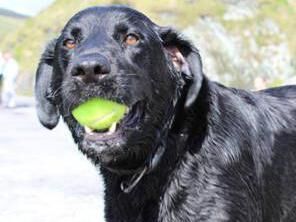
We said goodbye to Milo this week. Our half horse/half dog had been with us since my youngest was in first year and the eldest in Leaving Cert. Four teens and a labrador who was born on Christmas Eve and graced our lives for 12 years.
Now he’s gone.
The kids are now young adults in their twenties scattered across the globe - one in Melbourne, two in Barcelona, one in Dublin. They were all home for Christmas and each of them said their goodbyes before he left – knowing this might be the last time they would see Milo. When they got the WhatsApp to say he was gone, the phone started hopping immediately – anxious to connect - knowing a loved family member had left us.
Milo was a frisky puppy when he landed in our kitchen a dozen years ago. Full of energy, he loved company. Walks to the park meant he had to say hallo to every child and every dog. And they all said hallo to him.
Sometimes this ended in chaos. On riverside walks from Blackrock Castle to Passage he was quite capable of doing a sudden right turn and sending a runner flying. Another time, walking up a lane behind our house, I had taken him off the lead secure in the knowledge there was no-one about. But Milo sniffed out a toddler 100 yards further ahead and took off to say hallo.
That poor toddler saw a giant labrador thundering up the road towards him and took off bawling, to the terror of his grandmother who quite justifiably gave me an absolute earful. I wanted to say he was just being friendly but wisely held my tongue.
Another time, Milo gambolled in a front door down the road and scared a young mother who was changing her baby.
But these events were vastly outnumbered by all the kids who ran up to Milo wanting to rub his thick black coat and gaze into his brown eyes as he thumped his tail enthusiastically and revelled in the attention.
Ballinskelligs was his favourite place. The curving sandy beach, home to so many hurling balls to be snatched away from youngsters, rolling waves to play with, stones to be collected and dropped in the sea, then long snoozes in the sunshine when he returned home after a day of walks and hikes.
Visits to Glen pier, looking out to the Skelligs, where he spent hours jumping off the slipway and playing ‘donkey’ with the kids and a tennis ball.
Two of his best qualities were his loyalty, which was absolute, and his ability to listen. With four teens at home, there were always ups and downs. Kids coming in in the throes of angst – they would sit on the window seat in the kitchen with Milo and he would put his head on their lap and just be. Not saying anything, no rushing, no asking questions, checking their face to see what was wrong – just there, listening to their whispers and sighs, absolutely on their side.
Milo wasn’t allowed in bedrooms. He wasn’t even allowed sleep in the house with a perfectly good, sealed shed at the bottom of the garden. But I know, if the kids got half a chance, he would be found sleeping in the kitchen or slipping up to a bedroom and curling his ungainly weight around a duvet on the floor.
One day, that meant a discarded expensive Apple laptop was destroyed – crushed under his 50-plus kilos which no amount of dieting or walking could reduce.
The evidence suggests one of the reasons for the huge benefits dogs bring is what is called social recognition - the process of identifying another being that is hugely important and significant to you. The bond that forms between owner and pet is likened to the bond between a mother and her new baby.
The importance of social recognition is increasingly recognised for the role it plays in helping us form new networks. We know that forming healthy social networks is absolutely essential for mental health. Without them we become lonely, depressed and much more likely to become physically unwell. And pets seem to be able to fill that role.
Social recognition is thought to be related to the release of the chemical oxytocin – the so-called ‘love’ or ‘cuddle’ hormone released in childbirth and when breastfeeding. It is increasingly linked to social behaviour, a chemical messenger released during courting rituals, mother-and-infant as well as human-pet bonding. It signals recognition, trust and love.
When you take a dog for a walk, people talk to you, and it might be the only social contact an isolated person has for the whole day. People with disabilities often find other people socially awkward with them. Having a dog breaks down barriers and allows a more relaxed interaction that is good for everyone.
The tendency to gain weight was Milo’s downfall in the end. That and his love for a ball to chase, swivelling on those huge hips to scoop it up mid-flight.
Gradually, he became slower and heavier until finally he could hardly move. He would climb the steps to the first landing and lie there, ready to trip some unbeknownst midnight reveller coming in late in the dark.
But Milo never complained. Labradors have a high tolerance for pain, but since Christmas every step was an effort. In the end he gave up, lying on the stairs, sitting by the fire, staying in his bed rather than making his way to his bowl. It wasn’t fair to ask any more of him.
The thing about dogs is they love us unconditionally. They are the ultimate in equal opportunities – entirely indifferent to beauty, status, wealth, clothes-size or the ability to be ‘cool’. The simplicity and depth of this love is a source of constant joy.
Add to that the health benefits of daily walks and the social chats with other walkers. They teach kids to be responsible, compassionate, altruistic, and eventually how to manage when a loved one dies.
Goodbye, Milo – you will always be in all our hearts. Thanks for all the fun you gave us, the lessons you taught us, and the unconditional love you dished out to each of us through the years.



 App?
App?


