Mourneabbey tragedy: Recalling the night four soldiers died on Malllow to Cork road
A few months into The Emergency in Cork, in 1939, four Cork army men lost their lives on the Mallow to Cork road. PAT POLAND recalls the story
Mourneabbey tragedy: Recalling the night four soldiers died on Malllow to Cork road

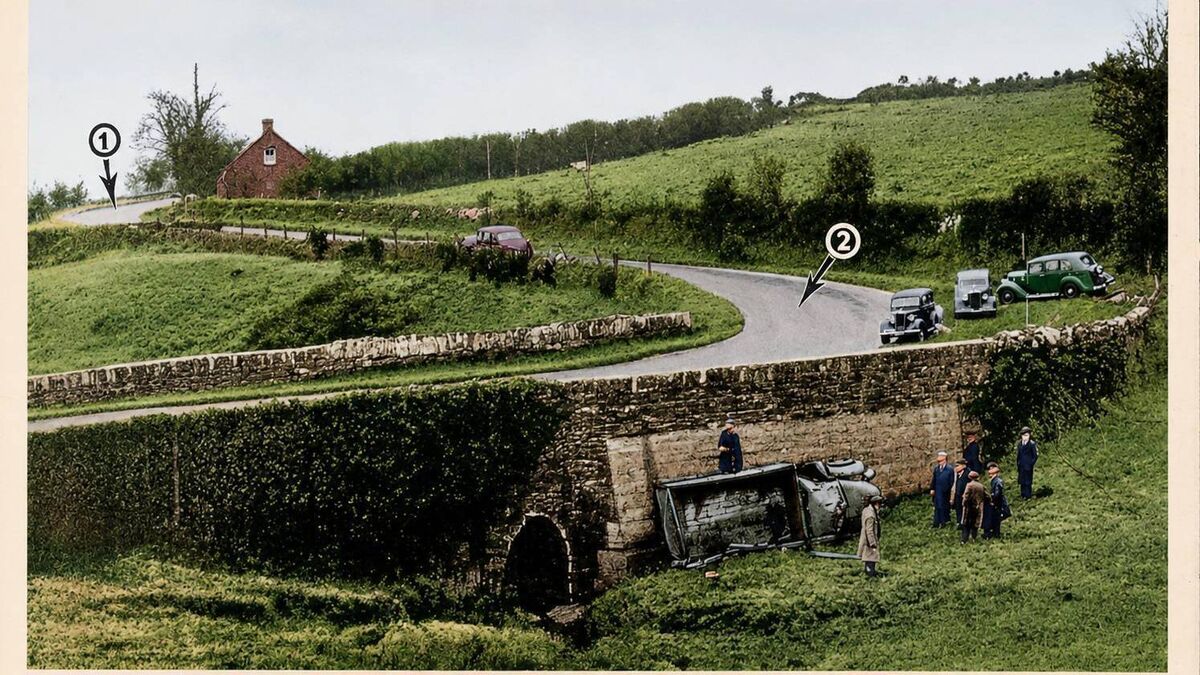
The scene after the tragedy at Mourneabbey on the Cork to Mallow road in November, 1939, in which four soldiers died when the car carrying them jumped the wall and plunged into the field below. The arrows mark apparent skid marks in the road at the time. All photos here colorised from Examiner/Echo originals

It was a month before Christmas in 1939, and the streets of Cork had taken on a festive, bustling appearance.
Although war in Europe had broken out two months earlier, emergency restrictions had not yet begun to bite. The perennial favourite, the Holly Bough, was on the newsstands, price 2d (two pennies); then, as now, a sure indicator that the countdown to the holiday season had begun in earnest.

In a pre-digital age, people had a plethora of entertainment venues to choose from in their spare time, from cinemas, to theatres, to dance halls. At the Palace, child star Shirley Temple was starring in The Little Princess. Our own Lennox Robinson’s The Whiteheaded Boy was being performed by the Abbey Theatre players at the Opera House, while the grandiosely-named Imperial Cinema (simply ‘Miah’s’ to its patrons) on Oliver Plunkett Street offered Hollywood Stadium Mystery.

Into this picture of daily life in Cork 87 years ago, disaster struck.

******

In November 1939, World War II had not really begun in earnest. In Cork, there were no air-raid shelters (yet), every second person on Patrick Street didn’t seem to be in a uniform of one kind or another (yet), and there was no fuel, food or clothing rationing (yet). The most obvious manifestation that times were changing was the ‘Blackout’.

Under Emergency Powers legislation, after midnight no chink of light could emanate from private or business premises, and all street lighting was turned off. Street lamps were fitted with special cowls to restrict their visibility from the air.

Those same Emergency Powers gave the government draconian, sweeping authority to deal with anyone, or any organisation, that might seek to compromise its stated neutrality (a stance, however, as we know now, that was rooted firmly on the side of the Allies from day one. Our own Lord Mayor, Jim Hickey, had set the tone back in February when he refused to entertain the officers from a Nazi battleship visiting Cork.)

Although nothing much seemed to be happening on Europe’s Western Front (people began calling it the ‘Phoney War’; to the Germans, it was the Sitzkreig, the ‘Sitting War’), for one section of the Irish population, at least, life changed.

Members of the Defence Forces’ Reserve, and the (part-time) Volunteer Force (later called, variously, the LDF/FCÁ/RDF) received their call-up orders as the international situation deteriorated.

They now found themselves full-time members of the Defence Forces for the duration of the Emergency; or ‘E-men’, for short. After basic training at the Curragh Camp , they were posted throughout the various military Commands.

On the morning of Saturday, November 25, 1939, the pre-Christmas buzz in Cork was suddenly suspended. An air of melancholy hung over the city like a chill fog as word filtered around of a terrible accident that had happened the night before on the Mallow-Cork Road; a highway with a reputation for its bad bends and numerous twists and turns.

******

The night before, November 24, the countryside was bathed in the light of a beautiful full, or ‘Beaver’ moon, which reaches its peak luminosity at that time of the year.

The headlights of the new Ford V8 army lorry picked out the road ahead as it sped towards Cork carrying ten soldiers home on short leave from the 9th Battalion, stationed at Sarsfield’s Barracks, Limerick.

No creature comforts then; barring room for two in the front cab, the remaining eight men had to sit in the back of the open truck, huddled up against the bitter cold in their ‘bull’s wool’ greatcoats. The long journey would soon be over , however, and presently they could expect to see the welcoming (but dimmed-out) lights of Blackpool in the distance and Collins Barracks, their destination, high up on the hill to the left.

The banter and raucous army songs that had sustained them in the earlier part of their journey had long since dried up. Tired and frozen, they just wanted to get home.

******

Some time after 9pm, a motorist travelling towards the city noticed some debris scattered across the road at a notorious stretch, incorporating a sharp double-bend, at Mourneabbey, about 16 miles from Cork.

Unsure of what it was, he slowed down to investigate and was horrified to discover the bodies of two soldiers, apparently dead, and their equipment, including rifles, strewn all around.

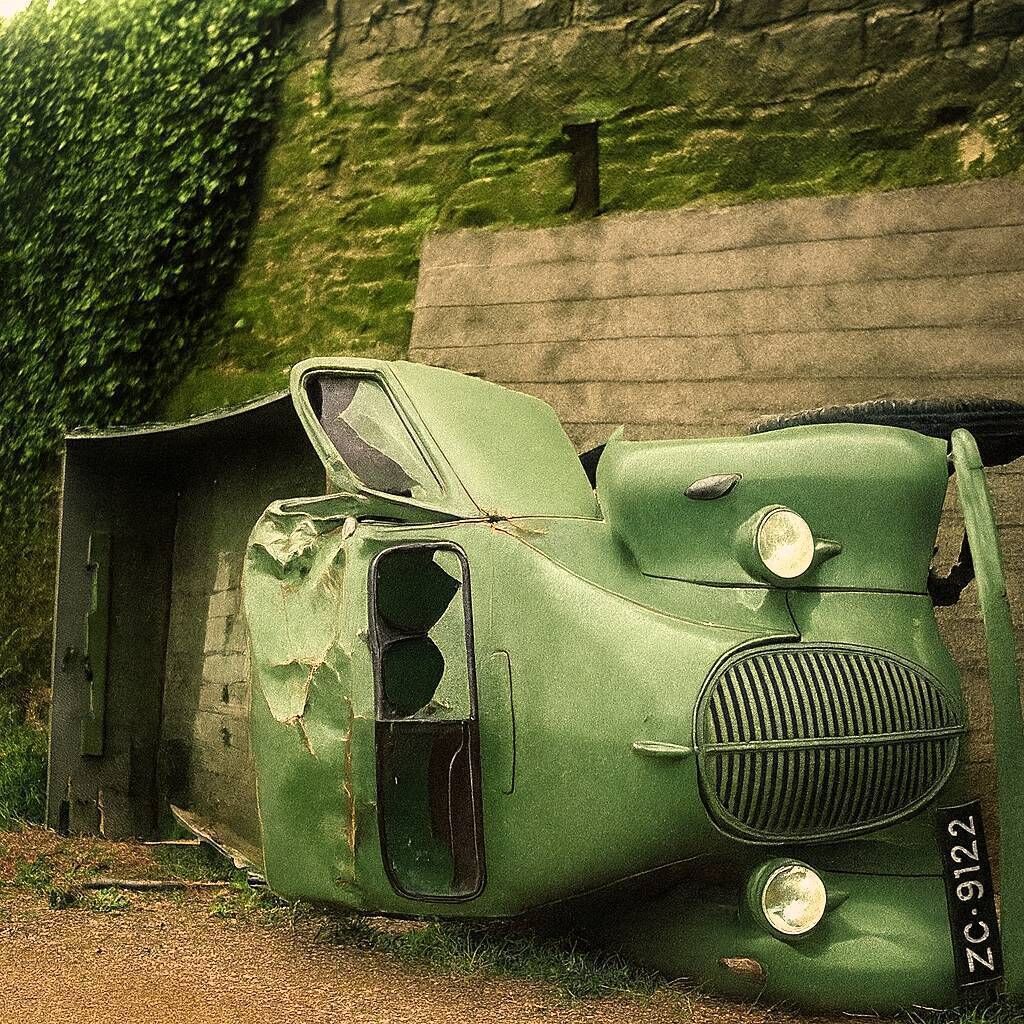
The army truck on its side after the accident in Mourneabbey on the night of Friday, November 24, 1939

Tracing the lines of some skid marks, he discovered the truck carrying the soldiers had somersaulted and jumped a 5ft wall at the second bend and plunged some 20ft into a field below.

Upon coming across further casualties, he realised that he could do nothing on his own and at once drove to Mourneabbey Railway Station - which closed in 1963 - about a quarter of a mile distant, where the Station Master raised the alarm, telephoning the Gardaí at Mallow and the Army authorities in Cork.

Meanwhile, back at the location of the accident, a bus travelling from Limerick had come upon the scene. One of the passengers was a soldier, travelling home on leave - there had been no room for him on the lorry. To his utter dismay, he discovered his best friend was among those lying dead on the roadway.

Quickly organising his fellow-passengers, the military man, knowing how many the truck was carrying, realised that one man was missing. A search revealed an NCO, wandering along the pitch-black road in a dazed and disoriented state, bleeding from the head. He was placed in the bus where the passengers attended to him as best they could.

Once the alarm had been raised, the response was swift. Soon, the headlights of numerous vehicles heralded the arrival of help.

From Mallow, a large force of Gardai under Supt Hughes, doctors Vaughan, Carroll, Murphy, and O’Connell, and Rev Frs O’Leary and Power, all converged on the scene, bringing powerful lamps and medical requisites and blankets. From the city came ambulances and personnel of the Army Medical Corps.

Expertly, the casualties were ‘triaged’ and shortly the convoy of vehicles sped off with the dead and injured, all to city hospitals, leaving the desolate scene of the tragedy in the charge of the Guards.

The first casualty was deposited at the North Infirmary shortly after 10pm.

******

Three soldiers were pronounced dead at the scene; the fourth died in hospital the following day. They were:

Corporal Charles Brown, aged 35, from Gurranabraher, Cork. Charles left a widow and seven children, the eldest of whom was only 13 and the youngest, a baby of three months. He had only been on active service a short while having been called up on the Reserve List.

Volunteer Patrick O’Keeffe, (24), of White’s Cross, Co. Cork. Patrick, unmarried, had been a member of the Volunteer Force since its inception in 1934 and was called up for permanent duty the previous August.
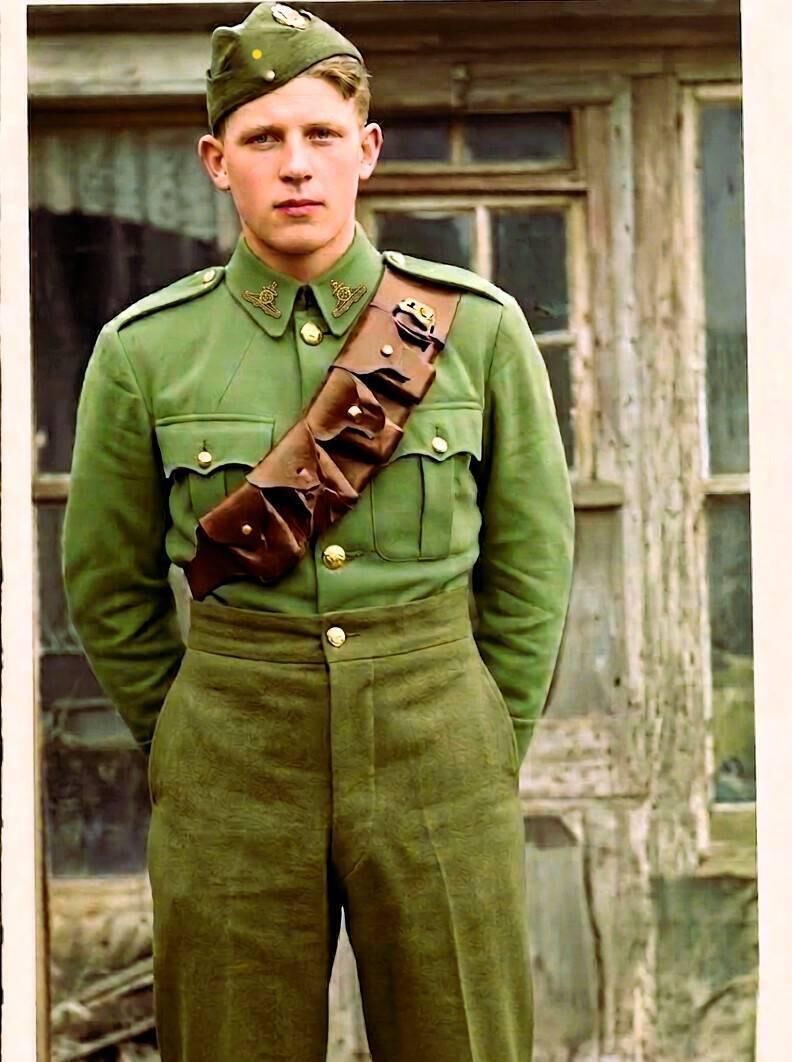
Volunteer Patrick O’Keeffe, of Ballythomas, White’s Cross, one of the victims of the Mourneabbey tragedy in 1939

Volunteer Daniel Crowley, 20, Blackpool, Cork. Daniel, unmarried, as a member of the Volunteer Force, had also been called up in August. His father described him as “a fine, good-looking fellow, 6ft 3in in height”.

Volunteer Richard Mintern, 28, of Blarney Street, Cork (died on the following day). Richard left a widow and four children, the eldest of whom were twin boys, a four-year-old little girl, and an infant of 13 months. Attached to the Artillery Corps at Sarsfield’s Barracks, as a Reservist (he had served three years in the PDF from 1927) he had also been called up in August. He was originally from Henry Street in the city centre.
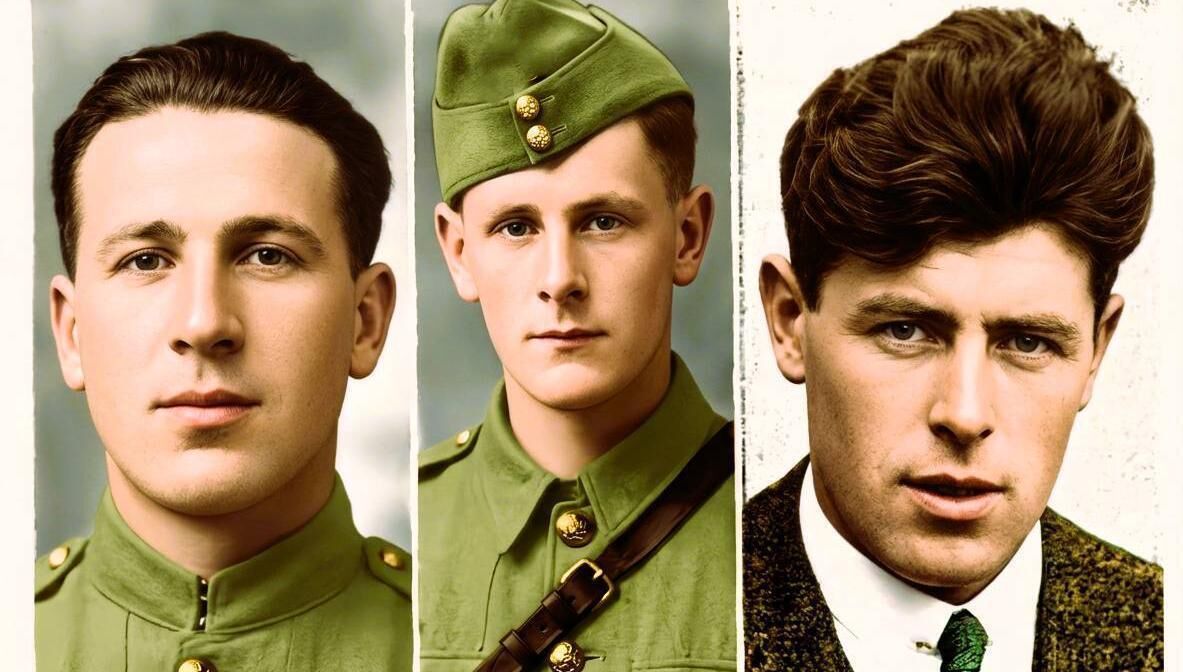
From left, Corporal Charles Brown, from Gurranabraher, Volunteer Daniel Crowley, from Blackpool, and Volunteer Richard Mintern, from Blarney Street - three of the soldiers who lost their lives in the accident in Mourneabbey in 1939

Those detained at the North Infirmary (all described as being seriously injured) included:

BQMS D.J. Murphy, St Luke’s, Cork

Private Casey, c/o Sarsfield’s Barracks, Limerick.

Volunteer Michael O’Sullivan, Shandon Street, Cork.

Corporal Patrick Murphy, Clondulane, Co. Cork.
The driver of the lorry, William Rea, 27, from Friar’s Road, Cork, miraculously escaped serious injury and was detained at the Mercy Hospital.

The tenth soldier, Sgt Mulcahy, a native of Cobh, was also reported to be not badly injured and was taken directly to Collins Barracks.

******

The Requiem Mass for the victims of the tragedy was held on November 26, 1939, at SS Peter and Paul’s church in the city centre, and, although a Sunday, with the majority of business premises closed, those smaller shops that were open respectfully closed their doors and pulled down their shutters while the obsequies got under way.

As the funeral corteges slowly processed through the streets, the Examiner reported that “thousands lined the route”. The Army, and civic dignitaries, was well represented, led by Col Michael J. Costello, OC, Southern Command and Comdt Halpin, OC, Sarsfield’s Barracks, Limerick. The coffins were draped in the Tricolour, and all four hearses were accompanied by their own Guard of Honour. Appropriate solemn airs were played by No.2 Army Band, under Lieut M.A. Bowles, and the Army Pipe Band.

Volunteer Patrick O’Keeffe’s cortege was the first to leave SS Peter and Paul’s. Accompanied by his former comrades from the Volunteer Force’s Regiment of Desmond, a Guard of Honour, a firing party, and the Pipe Band of the 4th Battalion, the convoy left for Mitchelstown where he was laid to rest.

Cpl Brown’s cortege then left for Rathcooney Cemetery in the north-eastern suburbs of the city, and, finally, the hearses containing the mortal remains of Volunteers Mintern and Crowley began the sad, last journey to St Joseph’s Cemetery in Turner’s Cross.

As the cortege approached Turner’s Cross football ground, where a match was underway between Cove Ramblers and Grattan United, battling it out in the semi-final of the Munster Senior Qualifying Cup, play was suspended and both spectators and players stood in respectful silence.

******

In the wider story of the Emergency, incidents like the Mourneabbey tragedy are easily overlooked. Histories often focus on neutrality, censorship, defence plans, and the dramatic moments when bombs fell or ships were lost.

Yet the Emergency was also built out of daily work: drilling in the rain, route marches on hard roads, and travelling long distances in heavy vehicles. The risks were real, and were carried by ordinary men. The Mourneabbey accident reminds us that readiness has many fronts, and that the costs of national preparation can appear in unexpected places.

Today, the names of Cpl Charles Brown and Volunteers Patrick O’Keeffe, Daniel Crowley, and Richard Mintern deserve their place in Cork’s Emergency history.

Their deaths were not caused by an enemy, but they occurred in service at a moment when the State was urgently preparing to defend itself and maintain its independence in a dangerous world.

The loss of four young soldiers returning on leave to their loved ones on a moonlit night in November, 1939, remains a solemn reminder that, even at home, duty can be hazardous, and remembrance matters.

More in this section

TV: Cork author delves into stories behind our fairy forts TV: Cork author delves into stories behind our fairy forts
My Weekend: 'I'm up with the lark..whether I like it or not' My Weekend: 'I'm up with the lark..whether I like it or not'
Books: Story traces the history of the Kerry-Cork butter road Books: Story traces the history of the Kerry-Cork butter road

Sponsored Content

New build, renovation or replacement? Seven window and door decisions to make before comparing quotes in Ireland New build, renovation or replacement? Seven window and door decisions to make before comparing quotes in Ireland
Oxford fertility expert brings 30 years of experience to Sims IVF Cork Oxford fertility expert brings 30 years of experience to Sims IVF Cork
BnM Securing Ireland’s energy future through home-grown renewable power at the heart of BnM plans
Contact Us Cookie Policy Privacy Policy Terms and Conditions

© Examiner Echo Group Limited

Add Echolive.ie to your home screen - easy access to Cork news, views, sport and more