The power of music: 'Singing has given my husband his life back'
Linda Kenny explores the profound and positive impact of music on the wellbeing of people in Cork who are living with conditions such as dementia, stroke or Alzheimer’s
The power of music: 'Singing has given my husband his life back'

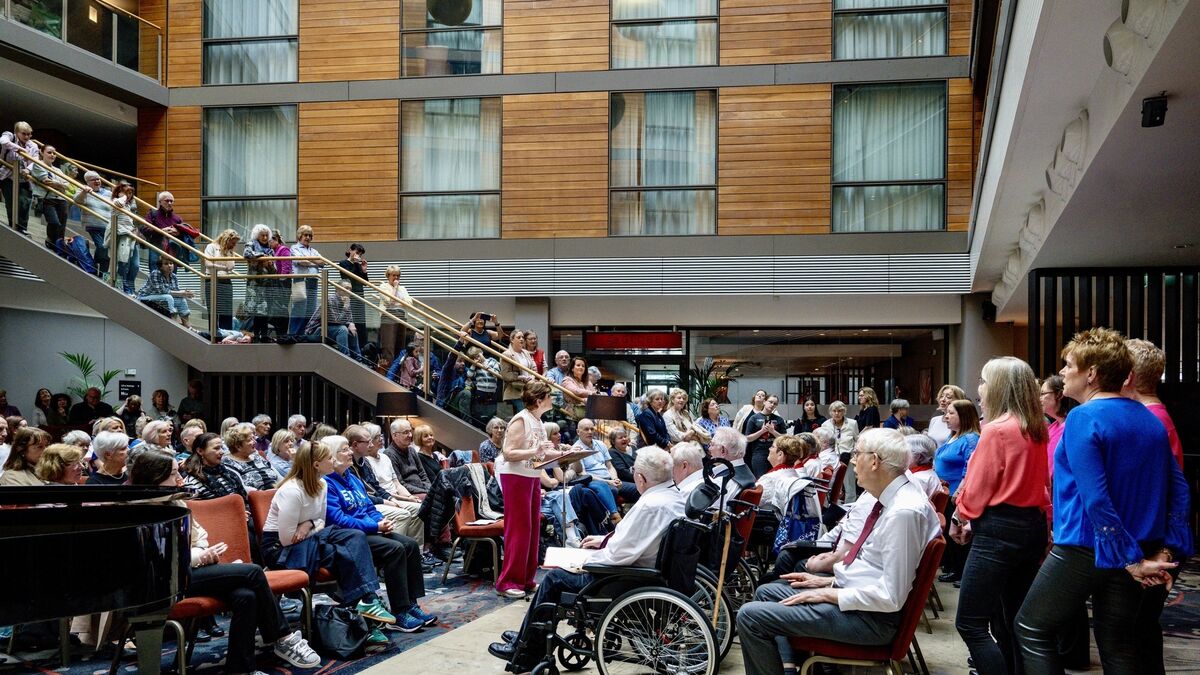
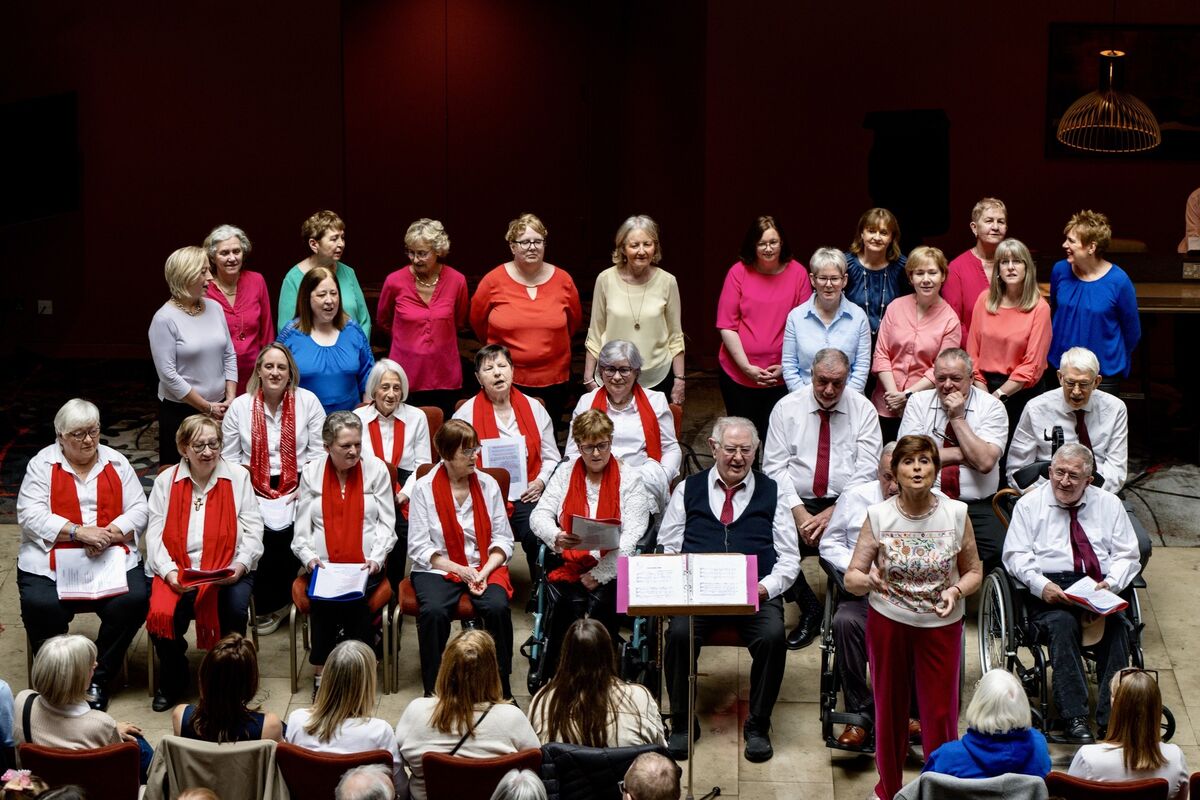
The Stroke Notes choir, made up of stroke survivors and their families from Cork Stroke Support, perform in the atrium of the Clayton Hotel as part of Cork International Choral Festival. Picture: Chani Anderson

For people who have suffered a stroke, or who are suffering from dementia or Alzheimer’s disease, singing can be an invaluable lifeline.
That was evident when Stroke Notes, a choir run by the Cork Stroke Support Centre, performed at the Cork International Choral Festival recently.

Feena McGrath, manager of the centre in Blackrock, said the weekly choir sessions are a vital support.

“Many stroke survivors would struggle with speech difficulties (aphasia) but can sing, because music and singing use different pathways in the brain,” says Feena. “Music is hugely important to stroke rehabilitation, igniting memories, improving and reducing depression and anxiety. We have about 20 people each week coming to our choir and music sessions.”

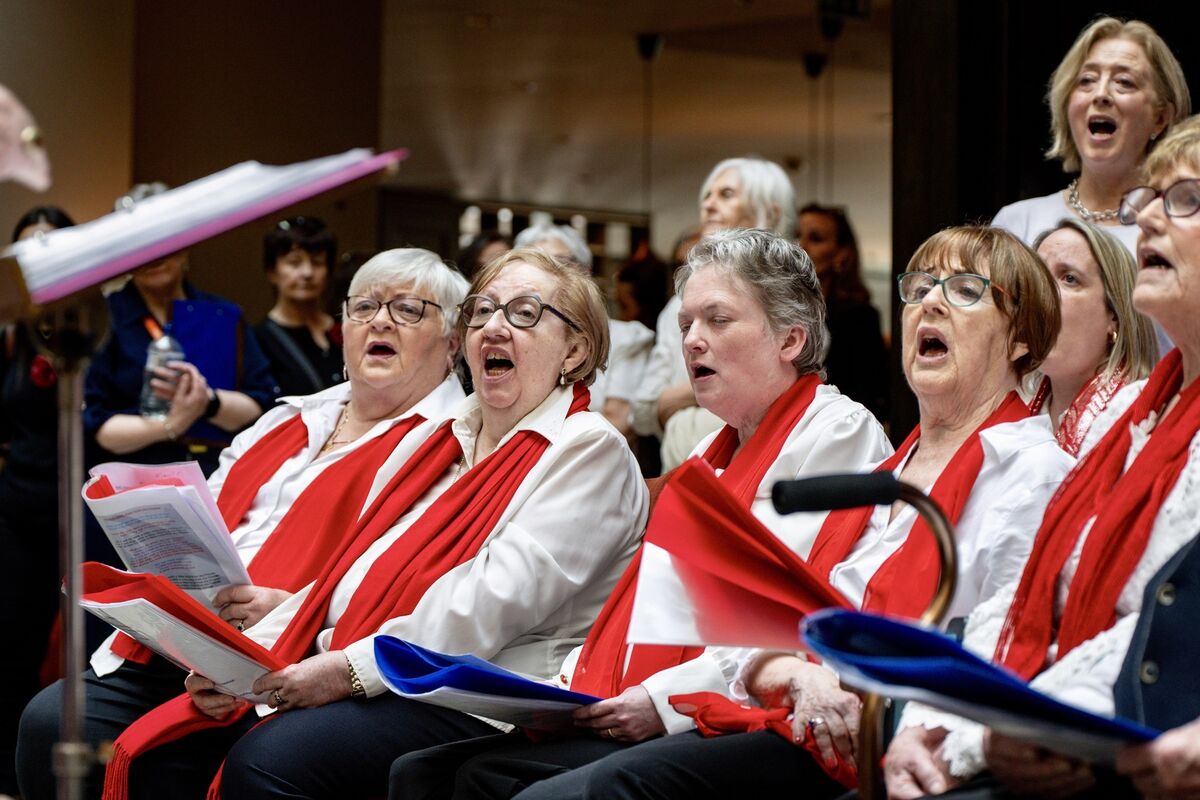
Members of the Stroke Notes choir perform during the Cork International Choral Festival at the Clayton Hotel Cork City. Picture Chani Anderson

The transformative power of music is truly remarkable.
“Singing has given my husband his life back!” says Eileen, who attends the choir alongside her husband, Pat, who has aphasia after a stroke he suffered on holiday almost two decades ago. While his speech remains very restricted, his rich singing voice fills the room as he rehearses with the Strokes Notes choir.

Jim, too, developed aphasia after a stroke at the age of 66, and attends with his daughter, Geraldine. For him, the weekly choir sessions offer more than music - they provide connection, identity, and belonging.

“It’s the social things that keep him going”, says Geraldine. “While my dad sometimes can’t talk at the speed we talk at, he is able to remember singing and whatever he has learned off by heart. It is fascinating as it is obviously stored in another part of the brain.”

Post-rehearsal, over a cuppa and birthday cake, the room hums with laughter, conversation, and a palpable sense of shared purpose and joy. Clearly, the social dimension of this collective singing experience is not simply an added benefit, it is central to its success.

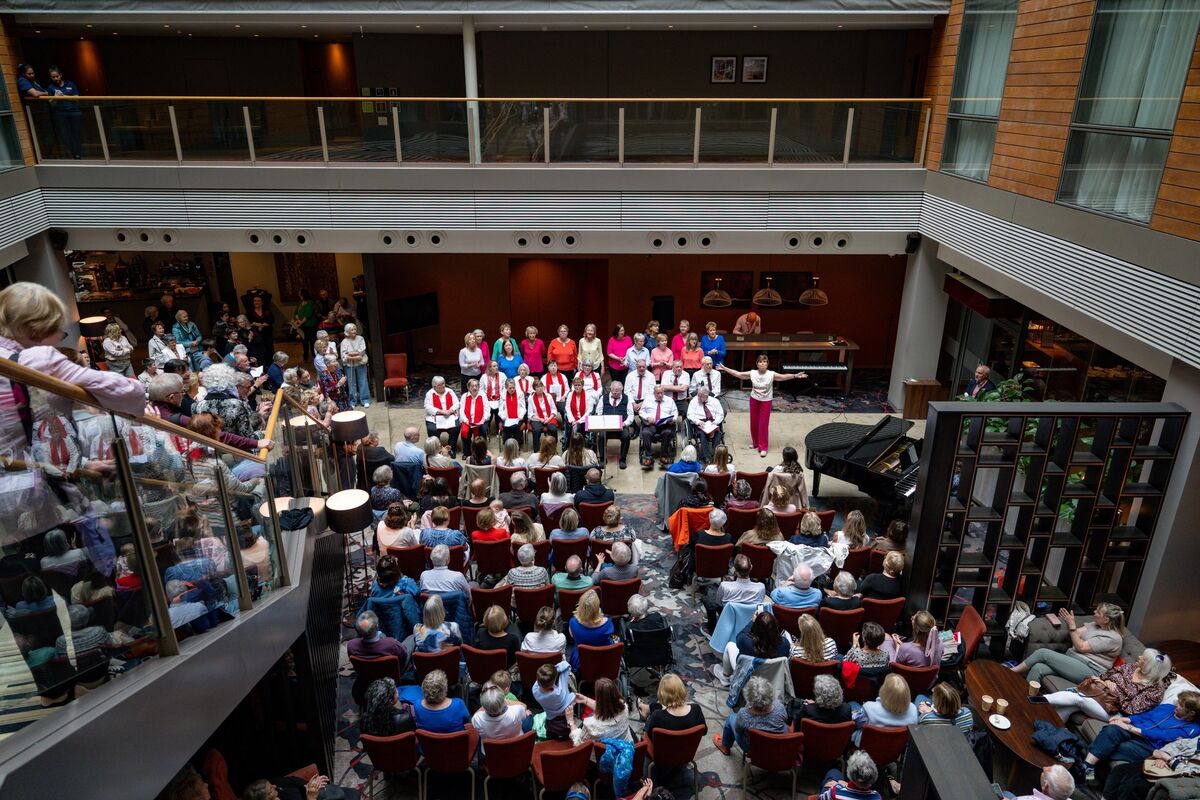
The Stroke Notes choir, made up of stroke survivors and their families from Cork Stroke Support, perform to a large audience in the atrium of the Clayton Hotel Cork City as part of the Cork International Choral Festival. Picture Chani Anderson

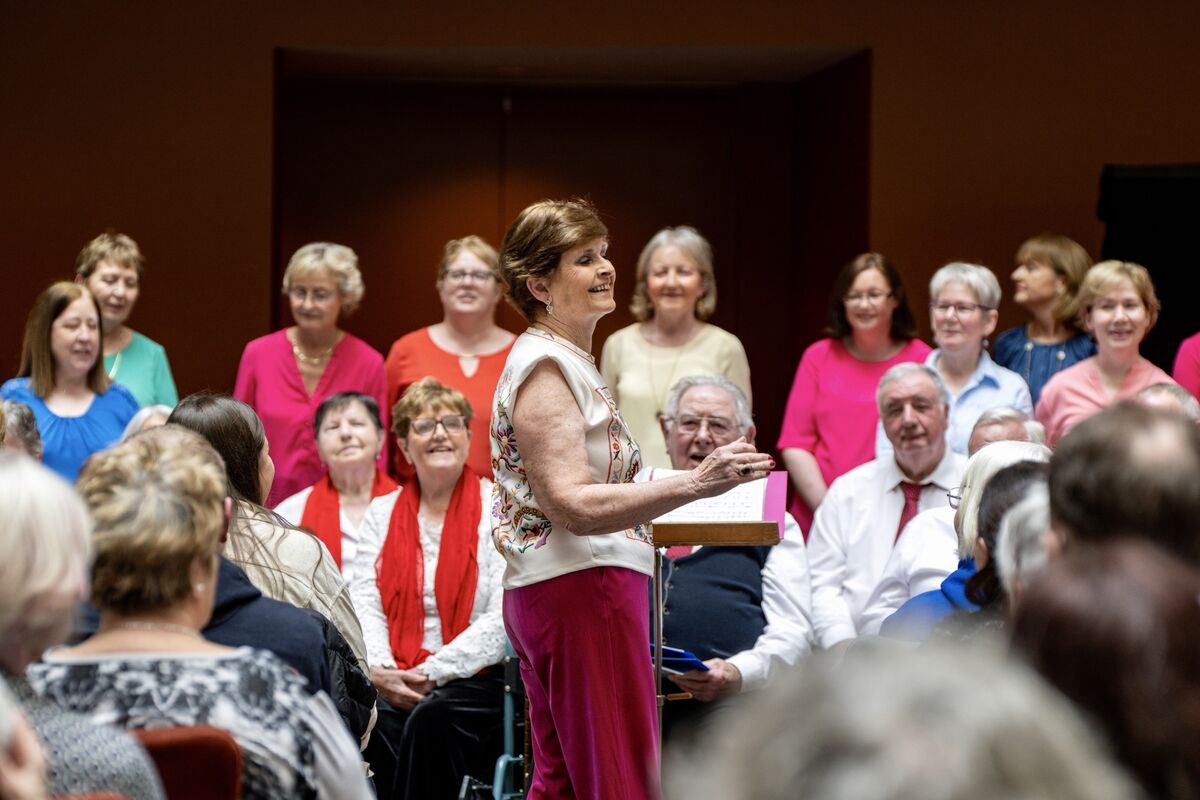
Their conductor, Bernadette Kiely, has been guiding the choir for almost five years. Both inspiring and exacting, she encourages the group to stretch their abilities, tackling harmonies, three-part rounds, and complex rhythms with determination and pride.
“The commitment is huge!” she says. “I’ll send them the soundtrack of the songs we are doing and print out the words (blue for the men, red for the ladies). It’s lovely to have something to work towards.”

With two SMA priests in the choir, they sang at three masses in the first term alone, and stage annual Christmas and summer concerts.

For the Cork International Choral Festival, the Strokes Notes choir sang alongside long-term collaborators the Finphonics - the staff choir from St Finbarr’s - in a rousing performance in the Atrium of the Clayton Hotel.

“After one such concert,” Bernadette adds, “someone came up to me with tears in her eyes and said ‘he doesn’t even talk to us at home and I’m watching him today sing song after song!’ Music gives the family something too.”

There can be similar positive effects for patients with dementia and Alzheimer’s disease.

What is it about music that allows people with life-altering neurological conditions to reconnect so vividly?

Science suggests that, unlike facts or names, often stored in areas of the brain vulnerable to damage, music is embedded in motor, sensory, and emotional centres, which are more resilient to cognitive decline.

Vanessa Bradbury, dementia advisor with the Cork branch of the Alzheimer’s Society of Ireland, highlights the importance of maintaining brain health through a holistic approach.

She explains that mentally challenging the brain, pushing boundaries through physical exercise, maintaining a well-balanced diet, and fostering social interaction, are all vital. Even after a dementia diagnosis, these can help support the brain and, in some cases, may even encourage the formation of new neural pathways.

She points to initiatives such as Singing for the Brain groups and Memory Cafés as playing an important role in this supportive ecosystem.

Betty Coogan knows this first-hand. She has been attending the Le Chéile Memory Café at St Finbarr’s Hospital since her late husband Jim was diagnosed with dementia. “Jim loved the sing-songs at the café and looked forward to them,” she says. “Pre-diagnosis, he could remember about five lines of a song.”

As his condition progressed, he could remember every lyric of every song. “We couldn’t shut him up,” Betty adds with a chuckle.

“The social dimension of the memory café is very important for the people and their carers. From the first day, I felt supported and welcomed, and met people who were walking the same journey as me.”

Bernadette Kiely leads the Stroke Notes choir performing at the Clayton Hotel, Cork city, as part of the Cork International Choral Festival. Picture: Chani Anderson

Even after Jim’s passing, Betty continues to volunteer at the café, which takes place on the last Friday of every month. “It’s very uplifting. I’d never miss it!” she says.
Music’s ability to unlock memory and emotion is also at the heart of the ‘Alive Inside’ programme, which was introduced by Lisa Howard during her time as Activities Manager at St Luke’s residential care home in Cork, working in a dementia unit.

Inspired by an award-winning 2014 documentary, Alive Inside, the programme uses personalised play-lists to reconnect individuals with their past.

“Music is specific to each person,” Lisa said, “so when creating the play-lists, it was so important to get the families involved, to learn about their loved ones, their back-story, to determine the songs they would enjoy, and to anticipate exactly what the emotions would be.

“In someone with dementia, while understanding and capacity will fluctuate, the emotions remain. They might forget the associated memory but will still have the feelings.

“They can feel over-stimulated by noise and there is so much uncertainty for them, that creating a familiar play-list, with songs that trigger familiar emotions, of the person within, can make such a difference.

“You can see that recognition in their eyes, see their faces light up. Just seeing the person come alive brings tears to our eyes too.”

“We have had brilliant results, particularly for residents who initially didn’t seem to chat or engage at all. With their headphones on, they would be singing on the top of their voices!”

While outcomes vary with the individual, Lisa stresses that music can improve focus and engagement, supporting everyday activities such as self-care and medication routines.

It may not restore a person entirely, but it reconnects them with who they are.

Jackie O’Donovan, a former activities co-ordinator, witnessed the impact of the Alive Inside programme on a deeply personal level while caring for her late mother.

“Throughout her life, my mam always loved music. So, as her disease progressed, I bought her an iPad and a headset, and created a song play-list for her drawn from the all the different stages of her life. If she was agitated or wandering off, the music calmed her.

“Her play-list became part of her care plan. Staff regularly used her music for interaction and stimulation during the end stages of her journey. One of the pastoral care team told me recently that when she sang to mam, she felt she was having a conversation with her, even though she was non-verbal. I thought that was very special.

“She couldn’t string a sentence together, but she could sing all the words of a song.

“Mum had the same play-list for two or three years. But there was so much comfort for her in this familiarity.”

The Stroke Notes choir, made up of stroke survivors and their families from Cork Stroke Support, perform in the atrium of the Clayton Hotel as part of Cork International Choral Festival.	 Picture: Chani Anderson
The Stroke Notes choir, made up of stroke survivors and their families from Cork Stroke Support, perform in the atrium of the Clayton Hotel as part of Cork International Choral Festival. Picture: Chani Anderson

Since 2023, the Down Memory Lane Music programme I help to run has been touring residential care homes across the city and county - as part of the Healthcare Hoolies, an initiative run by Cork County Council and Healthcare Ireland. One particularly striking memory for me involved a woman who was unable to speak at the beginning of a performance. Gradually, she began to mouth the words silently. As the programme progressed, she found her voice and sang into the microphone. Afterwards, she and I engaged in a lively conversation about her former career as a social worker.

It was both inspiring and revelatory.

These moments underscore the importance of human connection. The chats before and after performances, learning someone’s name, linking it to a familiar song, listening to personal stories - all these elements help break down emotional barriers and encourage participation. Yet, undeniably, at the centre of it all, is the music itself - unlocking memories, triggering emotions, and stimulating interaction.

After one Down Memory Lane event in Schull Community Hospital, Director of Nursing, Roisin Walsh, remarked: “We saw people smiling, singing, speaking Irish, and enjoying the morning, some with family members who were blown away to see their father and grandad, smiling and laughing at the stories and songs. It was fantastic.”

Jacinta McCormack, a HSE employee who runs the Fermoy Singing for the Brain (SFTB) group, echoes this sentiment. “One of the most meaningful parts is the human connection: the conversations before and after the sessions, the friendships that form and the sense of belonging that grows over time. At its heart, SFTB is about helping people feel included, valued and connected through singing.”

She recalls one woman in her 90s who, as she left each session, would say ‘It’s the best day of the week’. Comments like that stay with you.”

The roots of the SFTB Ireland initiative stretch back over a decade. In 2015, the North Cork Dementia Alliance, based in Mallow, piloted a programme designed to create a warm, fun, and welcoming space where people could come together to sing, socialise, enjoy gentle movement, and share experiences.

Today, with the support of the HSE South West Community Work Department, that vision has grown into a network of groups across the city and county, co-ordinated by a part-time SFTB coordinator and administrator. SFTB is currently unique to Cork, with several groups running and new ones developing. “Music is special,” insists Jacinta, “because even when other memories are hard to access, songs are often still remembered and easily recalled.”

  • As part of their Bealtaine tour of all city libraries from May 16–29, the hugely successful Down Memory Lane Music Programme - featuring Linda Kenny, Conor ‘The Loungeman’ O’Shea, Maurice Healy, and raconteur Pakie O’Callaghan - will perform at the launch of the Bright Minds Community Series at the City Library on May 23 at 12pm.
  • Open to those living with Alzheimer’s and dementia, as well as their families, the series is a collaboration between Cork City Libraries, Healthy Ireland, and the Cork branch of the Alzheimer’s Society of Ireland. It is a free event open to the public. The series includes a variety of talks and events, such as an art exhibition, hosted in libraries across the city throughout the summer. It concludes in September to coincide with World Alzheimer’s Month.
More in this section

Kerry v Cork - Munster GAA Football Senior Championship Semi-Final TV sport round-up: Cork footballers aim for double in Kingdom
Cork author: I hope that my book entertains ... and turns you on to magic Cork author: I hope that my book entertains ... and turns you on to magic
Rooms with a harbour view: 3 homes on sale on Cork’s coast Rooms with a harbour view: 3 homes on sale on Cork’s coast

Sponsored Content

55 years of Cork Simon Soup Run: The light that has never gone out 55 years of Cork Simon Soup Run: The light that has never gone out
How to get involved in Bike Week 2026 How to get involved in Bike Week 2026
Your local hearing care experts in Cork Your local hearing care experts in Cork
Contact Us Cookie Policy Privacy Policy Terms and Conditions

© Examiner Echo Group Limited

Add Echolive.ie to your home screen - easy access to Cork news, views, sport and more