John Arnold: I completed the holy trinity... Medjugorje, Lourdes, Fatima
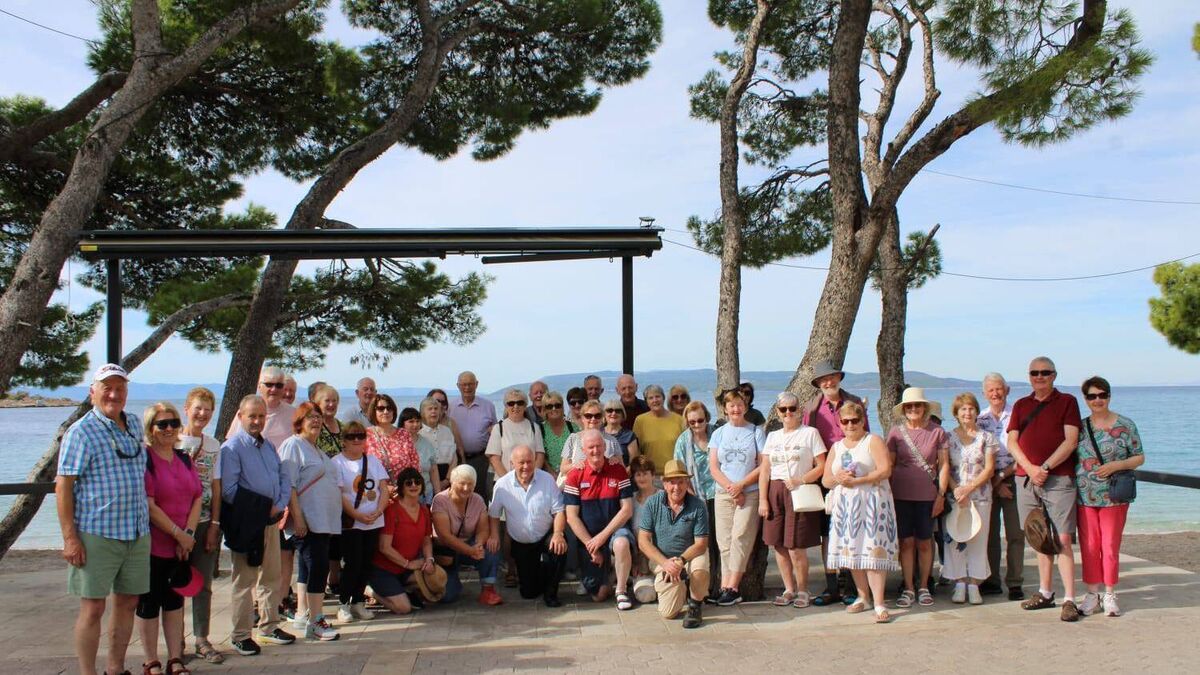
The Rathcormac Parish Social Initiative Group in Croatia
I knew very little about the breed of dog or its history until last week.
We had two wonderful tour guides and on a day trip in Croatia from Makaraska to Dubrovnik, he explained everything to us.
If right was right, and Yugoslavia as we knew it hadn’t undergone such profound change in recent decades, I’d probably be very familiar with the area. It’s rugged but stunningly beautiful - that’s why we had planned our honeymoon here in May, 1981.
Was it the great William Shakespeare who once wrote, ‘What’s past is prologue’? In other words, what’s gone before is but a preview of the future. Forty-five years ago, just the two of us had planned the trip to Dubrovnik. Now, in 2026, a group of over 40 came for this break to Croatia.
War, upheaval, and destruction beset the area near the Adriatic Coast as recently as the 1990s.
Because of television, we saw at first hand the savagery and bloodshed that tore the region apart in relatively recent times. It’s truly amazing, isn’t it, the power of human beings and ethnic groups to bring such horrors on themselves? Equally stunning also is the way recovery and healing can grow.
Our Scottish tour leader Frank explained that because of the enclosed nature of the Adriatic Sea, there is little or no tidal movement - the blue-green waves just lap in and out all day and night. Though late in October, we had gorgeous weather with heat up to the mid-20s most days.
Staying in the same hotel for the full week was mighty as we settled in easily and it was truly a home from home. On a half-board basis, breakfast and evening meal, I determined not to over-indulge but it wasn’t easy to stay back from the table.
Having all our group in the one hotel was brilliant as we met regularly at mealtimes -you could sit at one table one day and with a different group the next day.
Our first morning saw us on a walking tour of Makarska, situated on a very narrow sliver of land with massive mountains at one side and the crystal clear sea at the other – the mountains form the boundary with Bosnia-Herzegovina which is now a separate country. Like so many of the places we visited, many of the shops, cafes and bars are in buildings that are hundreds of years old.
We flew into Split and took a coach to the hotel. The second day we were back on that luxury vehicle for a 9am start for a trip to Medjugorje - a distance of about 50 miles.
On our journey, we had to present our passports twice, at the two border crossings between Croatia and Bosnia Herzegovina. The bus trip took abut an hour and a half through rugged, wild, mountainous countryside - not even a goat to be seen.
It was in 1981 that six children first saw visions of Our Lady on the Feast of John the Baptist, June 24. Medjugorje at that time was a little rural village where subsistence farming was still practised. Grain and tobacco were the main crops by which the peasants eked out a living.
Initially - as in Lourdes and at Fatima - no-one believed the children. Indeed, many thought the visionaries were simply making up stories or had gone mad.
Our visit to Medjugorje was short. We made the ascent on the hillside to the Blue Cross where hundreds were praying - one of the places Our Lady appeared. I’ve climbed Croagh Patrick a few times, but tis like hill-walking in comparison with Apparition Hill!
I climbed on up above with another of our group - my wife Mary, who’d been here before, warned it was tough but that was putting it mildly! Sharp, jagged rocks at all angles and no defined ‘path’ and trees bent from the wind everywhere. We climbed a few hundred feet with crowds criss-crossing, some climbing and some coming down. It was hard but worth it.
We got the bus back to the ‘town centre’ and visited the twin-domed Church of St James. Behind is a massive seated outdoor amphitheatre where thousands can attend Mass and other ceremonies.
A huge statue of the Risen Christ stands nearby. Not long after if was installed, pilgrims noticed a clear liquid flowing from the knee of Jesus’ right leg. This has been flowing, drop by drop, for many years now.
I knew I’d be asked the question! “Well, John, this year you’ve been to Lourdes and Fatima and now Medjugorje - which do you like best?” In truth, it’s impossible to answer that.
Each place is unique, different, and evokes various emotions and feelings. Our trip was only a whistle-stop tour and I’d like to return to Medjugorje in the future.
We had a free day on Saturday and went to Mass that evening in the ancient church of St Mark, where the remains of St Clement lie in two gold reliquaries. There had been a wedding earlier in the day and at 7.30pm the guests were still dancing, singing, drinking and eating in the Town Square!
George Bernaard Shaw said ‘those who seek paradise on earth should come to Dubrovnik’ - he was right! The Old Town with huge stone walls all round, streets of marble and medieval buildings is just stunning. We spent a few hours there on the Sunday, but I’d say one would want a whole week to do it justice.
We had a lovely boat trip to the islands of Brac and Hvar. I’m not a great fan of water, rivers, lakes, boats or beaches, but must admit the voyage was most pleasant and relaxing.
If one was writing up a ‘Must Visit Again’ list, this part of the world would be high up there.
Our last full day was spent in Split. The Roman Emperor Diocletian built his palace here about 1,700 years ago. Amongst the many Christians martyred near here by Diocletian was Bishop Domus. Ironically, the tomb of Diocletian was later destroyed and his bones scattered to the four winds. In his place now rests the tomb of St Domus!
We had a week of sunshine in Croatia and it started to absolutely lash rain just hours before we left. Tired, but with so many great memories, we came home last week.




 App?


