The day 15 Nazi sailors landed on Cork soil
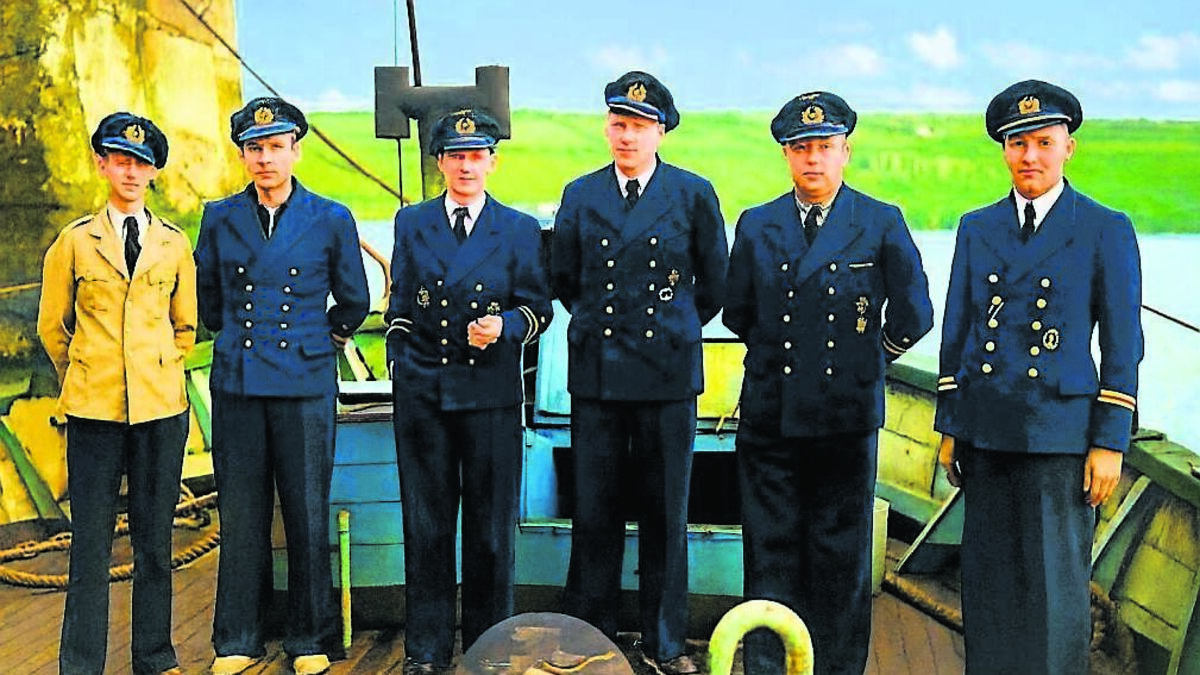
German naval officers at Kinsale in January, 1946. Korvettenkapitän Martin Clemen, the leader of the group, is third from left
It was Saturday morning, January 19, 1946, when solicitor Dick Hegarty left his home in Kinsale to take his usual bracing walk along the pier.
World War II had ended four months before. Although Ireland had been neutral in the conflict, it was a time of austerity, shortages, and rationing. Most people just wanted to put it all behind them and get on with their lives.
Hegarty, lost in thought, was suddenly confronted by two men in naval uniform blocking his path. His eyes alighted on the Iron Cross they wore, with the Nazi Swastika at its centre.
The senior of the two addressed him in flawless English. He was, he explained, Korvettenkapitän (Lieut Commander) Martin Clemen of the Kriegsmarine, the now-defeated German Navy. They were escaped Prisoners-of-War having sailed to Ireland from St Nazaire on the Atlantic coast of France. Their group of 15 comprised six officers, eight other ranks, and a civilian. Would the gentleman mind directing them to the nearest police station?
Clemen had been the commander of a flotilla of mine-sweepers. With Germany’s surrender, he and his crew were taken prisoner at St Nazaire and interned. Put to work by the French Navy clearing mines, they had been treated tolerably well but had learned that soon, with the job completed, they would be transferred under the control of the reconstituted French Army, many of whom had served in the Maquis and whose aversion to the Germans was no secret. Thus, they had decided to make their escape to a neutral country.
One thing they were adamant about; they did not want to be returned to France where they were certain a ‘reception party’ would be waiting to greet them.
When they made their case to the sergeant at Kinsale Garda Station, the wheels of bureaucracy slowly ground into motion. The telephone wires hummed, eventually getting the attention of Taoiseach, Éamon de Valera.
Word came through from Dublin that, until a decision was made as to their fate, they should be regarded as ‘illegal aliens’ and placed under ‘protective custody,’ subject to 24/7 Garda surveillance. Army officers from Collins Barracks, Cork, arrived and searched their little minesweeper and its occupants thoroughly. Satisfied there were no arms on board, the Germans were allowed to remain under the control of the gardaí.
While this played out, the sailors needed to be fed, showered and their clothes cleaned. The townspeople rose to the occasion. They were, after all, it was reasoned, other mothers’ sons. The men were taken to Murphy’s Hotel where the Red Cross documented them, they received a good meal, and later went for a long walk, accompanied, at a discreet distance, by the Guards.
Mrs Pamela Kennet, wife of British Army Brigadier Brian Kennet and scion of a long line of high-ranking Army officers - her grandfather was Surgeon-General to the Forces (and personal surgeon to two kings) and her father a Brigadier - invited them to tea at her home, Rampart House, Dromderrig.
Her brother, Major Edward Dorman, she explained, had been a prisoner of the Germans in Italy, and been well-treated, and she wanted to repay the kindness.
On Sunday morning, the group paraded in uniform to church services, some to the Protestant St Multose and some to the Catholic church of St John the Baptist. Later, they busied themselves by cutting wood and drawing fresh water back to their boat.
While townspeople were generally civil to them, as the days wore on, a certain hardening of attitude became apparent. Many locals had relatives who served, and died, fighting for the Allies in both World Wars, and the presence in the harbour of a British steam trawler, the Iser, whose crew was openly antagonistic to the Germans (they invited them to fight) did not help. At a meeting of the Urban District Council, it was proposed that electricity to the vessel be cut off.
But the principal cause of the increasing froideur to the visitors was one that was being played out far from Irish shores: the Nuremburg Trials. These had opened in the German city just eight weeks earlier, to try Nazis accused of war crimes. Graphic images of the appalling conditions in concentration camps had been shown in cinemas and reported in the press. The Irish Independent reported that the Nazis had planned to hang the Catholic Bishop of Münster (Germany) for denouncing their policy of so-called ‘mercy killings’.
But it was Clemen’s attitude towards the Trials that rankled with many Cork people. They were, he said, ‘just a comedy’, and the stories in the newspapers about Belsen Concentration Camp ‘were all propaganda’.
In the meantime, his fate, and that of his colleagues, had been decided. Fearing a major diplomatic row with the French and/or the UK, the sailors would be sent back to France.
Michael Rynne, the Government’s legal expert on foreign affairs, concluded that, as the war was over, they were ‘ordinary aliens’ who had simply landed on our shores without permits and were therefore liable to expulsion.
He advised: “The chief argument against giving the Germans permission to reside here, despite their illegal entry, would seem to lie in the bad precedent such indulgence would create. Ireland might easily become a refuge for all the displaced persons of Europe with the means of landing unexpectedly here.”
Warned against arresting the sailors too early as it might give potential legal advisors time to file habeas corpus applications, the Gardaí postponed their arrest until the last moment.
Just before midnight on Thursday, February 7, 1946, a special bus, accompanied by two car loads of Special Branch, drew up on the pier at Kinsale; 15 Guards accompanied the group, some travelling on the bus.
The convoy stopped briefly at the Bridewell Garda Station in Cork for formal documents to be completed, then it was on to Cobh where the French corvette Roselys was waiting. It sailed off with the PoWs at 3.30am. A party of French had earlier disembarked taken possession of the Germans’ vessel.
For Martin Clemen and his comrades, the war was finally over.
Postscript: Clemen never forgot the kindness shown to him and his comrades in Kinsale and for some time corresponded with people who had befriended them. “The friendship and understanding we received,” he said, “gave me new faith in mankind at a time I needed it badly”. If he was aware of growing animosity to them during their stay, he made no allusion to it.
Finally released from PoW camps, he studied at the University of Göttingen and became a Protestant clergyman. In the midst of poverty, hunger and ruin, he and his family lost all their possessions to the Russians. His wife died, leaving him to rear a family of five. He died in 1967, in a Swiss hospital, from cancer.