Throwback Thursday: Christmas memories...and a pudding recipe - from 1886!
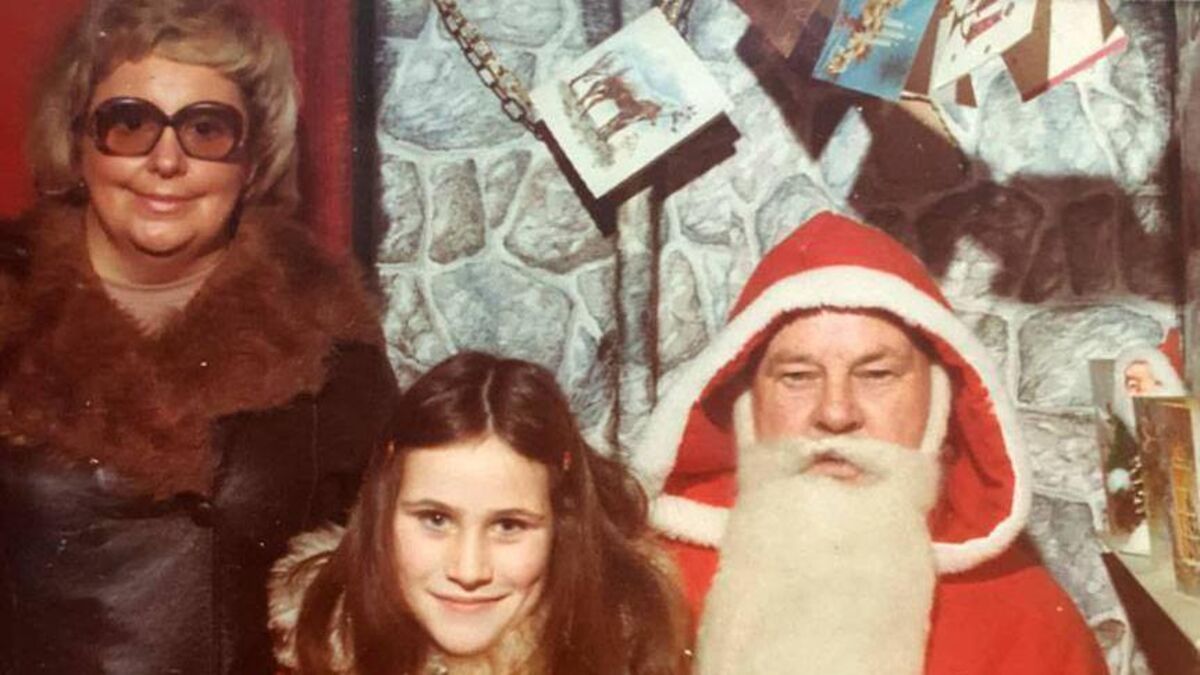
Yvonne Daly with her mother, May, visiting Santa in the early 1970s. Picture supplied by Yvonne’s husband, Fintan Bloss
An expat - but still faithful Corkman - Tom Jones has sent us his thoughts on Christmas for Throwback Thursday, reflecting back through 75 years of history.
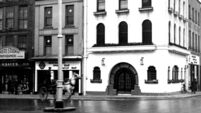
“A journey in my case that at times was spread across five countries, spanning three continents,” says Tom. “But this is also the 70th anniversary of the fire that destroyed the beloved old Opera House. A night indeed to remember, when Cork collectively cried, and I personally witnessed it burning from my bedroom window, just before my 5th birthday. It’s a memory I’ve never forgotten.”
Tom adds: “Having recently enjoyed the Christmas tree lighting at the Rockefeller Center in New York City, and a visit to The Radio City Music Hall festive spectacular, somehow my mind keeps harking back to a more simplistic period in my life.
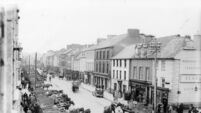
“I was born at the bottom of Shandon Street in December, 1950, when the full moon of December, also known as The Cold Moon, illuminated Shandon steeple as it cast its shadow through the window across the slatted orange box which was my crib.
“Those were tougher economic times in my native city, and indeed in Irish history. Yet I recall fondly the simpler Christmas lighting of good old Pana and other streets.
“A time when Roches Stores once illuminated its entire frontage with a display simulating moving figures. How bad, as they say, considering it was achieved with the old incandescent light bulbs, so unlike the modern tubular LED lighting, or the computer-generated images projected onto a building nowadays.
“It was a wonderment of enchantment at the time when viewed through the eyes of a child,” recalls Tom
“It’s strange how some visions dwell forever in the caverns of our memory. The delight of seeing the window displays of festive themes, in The Munster Arcade, Cash’s, and others. The yearly pilgrimages to the various and plentiful churches to see and compare their Nativity scenes.
“It goes without saying that a visit to Woolworths would be recorded in the memory of any child of the 1950s. The excitement of mounting the stairs to the wonderland displayed on those high counters above.
“Likewise, the display of toys in the windows of Kilgrews, The Lee Stores, Woollams, and other toy shops, as we pressed our cold noses against the glass in hopeful anticipation that Santa or somebody would deliver the goods on Christmas Day.
“Then came St Stephen’s Day, when we gathered on the hills and terraces of Spangle Hill in order to show off our own presents, see what friends had received, and revel in our good fortune, whatever it might be.
“Many of the toys received were simple, but it only took a child’s imagination to fully appreciate their true value and significance.”
Tom also recalls another strong Cork tradition on St Stephen’s Day.
“That was also the Day of the Wren, or The ‘Ran, as pronounced on the Northside (different areas of the city spoke with a different parlance). To the best of my recollection, the song went something like this:
“The ‘RAN The ‘RAN the jewel you see,
Up on a holly and ivy tree,
If you’re sick or if you’re poor,
May the Lord have mercy on your poor soul,
Knock on the knocker ring on the bell,
Please give us a copper for singing so well,
Singing so well Singing so well,
I have a box under me arm,
Tuppence or Truppence would do me no harm,
Up with the kettle and down with the pan,
A penny or two to bury The ‘Ran..
Tom recalls: “If you happened to be a mite successful in such endeavours, then like a mounted cavalry of sorts, with friends galore, we galloped into town to see the matinee picture show of the day. All in glorious technicolor to brighten the grayness or monochrome of the zeitgeist of our lives.
“The Coll, The Palace, The Lee, The Pav, The Capitol, The Ritz, or The Assem’s, or the Mecca for us northside kids, The Lido, sadly, are all now graveyard tombstones lodged in our memory banks.
“Armed with Acid Drops, Clove Rocks, Bulls Eyes, Peggy’s Legs, Fizz Tubes, Gobstoppers, or, if you were flush with coin, Rowntrees Gums, or Pastilles, or, a favourite of mine, a packet of Charms, which were little square pieces of candy with different fruit flavours. (A gentle, humorous caveat here: the Acid Drops aforementioned were not of the Dr Timothy Leary type of the latter 1960s.)
“If Christmas represents a season of joy, good tidings, blessings, goodwill to mankind, and peace on earth, may its inspiration live forever,” says Tom fervently.
“So, with affection and recollection in memory of those innocuous times, to all back at home in Cork city, and dear old Erin’s isle, Nollaig Shona Dhuit.”
Tom, what memories you bring back! Even that mention of the old wooden orange box brought into use as a crib.
Back then, when young couples couldn’t even imagine demanding a smart new house with all the essential appliances already plumbed in place, and lots of shiny modern furniture, those orange boxes were used not only as cradles but as bookcases, tables, even seating (hopefully with a cushion or sack on top). Tea chests too, and anything else that was sturdy enough to withstand daily life.
And what was wrong with them? No problem with the neighbours seeing them, they were living in the same difficult times. Second-hand clothes, thrifty buying of groceries, make do and mend. They were years which formed many a strong character.
Does any reader still have a treasured Cork butter box tucked away somewhere? Used as a turf bucket or to stand the Christmas tree in? A memory of the days when our butter ruled the world and could be found as far away as Caribbean sugar plantations.
That’s why our butter is always so well salted. It had to be to survive on the voyages it took. (How many of you, trained since babyhood on that taste, find yourself sprinkling salt on Continental butter when you are away on holiday? It’s a hard habit to break.)
Can’t you just see the heavy drays of the 19th century, loaded with butter boxes, each one stamped with our proud identity, slipping and rumbling down the narrow streets from Shandon down to the quaysides, there to be stacked on the boats which were preparing to depart for foreign lands?
And how many people in other countries, who had never visited Ireland, looked with pleasure on the dish of creamy yellow butter on the breakfast table, and prepared to spread it on their toast? Plenty still do!
Even in the Middle Ages, monks who travelled out from Ireland across Europe on their missionary work complained if supplies of the good old native product were not in sufficient supply in the draughty monasteries of the Alps or the Pyrenees.
It’s hard enough getting up at all hours to chant and pray without that comfort on the communal breakfast table to look forward to.
And are the Wren Boys still to be found around the city on St Stephen’s Day, chanting their immemorial song? They are certainly very much in evidence still down in Dingle, where the pubs are packed from dawn with participants creating straw costumes, planning their route, discussing past events, and tuning their instruments, prior to setting out into the draughty street to wind their way in the ancient procession.
It’s a very old custom indeed, the Wren Boys, and nobody is quite sure where it originates, although it is in all probability a memory of the old Corn King tradition, where the king (ie, the grain crop) dies at the end of the old year, but returns with the spring to promise a fruitful harvest to come.
(You don’t need telling that the wren is the king of birds, but happily these days the image is usually a bunch of feathers or a little cushion of moss decorated with holly berries.)
Also on the theme of Christmas, Fintan Bloss has generously shared with us some charming photographs from his family album, including one of his wife Yvonne (nee Daly), with her mother, May, visiting Santa in the early 1970s.
Wonder which Santa it was, Fintan? By then we had them in several major department stores, although it was still unusual to visit any more than one imitation before the big day itself.
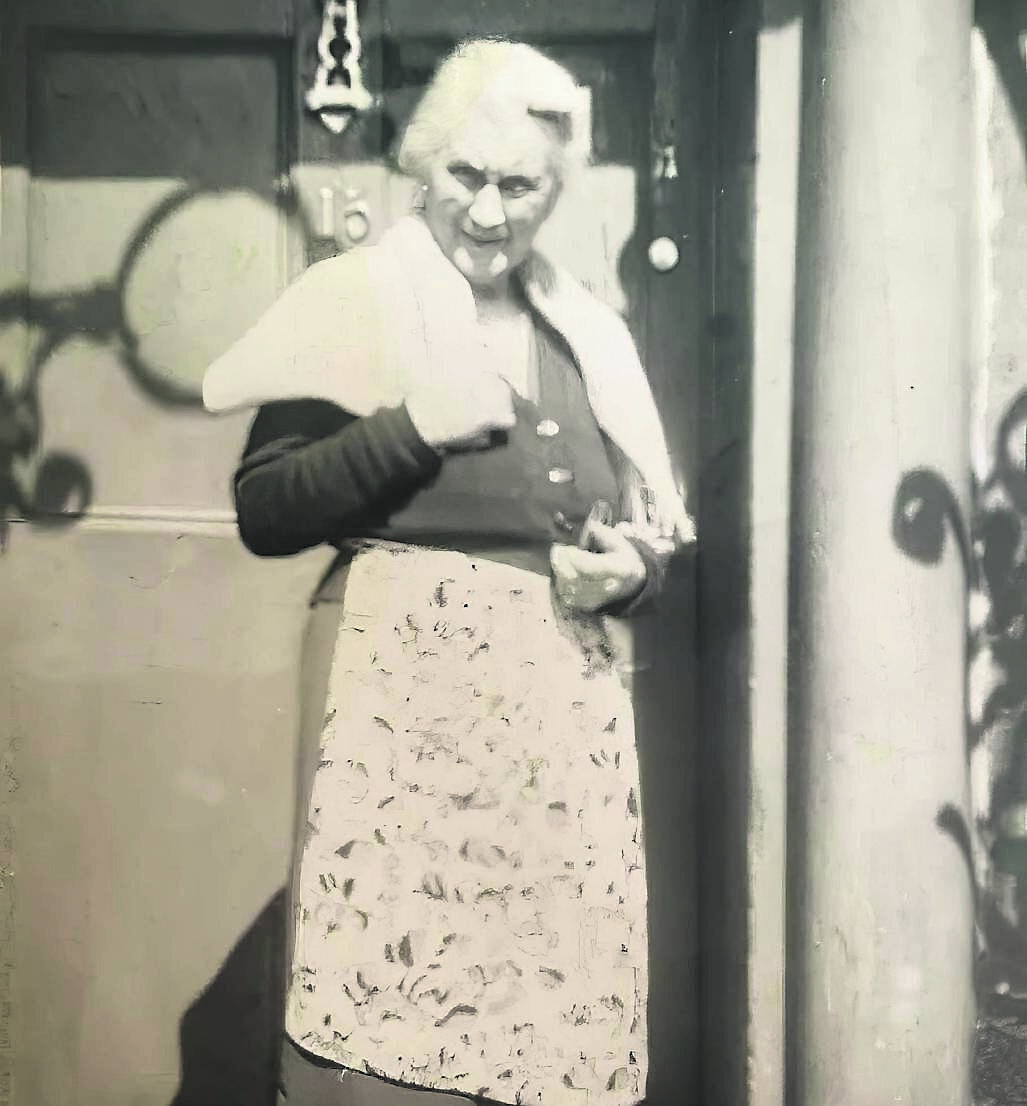
Fintan also discovered his grandmother Sarah Ann Buckley’s cookbook dating from 1886, and furnished us with a copy of her Christmas pudding recipe, tried and approved over many years.
The aforesaid Sarah Ann was a strong and redoubtable resident of 15, North Mall, and since she would only have been five or thereabouts when that recipe was copied in, it clearly came from a generation earlier that knew the value of such things.
Indeed, this writer treasures her own mother’s cookery book, now very faded and worn, but holding within its battered covers recipes carefully written down with a fountain pen and green ink, from the 1930s to the 1960s.
She was an O’Brien, and before, during, and after her student years at UCC, gave a hand in the family business, creating pastries and cakes with a light hand that I could never emulate, try as I might.
Our absolute favourite as children was her sticky delicious gingerbread, but she didn’t often make that, since she said it took a lot of time (and with five of us, plus a bookshop to run, there wasn’t usually much spare time!) But of course she had a Christmas pudding recipe too, and by the look of the ingredients, that could well be a pre-war recipe.
How many of you might have just such a cookbook tucked away in a cupboard? Why not haul it out and try some of those old recipes?
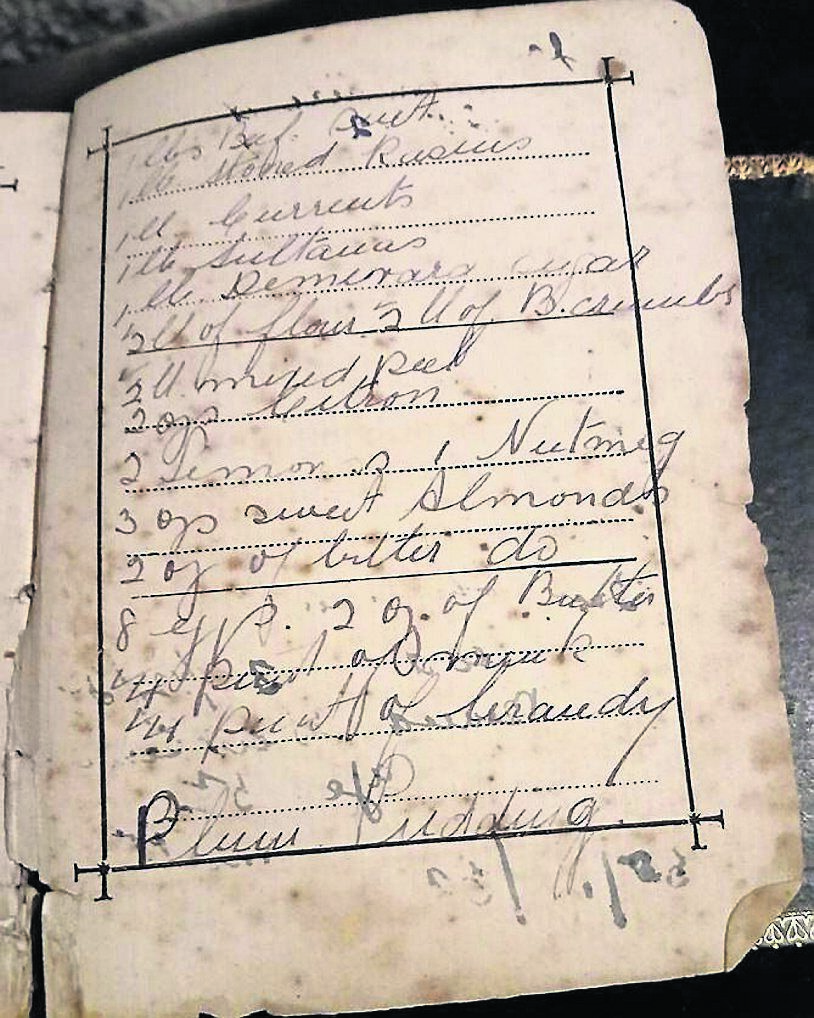
Remember, they were often handed down from generation to generation, and could date back far further than you think.
They might reflect, too, times of plenty and times of penury in their ingredients, for example pre- and post-war when the variety of goods on sale in the local grocer’s could be very different.
Which reminds me – can anybody remember ration books and rationing after World War II? There were a couple of old ration books tucked away in a cupboard when this writer was small, and they weren’t of much interest then, but now one wonders if Ireland did indeed have rationing, and if so, why? Were we sending all our plentiful produce abroad?
It was certainly all too common in the late 1940s and early 1950s to see country children suffering with the bow legs of rickets, showing the lack of good rich milk in their diet. Did all that butter, milk, and cheese go to England? Enquiring minds want to know!
If you do know anything about that, or if you have suddenly remembered an old recipe that your grandmother made specially for you, then write and tell us!
Email jokerrigan1@gmail.com or leave a message on our Facebook page: www.facebook.com/echolivecork.