Corks, boy... era when the city was awash with wine
Whether it was planting vineyards or glugging claret, 18th century Corkonians adored wine, says PATRICIA McCARTHY
Corks, boy... era when the city was awash with wine

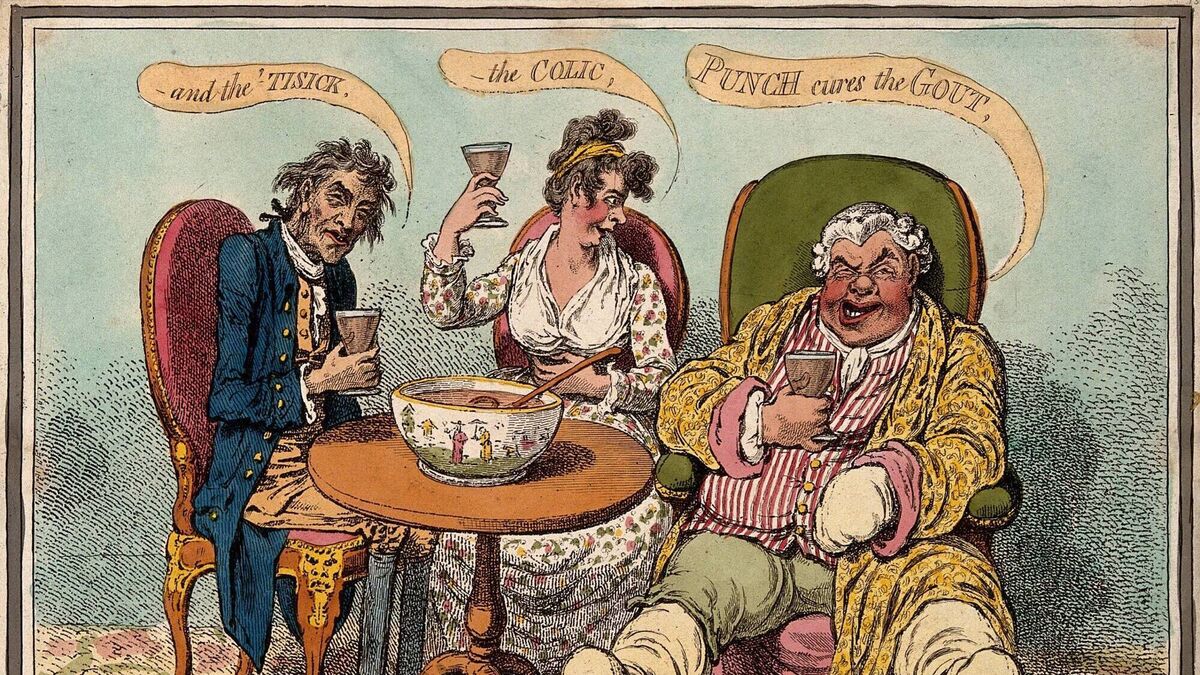
A cartoon by 17th century British caricaturist James Gillray as people drink punch to treat phthisis (tuberculosis), colic, and gout. 

IT was thanks to a native of Cork that I began to research the extraordinary amounts of Bordeaux’s red wine that were consumed in Ireland during the 18th century.

Ted Murphy’s book, A kingdom Of Wine: A celebration Of Ireland’s Wine Geese (Cork, 2005) contained amusing anecdotes about wine drinking and smuggling at that time.

I had been amazed at the amount of it consumed in Ireland by the upper classes when researching my previous book, Life In The Country House In Georgian Ireland, so this was the spur for me to embark upon my own book on the subject of wine.

Bordeaux’s red wine was referred to by the Irish as ‘claret’, from the old French ‘clairet’, meaning ‘clear’ and ‘light-coloured’, similar to today’s rosés. When Jonathan Swift spoke of ‘Irish wine’, everyone understood he meant claret.

After the political turmoil and wars of the 17th century, house-building in Ireland by the wealthy classes began in earnest. Owners furnished new or refurbished houses, laid out the grounds, and planned social occasions at which they could show off their tasteful decoration and the contents, which included, of course, wine from their well-stocked cellars, particularly claret.

Like Swift and others, the St Leger family had the name of their Cork seat, Doneraile House, fused onto their personal wine bottles.

Incidentally, in a 1775 book on the history of wine, Sir Edward Barry (1698-1776), the Cork-born medical doctor, recommended some of the “gentlemen of fortune... especially those in the most southern parts of the county of Corke”, should plant vineyards and make wine... as a “rational and elegant amusement”.

Indeed, Richard Boyle, the 2nd earl of Cork (1612-98), procured vine roots from England to plant at Lismore Castle. To my knowledge, history does not reveal if wine was produced there. Figures show the amount of wine exported from France to Ireland between 1771 and 1789 was double the amount of French wine imported to England, Scotland and Wales combined.

The background to this brings us back to those who fled Ireland at the end of the 17th century to join relatives who had settled in France, many of whom were involved successfully in the wine trade in Bordeaux.

One was Abraham Lawton of Cork who, it appears, had up to 10,000 customers, which in some years accounted for about 20% of the total production of wine in the Médoc!

With a ready-made market for claret, family members in Ireland established themselves as wine merchants. None of this was new to Cork: between 1436 and 1644, except for four years, every mayor of the city was involved in the wine trade. The first, in 1273, was Richard Wine who, as tradesmen did at that time, took the name of his job.

There was much criticism at the time of the extravagant amount of food served up at dinners in Ireland and the excessive amounts of wine consumed.

Mrs Mary Delany observed in 1744: “You have plenty of everything, a variety of wines, and are seldom permitted to stir until you have swallowed an inordinate quantity of French claret… that I look upon as highly destructive to this country.”

She was not alone in her criticism. John Boyle, 5th Earl of Cork and Orrery, described a dinner in Cork in 1737: “…nonsense and wine have flowed in plenty, gigantic saddles of mutton and Brobdingnagian rumps of beef weigh down the table. Bumpers of claret and bowls of white-wine were perpetually under my nose, till unable to bear the torture... I slipt away leaving a hat and sword to be my representatives...”

Earls can probably get away with abandoning the table, but one man at a drinking party, seeing his companions fall victim to the power of drink, slid under the table ‘among the slain’ where, after a short while, he felt a small pair of hands at his throat and a voice saying: “Sir, I’m the lad that’s to loosen the neckclothes” - in fear of suffocation!

Gout, which Orrery referred to as ‘the Irish hospitality’, was rampant, and a frequent suggested remedy was to drink even more wine.

Willian Conyngham, recovering from illness, received advice from a friend: “I beseech you not to drink less than a Bottle of good claret after your Dinner and a Pint of old Port after your Supper”. Daniel O’Connell, suffering “a slow nervous fever”, was advised by his doctor in 1794 to drink a bottle of port per day to cure it.

Needless to say, shipwrecks on the Cork and Kerry coasts attracted locals in the hope of salvage.

In the 16th century, Donal MacCarthy Reagh, whose Irish title was the 12th prince of Carbery (1505-31), was also known as ‘Donal-of-the-pipes’ (of wine) due to his adroitness at ‘finding’ cargoes of wines from shipwrecks, and the story goes that Anne Boleyn’s family, who had a house on the Old Head of Kinsale, made their fortune as ‘wreckers’.

Where else but in Cork would one find discerning thieves - in 1777, at Gilbert Mellefont’s home in the county - who got away with 22 bottles of claret!

If there was any doubt about Cork’s enjoyment of the grape, one has only to note a street name in the city - Sober Lane - recalling Father Theobald Mathew’s campaign to promote abstinence from alcohol, which was launched nearby in 1838.

An Irish corkscrew...

BEFORE cork stoppers were used, wine was drunk from the barrels in which it was shipped, using bottles and jugs to bring it to the table.

Bottles were stoppered with tapered wooden bungs, wrapped in cloth soaked in wax or oil, that projected from the bottle.

In the 17th century, using cork was found to prolong the life of wine and improve its taste: this required a tool to extract it, and the corkscrew was invented.

A Belfast academic discovered the earliest known reference to a corkscrew while translating the Latin lyrics of a ninth-century Irish monk:

Doth not the cork redolent of Balsam Suffer the piercing of the iron corkscrew Whence from the fissure floweth out, A precious drop of liquor.
Exploring Claret In Georgian Ireland: A History Of Amiable Excess, by Patricia McCarthy, is published by Four Courts Press, Open Air.

Read More

Saluting Cork hurling legend Dinny, who died 50 years ago this week

More in this section

Throwback Thursday: Christmas memories...and a pudding recipe - from 1886! Throwback Thursday: Christmas memories...and a pudding recipe - from 1886!
Throwback Thursday: ‘I’ll always remember the glow in the sky’ Throwback Thursday: ‘I’ll always remember the glow in the sky’
Throwback Thursday: Pioneer trips, and boy scout reminiscences Throwback Thursday: Pioneer trips, and boy scout reminiscences

Sponsored Content

River Boyne in County Meath, Ireland. Water matters: protecting Ireland’s most precious resource
Turning AI ambition into action: Dell Technologies leads the way Turning AI ambition into action: Dell Technologies leads the way
Delicious desserts and exclusive pours, perfect for Christmas Delicious desserts and exclusive pours, perfect for Christmas
Contact Us Cookie Policy Privacy Policy Terms and Conditions

© Examiner Echo Group Limited

Add Echolive.ie to your home screen - easy access to Cork news, views, sport and more