Trevor Laffan: Where there’s a sport, there’s cheats, and some will prosper
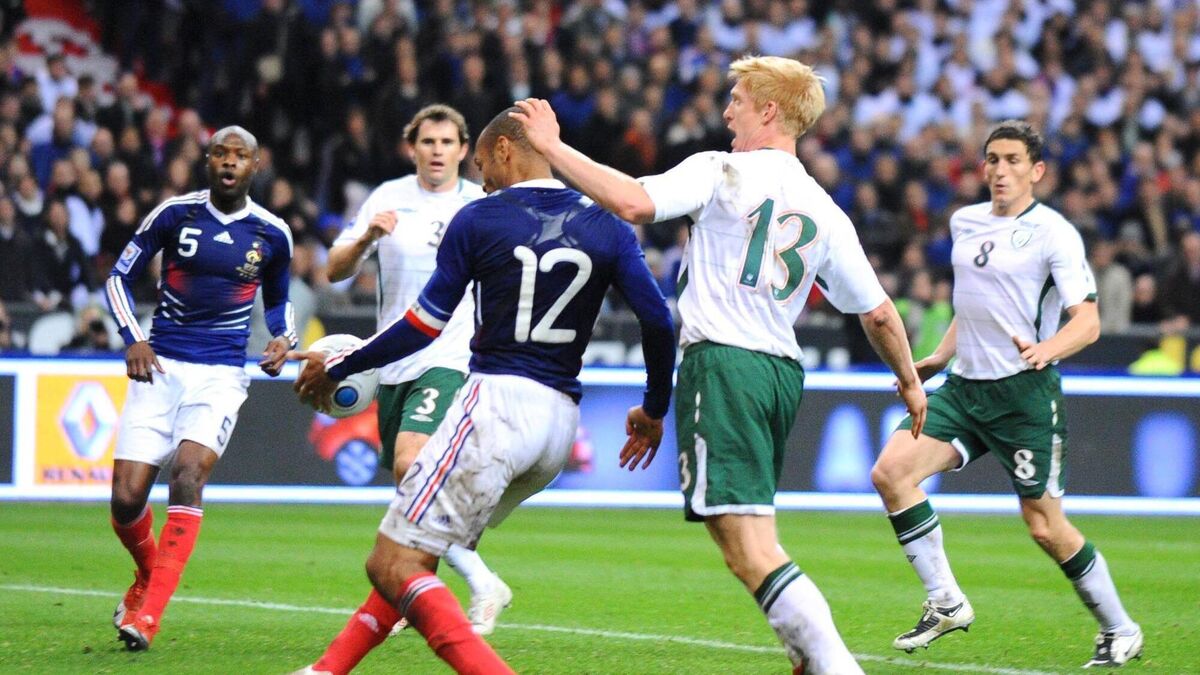
The infamous handball by Thierry Henry in 2009 which could have cost Ireland a place in the World Cup finals.
Players rolling around the ground feigning injury trying to get a response from the referee. Dropping like a stone after being tipped on the face by a flailing hand as if they had been struck by Mike Tyson. Roaring in agony until the referee’s whistle signals a miraculous recovery.
Not only is that kind of play-acting embarrassing, it’s also cheating in my opinion.
The Argentinians and the Paraguayan’ took this to a new level during the recent World Cup, but the Premier League has its fair share of pretenders too.
Where there is sport, there will always be those prepared to bend the rules, or even break them to gain an advantage over opponents. Especially in professional sport where the financial rewards are often enormous.
Some are prepared to do whatever it takes to win, and there are those who think that’s OK.
The Republic of Ireland soccer team suffered from a cheating incident back in 2009 at the hands of Thierry Henry. The French team faced the Republic of Ireland in a two-legged play-off for the World Cup finals. After taking the lead in Dublin, the French allowed the Irish back into the tie.
In extra time, Henry handled the ball. He palmed it into the path of his teammate William Gallas, who scored.
There was a similar incident in Mexico in 1986 in the Argentina versus England game. The first goal was notorious because the late, great Maradona slapped the ball into the net over England goalkeeper Peter Shilton in what became known as the ‘Hand of God’ incident.
The referee failed to spot it, even though everybody watching around the world saw exactly what had happened.
Then, to rub salt into England’s wounds, Maradona scored a second.
Cheating isn’t confined to football. Boxing, horse racing and professional cycling have all had a cloud of suspicion hanging over them at certain times. No sport is completely immune from cheats.
Whether it involves performance- enhancing drugs, match fixing, or some other form of skullduggery, attempting to gain an unfair or illegal advantage is cheating.
The most recent example is under investigation in the UK.
According to , North Yorkshire and South Durham League are investigating Saltburn Cricket Club after a video of the match appeared to show a fielder allegedly tricking an umpire by clicking his fingers to imitate the sound of a ball edging the bat.
For non-cricket enthusiasts, like me, an edge is when the ball glances off the batsman’s bat and is caught by the wicketkeeper. That puts the batsman out of the game.
After an initial post on social media, a number of other videos emerged that seemed to show the Saltburn’s player clicking his fingers as the ball passed the bat into the wicketkeeper’s hands. The umpire then gives the batsman out.
In one of the videos, the batsman even raises the issue with the umpires, to no avail.
Golf isn’t free of controversy either. I’m not a golfer, but I know it’s very much an honour-based game. There’s a lot of trust involved, but there are plenty of opportunities to gain an advantage too. I’m told there are players who are even known to be regular offenders.
Then there is moving the ball to a preferable spot by claiming you were just ‘identifying it’, breaking overhanging branches that interfere with your swing, or accidentally knocking off a branch on a practice swing and not declaring it - all are examples of foul play.
Grounding a club firmly in a bunker to improve your strike, or flattening grass around the ball, are also against the rules but these things do happen. Professional American star Bryson DeChambeau was involved in a controversial incident during this year’s British Open and received a two-stroke penalty for trampling the rough grass on the 5th hole during the second round.
On his second shot to the hole, DeChambeau was in deep grass. He stepped up to his ball, then stepped back behind it once more to check his line, flattening tall grass in his swing path in the process.
According to the Rules of Golf, you must play the course as you find it. Anyone who improves the area of their intended swing, even unintentionally, is subject to the basic penalty of two strokes in stroke play. This rule applies even if there was no intent.
DeChambeau didn’t agree with the decision, but had to accept it, which meant about $280,000 less in prize money after finishing further down the leaderboard.
One of the worst examples of cheating in sport occurred at the 2000 Paralympics in Sydney. Spain’s intellectually disabled Paralympic basketball team won the gold medal, but their team wasn’t what they seemed to be. An undercover journalist revealed shortly after they won that almost none of the players had any disabilities at all.
It turned out the required IQ tests were not conducted by the Spanish Paralympic Committee, and not only were 10 of the 12 basketball players not intellectually disabled, but some other Spanish gold medallists weren’t either.
The team was stripped of its gold medals, and all events for its intellectually disabled athletes were suspended for several years.
It has often been stated in relation to sport that it’s not the winning or losing that’s important, but it’s the taking part that counts. Obviously, not everyone agrees with that sentiment.







 App?
App?


