John Arnold: Imagine... we nearly got our own railway here in Bartlemy
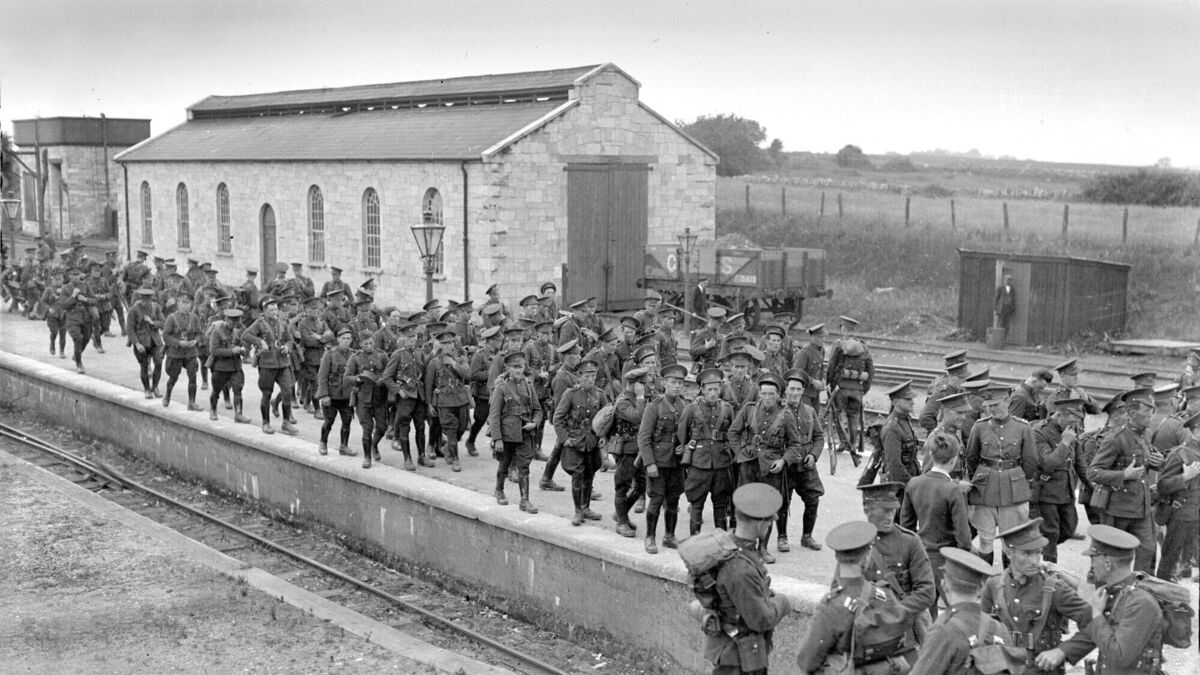
Irish Army troops at Fermoy Railway Station after a training camp at Kilworth in June, 1935. John Arnold recalls visiting here shortly before its closure in the 1960s
Once, that I can remember, was I at Fermoy Station to see an actual train on the tracks there. It must have been in the mid-1960s.
My father had a first cousin, Seamus Barry who lived in Bristol. His father James Barry was a brother of my grandmother.
James emigrated to England and married Mary O’Curry from Belfast. Their son Seamus lived in Bristol - I think he worked in the Post Office.
My father had died in 1961, but Seamus always kept in contact with our family right up until close to his own death in the early 1990s. I suppose he knew that bringing up five children wasn’t easy for a widow - as well as keeping a farm going.
He sent over his complete set of Encyclopaedia Britannica books -presumably he thought they would be useful for school-going children. So he packed the 21 volumes with navy-blue cardboard covers into a wooden box, a bit like a tea-chest. He despatched the cargo by boat to Rosslare and from there the box was delivered to Fermoy Station.
From its opening in May, 1860, until closure in 1967, that railway line served as a great link with Mallow and back to Killarney. Then, in the expansive decade of the 1870s further rail lines were added. Firstly - at the behest of the Duke of Devonshire - the line from Fermoy to Lismore opened in 1872. Six years later, the ‘final piece of the South Munster jigsaw’ was added with the opening of the line to Waterford city.
Looking at the railway map of Ireland for 1890, well, it’s like virtual spiders’ webs of lines big and small.
I went on my very first train trip while I was in National School. My initial ‘hurling special’ was the final in September of 1972. A few years before that I went with my Auntie Jo on the ‘Rosary Train’ to Knock - well, nearly to Knock. We got a bus from Rathcormac around 6am of a July Sunday morning over to the station in Mallow. There we joined hundreds, maybe thousands - the crowds seemed ginormous to a boy of nine or ten - on the train bound for the County Mayo.
In comparison to today, the train seemed to be going very slowly over bumpy tracks. On the tannoy, or public address system, in each carriage the 15 decades of the Rosary were ‘given out’ several times.
A child’s memory can be vague but I still think that tens of thousands came by train from all over Ireland to the Marian Shrine in those far off days. We always took tea and sandwiches with us to Knock - I don’t think the ‘tea or coffee?’ trolley on the train had been invented 60 years ago.
We never wanted or welcomed the English invaders to this country, but credit where credit is due, they built and left us a superb rail network. They were here for 700 years but it didn’t take us very long to dismantle the most of the railway lines!
I’ve often debated the short-sightedness of the decimation of what was a very efficient transport system. Then, I’m rightly told that when motor cars and buses were ‘invented’ and came into popular usage the era of the railway was doomed.
Read More
I agree it’s a theory put forward by many, but now we’ve gone the full circle twice over with traffic-jams and huge road backlogs.
OK, I suppose in the economically depressed decades from the 1920s until the 1960s, investment of scarce resources had to be prioritised, but the song title, ‘When will we ever learn’ comes to mind.
Imagine, in this area alone, one could get a train to Mitchelstown, Glanworth, Ballindangan or Ballyhooley or from Killeagh and Mogeely - and of course Youghal!
We have long since seen the massive economic value of tourism – wow, a train to Killybegs, the Glenties or Dungloe, and in Cork trains served Bantry and Clonakilty, Schull, Courtmacsherry and Baltimore. Some time I must do a proper study of the timeline of our railway closures and the thinking - if any, behind such decisions.
I suppose more cars meant less passengers on trains and a case of diminishing returns.
What a boon to tourism, agriculture and industry the Killarney to Waterford line would be in today’s world! At least the Cork to Youghal route was simply ‘mothballed’ and in 2009 the line to Midleton reopened.
Sadly, over ten years ago Irish Rail announced that reopening the line to Youghal - closed for passenger trains since 1963 - was not in their plans.
The Greenway is great, an absolutely wonderful amenity. Having walked it, for the life of me, I couldn’t understand why the walking/cycling track wasn’t just kept to the right or the left, thus ensuring the possibility -however remote - of a light rail or mono rail or solar powered transport system at some time in the future. Then again I’m not a planner or engineer or someone with technical know-how!
If things had turned out differently back the years, we might have had not one but two railway lines in this parish! At one time, Edmond Burke Roche lived in Trabolgan House in East Cork for the summer and at Kildinan Hose - and later Kilshannig House - for the winter. He owned thousands of acres of land and, with his ‘tenant’, Irish railway engineer Wiilliam Dargan, introduced flax growing to the Bride Valley.
Roche was an influential man with many friends in high places. He put forward the proposal for a railway line connecting Cork city and Fermoy. His route was from the northside of the city through Carrignavar and Glenville and - very conveniently - having a station close to his residence in Kildinan, on through Rathcormac and to Fermoy.
His plans were not progressed with, however.
In the autumn of 1845, proposals for a railway line from Carrigtwohill to Fermoy were published.
An article on the outlined the possible routes - generally through Lisgoold, Leamlara, Bartlemy, Rathcormac and Castlelyons, and hence to Fermoy.
The planners hedged their bets by naming practically every townland along the way, including ‘Garrantaggart’ - the plans didn’t go ahead.
Again, in November, 1864, new plans for a railway line from Midleton to Fermoy were announced. The proposals must have gone a bit further because some actual ‘site work’ was initiated.
On the borders of Ballyogoha and Desert townlands in this parish, a ‘cutting’ for the proposed rail line was completed along the side of a hilly field - but that’s as far as it got.
Several more proposals were forthcoming to link Midleton with Fermoy, but around 1900 the plans were finally completely scrapped.
Several meetings were held locally to protest at this decision. The economic benefits of a ‘local’ railway link were highlighted but no one in authority - in London - listened.
Imagine if such a railway line had been built - it could well be a case of ‘Next stop, Bartlemy’!



 App?
App?


