Trevor Laffan: Queues, rubbish... reasons not to climb Everest are mounting
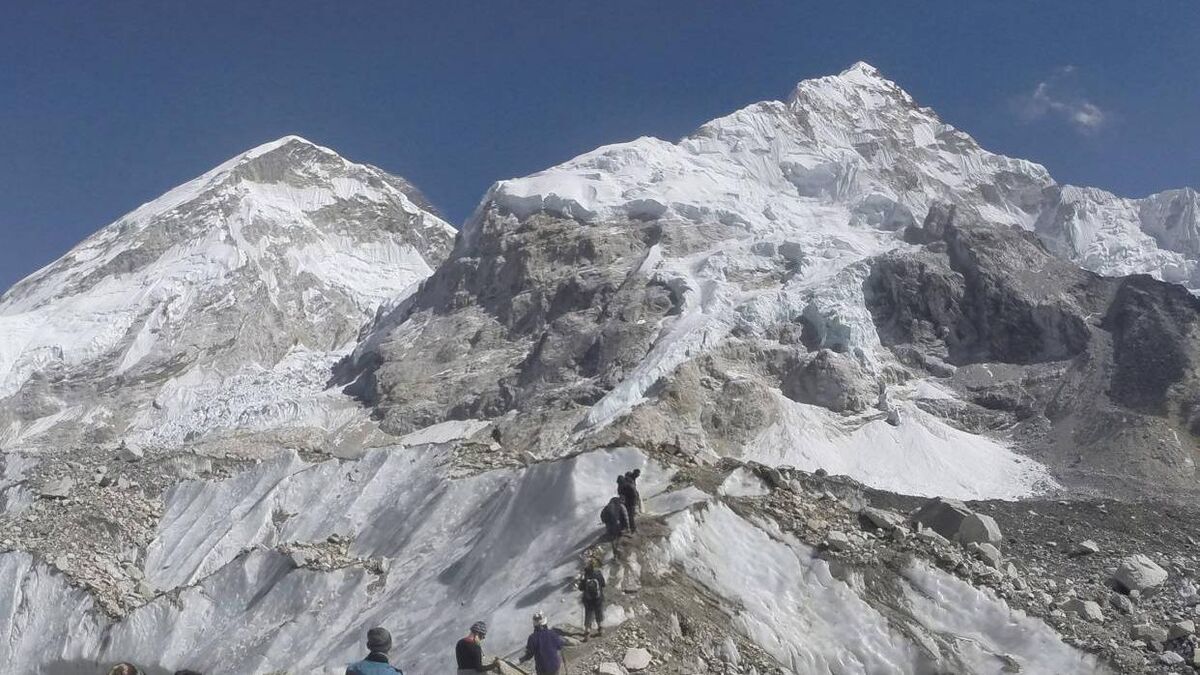
The amount of breathable oxygen up there is one-third what it is at sea level.
Lack of oxygen, powerful winds, and extremely cold temperatures means there’s no plant or animal life there. It’s not exactly a hospitable environment, which prompts the question, why in God’s name would anyone want to go up there?
The answer of course is that there are certain people who just can’t resist a challenge.
On May 29, 1953, Edmund Hillary and Tenzing Norgay answered that call and reached the summit of Mount Everest, which became the first recorded ascent of the world’s highest mountain.
Their expedition used basic oxygen systems and local Sherpa support. They carried heavy packs and cut steps into ice, and their achievement paved the way for modern climbs.
Mad stuff, Ted.
I was full of admiration whenever I heard of brave souls preparing to tackle this mountain, especially as climbing the stairs was the closest I ever came to scaling dizzy heights.
Now, though, it seems to me that making your way to the summit of Mount Everest is no more than an organised hill walk at altitude.
According to mountainroutes.com, more than 860 climbers reached Everest’s summit in 2024, continuing a record trend. In 2025, roughly 846 climbers had scaled its peak.
Since Edmund Hillary and Tenzing Norgay successfully climbed Everest in 1953, more than 13,000 summits have been recorded.
Today, commercial operators arrange the logistics, permits and high-altitude support so climbers with a reasonable fitness can now reach base camp with guided help.
However, the experts say summit attempts still demand serious preparation, resilience, and unwavering mental strength as it remains the ultimate mountaineering goal.
In addition, for every climber there is at least one local worker who cooks, carries equipment, and guides the expedition.
The mountain has become so overcrowded that oftentimes climbers have to stand in line for hours in freezing cold conditions to queue to reach the top, where the air is so thin an oxygen mask is needed to breathe.
They walk single file at a snail’s pace over the Hillary Step, the last obstacle before the summit. When climbers finally reach the summit, there is barely room to stand because of overcrowding.
But where you have humans, you have a mess, and according to , Everest is so overcrowded and full of trash that it has been called the “world’s highest garbage dump”.
More than 600 people attempt to summit Mount Everest every climbing season during the few weeks of the year when weather conditions are just right.
Each of those climbers spends weeks on the mountain, adjusting to the altitude at a series of camps.
During that time, each person generates, on average, around eight kilograms (18 pounds) of rubbish, and the majority of this waste is left on the mountain.
The slopes are littered with discarded empty oxygen canisters, abandoned tents, food containers, and even human faeces.
At Base Camp, there are tented toilets but that is where the toilet facilities end. For the rest of their expedition, climbers have to relieve themselves on the mountain.
No-one knows exactly how much waste is on the mountain, but it is in the tons. Litter is spilling out of glaciers, and camps are overflowing with piles of human waste. Climate change is causing snow and ice to melt, exposing even more garbage that has been covered for decades.
All that waste is trashing the natural environment, and it poses a serious health risk to everyone who lives in the Everest watershed.
Rubbish isn’t the only stain on the mountain, apparently.
According to UK, investigators have uncovered a criminal network of ‘fake rescues’ that have ‘tainted’ Nepal’s image.
These allegations include claims that helicopter rescue pilots are systematically charging for flights that didn’t happen, doctors are charging for procedures that didn’t occur, and, in some cases, climbers and trekkers are getting ‘altitude sickness’ that is more related to what has been put in their food.
Sources claim that between 2022 and 2025, there were more than 300 fake rescues, leading to a fraud bill of nearly $20 million.
According to the investigation in the : “The mechanics of the fake rescue racket are straightforward: stage a medical emergency, call in a helicopter, check a tourist into hospital, and file an insurance claim that bears little resemblance to what actually happened.”
A helicopter rescue is particularly lucrative if several trekkers can be put on the same flight, but each is allegedly billed for the full cost. That’s worth thousands of pounds.
In some cases, climbers have been persuaded by guides that they need a helicopter descent. Some are thought to be not sick at all, but take it, for an easier route down. Others may indeed have altitude sickness, but for most that passes with rest and a gradual descent.
A total of 32 people have been charged and 11 arrests made so far in relation to the allegations.
As if I needed any more excuses to avoid climbing that mountain.







 App?
App?


