Great Cork sculptor celebrated at city museum
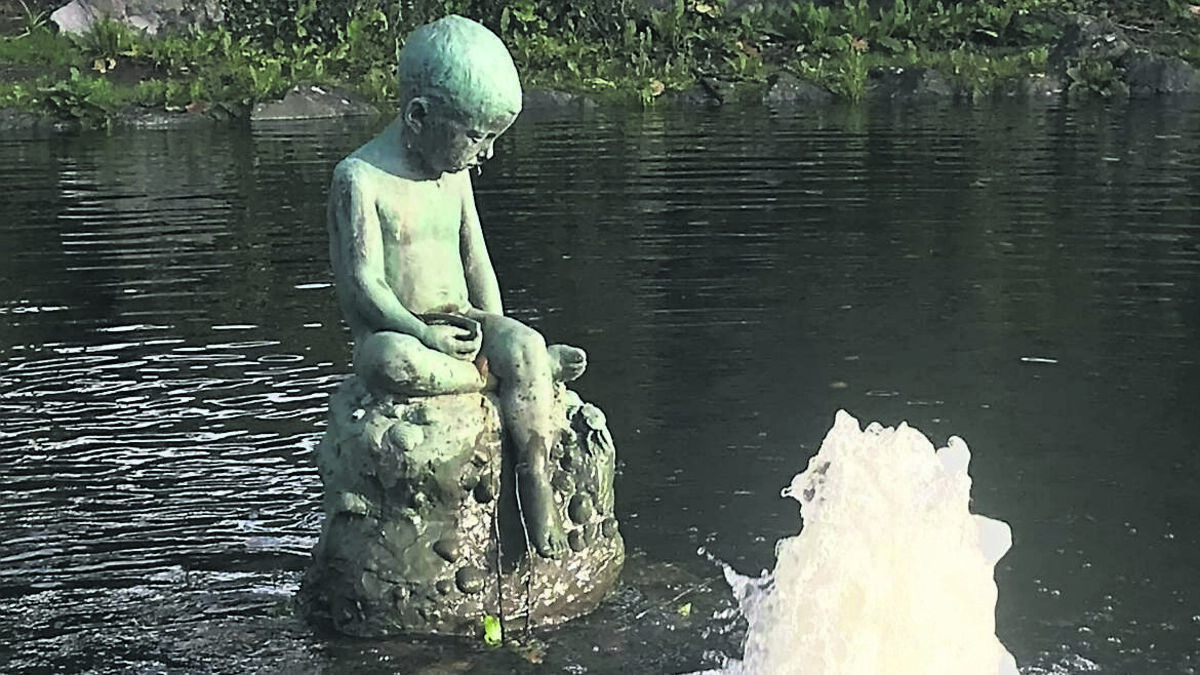
Joseph Higgins’ most famous work, Boy With A Boat, at Fitzgerald’s Park In Cork city
An exhibition on sculptor Joseph Higgins has opened in Cork Public Museum, following a symposium in Cork City Library last month.
A somewhat obscure figure, Higgins’ career was cut short by his death at just 40 years old. Still, many will be familiar with his most famous work, Boy With A Boat, located in Fitzgerald’s Park.
Despite its brevity, Higgins’ life was deeply entwined with the city’s history. He was born in 1885 to William Higgins, a schoolteacher who lost his job for taking part in the 1867 Fenian Rising. After a stint in prison, William was employed as a cooper in the Ballincollig Gunpowder Mills, working for the military he once tried to supplant.
Aged 14, Joseph moved to the city where he worked as a clerk at Newsome & Sons, a tea and coffee merchants in what is now home to PTSB on Patrick Street. Here he befriended a colleague, Terence MacSwiney. It was Higgins who informed Muriel MacSwiney of her husband’s final arrest in 1920.
Higgins attended night classes a few streets away at the Crawford School of Art, then located at the gallery’s current premises. The school was then involved with that period’s Arts and Crafts movement which sought to marry the ‘fine’ and ‘applied’ arts, crafting functional objects with due consideration paid to artistic merit. He learned wood carving, modelling, and stone carving, alongside traditional, academic painting.
This exhibition centres around a bust of Daniel Corkery, commissioned by the writer and UCC professor himself while the artist was still in college.
A champion of local culture, Corkery supported Higgins, later convincing the Crawford to acquire his Toilers Of The Sea and Strachaire Fir.
This bust, housed in UCC since 1967, portrays the author lost in thought, as he looks to the side with an off-kilter gaze typical of Higgins’ work.
Photographs of Higgins’ paintings and sculptures are also on display, including a wood-carving of Michael Collins as he addressed a crowd on Grand Parade in 1922.
Cut from the limewood of a neighbour’s fallen tree, Collins stares at his audience, neck craned and mouth agape, suggesting the performative movements of a man mid-speech. This playfully contrasts with the stoic depiction by Séamus Murphy, located just outside in the park.
This small exhibit is well situated amongst several works by the more widely-celebrated Murphy, who also trained at Crawford and was similarly interested in functional work of high artistic quality. Such work can be found throughout the city, from the gravestones in St Finbarr’s to a carved dog bowl hidden beneath the front window of Cameron Bakery on Patrick Street.
As the subject of last year’s ‘One City One Book’ festival, the republication of Murphy’s Stone Mad has seen renewed appreciation for the contribution craftsmen once made to the city. Murphy’s book chronicles the dissolution of stonemasonry in Cork as the work of ‘stonies’ was replaced by cheap building methods.
Murphy recalled his colleague’s reaction to the news Turner’s Cross Church would be built with concrete: “I never thought I’d live to see the day when stonies would be two a penny and that’s the price ye’ll be worth before long. Concrete is the coming thing […] People aren’t building for the future any more, them days are gone.”
One can imagine this stony’s possible reaction to the newly-refurbished Bishop Lucey Park! Aggravated by a lack of green spaces, public backlash has seen the park criticised for the large swathe of plain concrete and metal recently installed for a total cost of €7m. The only piece of legitimately crafted stonework is the 800-year-old city wall.
Perhaps this drab design is an appropriate tribute to its namesake. The film-maker Louis Marcus once remarked that Bishop Lucey, “who built enough churches to keep a sculptor busy for life, preferred gaudy imported statues to locally worked stone”.
Lucey was even told to avoid Murphy’s work by Archbishop of Dublin John Charles McQuaid. Given that a motion was passed last year to change the park’s name, however, this may not be the case for too long.
A copy of Murphy’s The Onion Seller is one of only two pieces of artwork in the park, first donated in 1985 by Sunbeam Wolsey. The company’s founder, William Dwyer, was Murphy’s benefactor and insisted that all Sunbeam factories feature the work of Irish artists. Such devotion to handcrafted public art is now sadly reduced.
There is added poignancy to the celebration of Cork’s craftsmen at a time of such public disillusionment with large city projects. A public park is, after all, an essentially artistic project, obligated to be both aesthetically pleasing and functional.
Maybe the Arts and Crafts ethos that gave the city local gems like the Honan Chapel and many of the pieces decorating Fitzgerald’s Park should be revisited.
Higgins never made a living from his art and died of TB before any of his works could be cast. When Murphy married Higgins’ daughter Maigread in 1944, he cast 12 of her father’s works in bronze and gifted Boy With A Boat to the city.
It is 100 years since Higgins’ death, 50 since Murphy’s. This exhibition serves as an evocative reminder of the city’s past and the importance it once placed on craft. It should inspire the viewer to seek out such work across the city.
Should they wish to skip Bishop Lucey, The Onion Seller may also be found on Coal Quay.



 App?
App?


