Jimmy Crowley: Marking a century of Amhrán na bhFiann
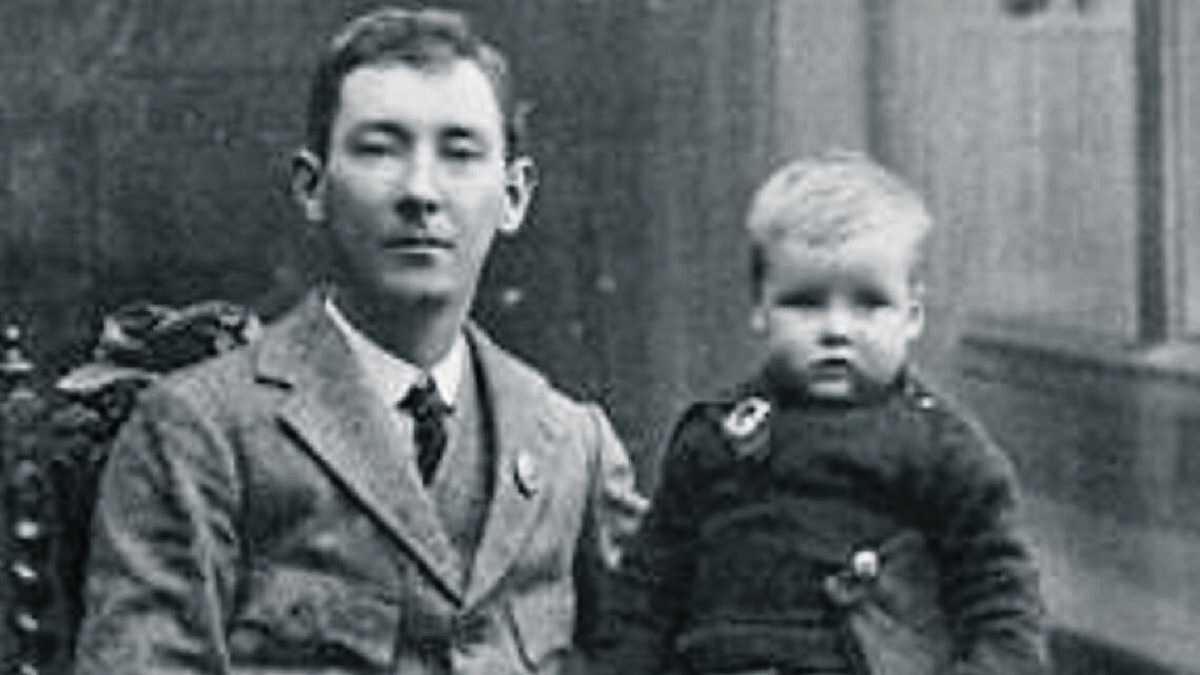
Peadar Kearney, composer of Amhrán na bhFiann, with his son Pearse in 1917
The Soldiers’ Song was composed by Brendan Behan’s uncle, Peadar Kearney, in 1907, working in collaboration with Patrick Heeney, who was mainly responsible for the melody.
In 2006, the first draft of it, written on school copybook paper fetched €760,000 at an auction in Dublin.
The stirring ballad was published in all the revolutionary papers in its day, where ballads were an important ingredient in the forging of the cosmos of the new Nation State.
An irrefutable march, it was soon adopted as such by the Volunteers and was sung by the Irish rebels at the GPO in Dublin in 1916.
Kearney wrote a plethora of outstanding Irish ballads which have long remained upon the lips of the Irish people, like The Bold Fenian Men, The South Down Militia, Nell Flaherty’s Drake and The Tri-Coloured Ribbon.
But the delicate state of politics, appeasement and ‘inclusion’ that was called for in the early years of the Free State did not cry out for the adoption of an anthem that was conceived in the fortunes of war.
Seminal personages in Irish political affairs like Seán Lester, publicist at the Department of External Affairs, considered The Soldiers’ Song to be “hardly suitable in words or music”.
Interestingly, at the Paris Olympic Games in 1924, the Irish State choose Thomas Moore’s Let Erin Remember as its anthem. But there was concern at the lack of a fixed, suitable, stirring national anthem, giving Unionists the opportunity of perpetuating God Save The King (George V was the monarch at the time).
On July 12, 1926, the Executive Council decided to endorse The Soldiers’ Song, with W.T.Cosgrave being its main sponsor.
The Soldiers’ Song was played by Radio Éireann from its establishment in 1926. Cinemas and theatres did likewise until 1973.
One of the more memorable defences of the song comes from Thomas F. O’Higgins, Cumann na nGaedheal TD and medical practictioner, who represented Cork Borough from 1948. In a heated debate in Dáil Éireann he said: “National anthems come about, not because of the particular suitability of the words or notes but because they are adopted generally by the nation. That is exactly how The Soldiers’ Song became a national anthem in this country. It happened to be the anthem on the lips of the people when they came into their own and when the outsiders evacuated the country.”
For my money, the sensitive, exalting orchestral arrangement commissioned by Raidió Telefís Éireann and played at a slow tempo at the end of transmission from 1962 excels all other versions. Earlier, in the accompanying film, RTÉ lovingly depicted the Blasket Islands; Cape Clear, an old lad with a peaked cap on a donkey and cart going ‘west along the road’ as a proud Aer Lingus Viscount flew overheard, a poignant dichotomy of the two Irelands.
As a youngster, that four minutes of magic sent chills of love for Ireland down my spine. That’s why Amhrán na bhFiann, with its indelible cultural association — bearing an ingenuous naiveté — knocks Ireland’s Call into a cocked hat. Here, ample care hasn’t even been taken to synchronise tune and libretto.
Although thousands will disagree; the Call is a shallow, quick-fix celebration of Irishness in English, carrying a toady cargo of prostration.
From the 1930s, the public use of The Soldiers’ Song became more common, with increased demand for an Irish language text. The translation which was eventually adopted was written by Liam Ó Rinn, later Chief Translator to the Oireachtas.
Ó Rinn’s translation soon acquired some unintended currency. The anthem was being sung in Irish at GAA events as early as 1931. The GAA’s journal, An Camán, reported, that ‘”it was urged that Irish should be used to the fullest possible extent in the work of the Association.”
It is not entirely clear by what process the Irish language text eventually overtook the English. It behoves those who are involved in the restoration of the language to linger on this amazing phenomenon.
While lines like Buíon dár slua, thar toinn do ráinigh chughainn are sung with great gusto; how many of us can, hand on heart, say we know what we’re singing about?!
Nor should we blame the people! Motifs like thar toinn (over the waves) are from an earlier, Jacobite canon; while the defective verb ‘ráinigh’, meaning to arrive, is not part of simple everyday Irish like tháinig! But the line is perfect in its poetical economy.
National anthems are part of the complex metalwork that forges the anatomy of a nation state. Some day I promise to treat myself to the inspirational experience of sitting outdoors in a Paris café on Bastille day (July 14) while a marching band and a forest of tricolors pass by proudly releasing the heart-rending strains of La Marseillaise into the blue heavens. Evidently, there is no feeling in the world like it; the knowledge of having benefited by the precepts of freedom and egalitarianism that were wrought by the French revolutionaries, who shaped our aspirations too.
But the French don’t hate the English anymore! Even after hundreds of years of battles by land and sea! Now they play soccer together, slag each other off, cross connecting in every imaginable way. But neither country ever apologies for its language or for being proud of her monarchy or her republic.
It is time we endorsed this route of no apology and embraced the fact it was through the fortune of People’s War against the greatest empire in the world that the bells of freedom were finally rung. And let it never again become the premise and rant and fascist rallying call of the barroom balladeers.
Rather, let us welcome our nearest neighbours when they call to see us — not to see a toady copy of England but to savour the fascinating evidence of a distinctive and confident, friendly neighbour.







 App?
App?


