What's the psychology behind the recent anti-immigration protests?
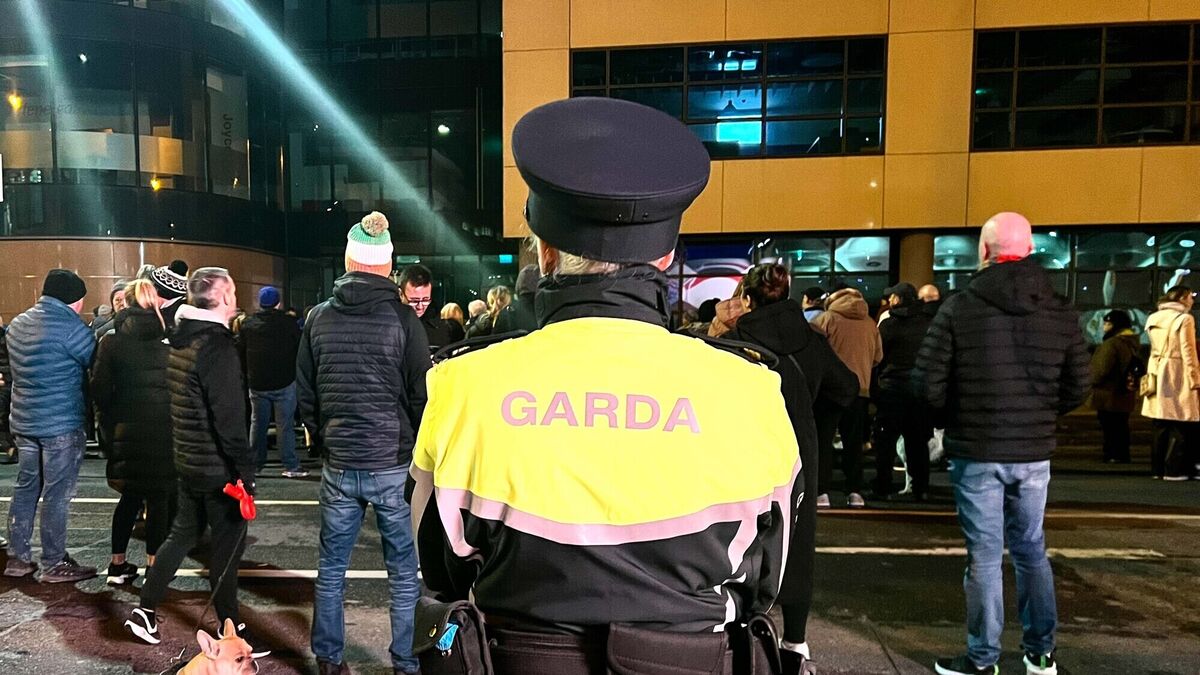
A Garda presence at a protest in Dublin recently, against refugeesmoving into an old ESB building.
IN the early 20th century, the American author and journalist Alfred Henley Henry Lewis said “there are only nine meals between mankind and anarchy”. In this, he slightly anticipated Lenin, who wrote “every society is three meals away from chaos”.
This may seem quaint, outdated, but it is echoed in the MI5 mantra that “society is only four meals away from anarchy”.
As a psychologist, reading news and views on current debates and demonstrations on immigration strongly brought these quotes to mind for me. The reason? They prompt me to think in terms of Maslow’s Hierarchy of Needs.
Abraham Maslow was a humanist psychologist, who proposed a hierarchical, pyramidal model of human needs. At the base of the pyramid are found the most basic, fundamental needs – e.g. food, shelter - and each successive tier represents needs of a different character, safety, love, esteem, and ultimately self-actualization (being our ideal authentic selves).
The theory signals that needs on the lower levels must be largely met before we can make real progress towards the goals higher up the model. And the lowest level is effectively what we need for survival - the basis for our ongoing existence now and for the foreseeable future.
If the needs at this basic level are not met, then we are fundamentally under threat, and can only be expected to react accordingly; stress, anxiety, worry, fear.
Our defences are up and we are prepared to protect ourselves and our threatened resources (and this only applies to resources that can be seen as being under threat; it’s difficult, for example, to imagine conflict in 2023 Ireland over access to drinking water - put in post-earthquake Syria? Or in an Ireland with high charges for tap water during a recession?)
Right now, it is possible to identify basic needs that are not secure in Ireland. One is food (consider the Barnardos report that 29% of parents are cutting back on foods to ensure their kids eat properly). Another, longer-standing and more visible threat, is to housing. Ireland has had a dysfunctional housing system for some time, and rent, house prices and homelessness keep on climbing.
Even where we ourselves are not directly threatened in this way, we can still be affected by what we see. Both evolution and social psychology explain our social nature as a species, and why we react to threats against family and community. Knowing that relations and others like us are at risk of homelessness or harm can be enough.
So here we find ourselves. There is a threat at the level of the most basic needs - shelter. It is visible and undeniable, and no solution appears forthcoming.
And as a species which is always trying to make sense of the world (often with tragic results - see the pogroms of the Jewish population in much of Europe in response to the Black Death), we look for explanations.
Many are offered, and one is immigration - and the more identifiably ‘different’, the immigrants, the better. We appear hardwired to categorise according to three dimensions (even infants do it!) - age, sex, and ethnicity. While most of us know plenty people of different ages and genders, we may not know many of very different ethnic and cultural backgrounds - making these groups fertile ground for explanations of misfortune. Add in Realistic Conflict Theory, which suggests that ethnic tensions can arise when there is an objectively reasonable interpretation that groups are competing for scarce resources, and there is a potential tinderbox here - a tinderbox some people are very anxious to ignite. Already we see mixing and overlapping of explanations of anti-immigrant demonstrations - resources such as housing, but also for example that immigrants are taking advantage of us and/or threatening the safety of women and children.
From a coaching psychology perspective, Step One here would be to identify the chief issue, and seek to address that. If the secondary issue seems important enough in its own right that can be attended to later. I would ask anyone who attends these anti-immigration protests, supports them, speaks publicly or privately against immigration or against immigrants - what is the issue that primarily motivates you? Is it scarce material resources such as housing? Is it preserving the traditional Irish culture? Is it a perceived threat from young men of different cultures? I suspect that for the majority, it is housing.
The next question would be what might make the situation better? In the case of housing, one could look at reducing demand; but one could also look at increasing supply. The recent census showed that there were over 166,000 unoccupied dwellings in Ireland - might their use for accommodation be a good way to address the issue? Considering the duration of the housing crisis, might increasing output be a better goal? Is shutting the border the best or only way?
I feel these questions - what is your main motivation, and what’s the best way to deal with this - if considered seriously can direct how we might all act in accord with our values, and where we might focus our attention to end the crisis we perceive.







 App?
App?


