Kathriona Devereux: Moon trip left me cold, we have more pressing matters on Earth
Wonderment at the velvet black studded with starlight diamantes is a surefire way to put our short lives in perspective and make yourself feel completely insignificant and unimportant.
Contemplating the cosmos and understanding that almost every pinprick of starlight is a roaring hot sun millions of miles away; and the light we are looking at has taken years to reach us, is sure to snuff out any over-inflating egos.
Stargazing is universally mesmerising, and we understand much about the complexity of space thanks to generations of thinkers, scientists, mathematicians, astronomers, and explorers.
For a long time, I understood the lure and audacious urge to go ‘there’, to Space, the final frontier, and explore beyond our home planet.
The moon being a mere 385,000 kilometres (give or take) away is an understandable ‘must visit’ destination. But in recent years, space missions have left me as cold as night-time on the far side of the moon.
I was deeply moved by the astronomer Carl Sagan’s speech about the Pale Blue Dot - an iconic photo of our home planet taken in 1990 by the Voyager spacecraft six billion kilometres from Earth.
Earth appears as a tiny pixel in a vast cosmos - a ‘blink and you’ll miss it’ location. Yet, as Sagan said: “There is perhaps no better demonstration of the folly of human conceits than this distant image of our tiny world. To me, it underscores our responsibility to deal more kindly with one another, and to preserve and cherish the pale blue dot, the only home we’ve ever known.”
I even got to NASA one day to film at the Goddard Space Flight Center to see where they ‘shake, bake, and irradiate’ technology destined for spacecraft.
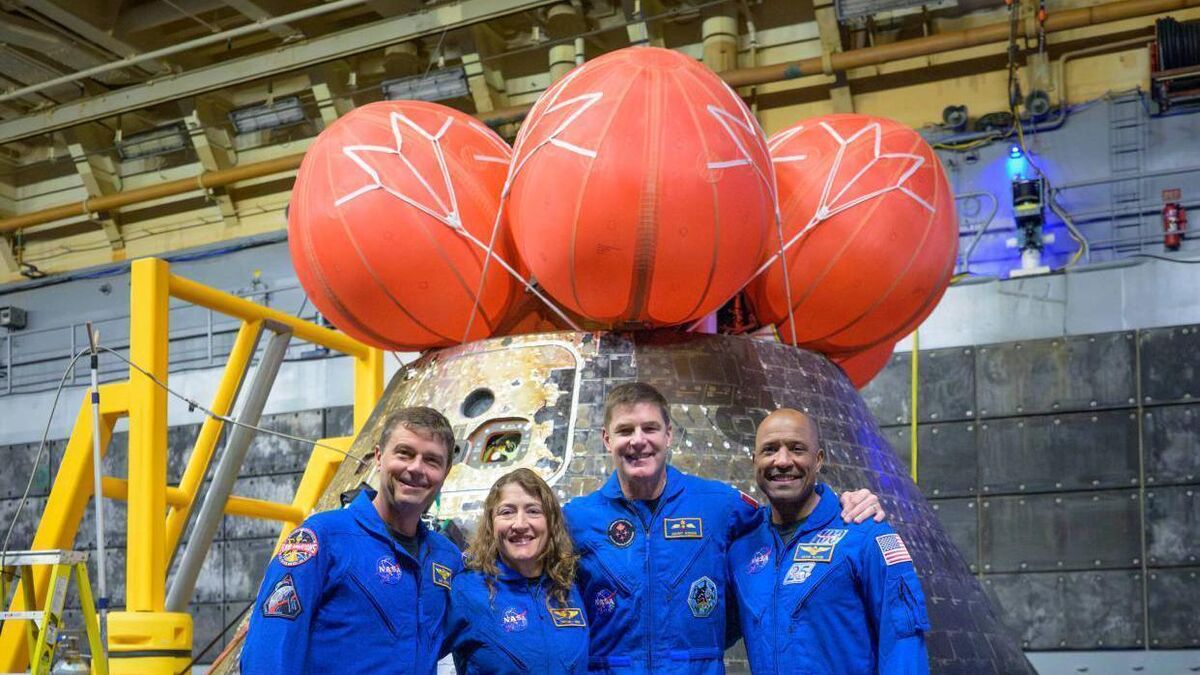
But despite this decades-long enthusiasm, I couldn’t help rolling my eyes throughout the coverage of the Artemis’ recent ten-day mission.
“We are going for all of humanity” was Artemis’ official programme tagline. Give me a break.
At the same time, NASA was talking about a “voyage for humanity”, the U.S President was threatening to commit war crimes and end Iranian civilisations.
The deranged violent whims of Trump certainly took the gloss off NASA’s achievements.
There were positives, not just the technological achievement of everyone coming home safely. There was the significance of seeing an inclusive crew with a black and female astronaut part of the pioneering mission. There was the touching moment when the crew requested an unnamed lunar crater to be called Carroll after the late wife of the mission commander. There was the heartening fact that hundreds of scientists, engineers, technicians, and logisticians across the world can collaborate successfully to pull off a feat of this kind.
But, could, and should, this talent and energy be directed instead to solving some of humanity’s most pressing problems - the accumulation of too much carbon dioxide in our atmosphere, polluted waters, collapsing nature, the fact this country, and many more, grind to a halt without a steady and cheap supply of oil (the burning of which is heating our planet).
If the past week has taught us anything, it is that we really need an alternative to fossil fuels.
When the Apollo mission successfully put the first man on the moon, the musician Gil Scott-Heron released a track, , which critiqued the resources spent on the space program while Black Americans were experiencing social and economic disparities at home - issues that still remain more than 50 years later.
Global aid funding was down 25% last year, but hey whitey is on the moon.
The standard defence of costly space programmes is that they pay for themselves in innovation. Throw enough money and enough brilliant minds at the gnarly problem of getting a human to the moon, and the ripple effects transform life back on Earth - advances in computing, materials science, satellite communications, medical technology.
The Apollo programme didn’t just put a man on the moon; it turbocharged technological progress.
So here is the obvious question: why aren’t we doing the same for the climate crisis?
We have a problem that is, by any measure, more urgent and more consequential than planting a flag on the lunar surface.
Where is the moonshot for decarbonisation? Where is the Apollo or Artemis programme for renewable energy, carbon capture, or sustainable agriculture?
The answer, depressingly, may come down to the fact that space exploration has always served geopolitical prestige and, increasingly, private profit. The climate crisis, by contrast, demands we invest in saving something that cannot be owned - the stable, liveable planet we already have.
The real imbalance isn’t spending ‘too much money on space’ - it’s too little climate spending and too much money flowing into fossil fuels and defence spending.
It’s not that space is crowding out climate action. It’s that climate action isn’t being prioritised enough, full stop.
As Carl Sagan said: “Our planet is a lonely speck in the great enveloping cosmic dark. In our obscurity, in all this vastness, there is no hint that help will come from elsewhere to save us from ourselves.”







 App?
App?


